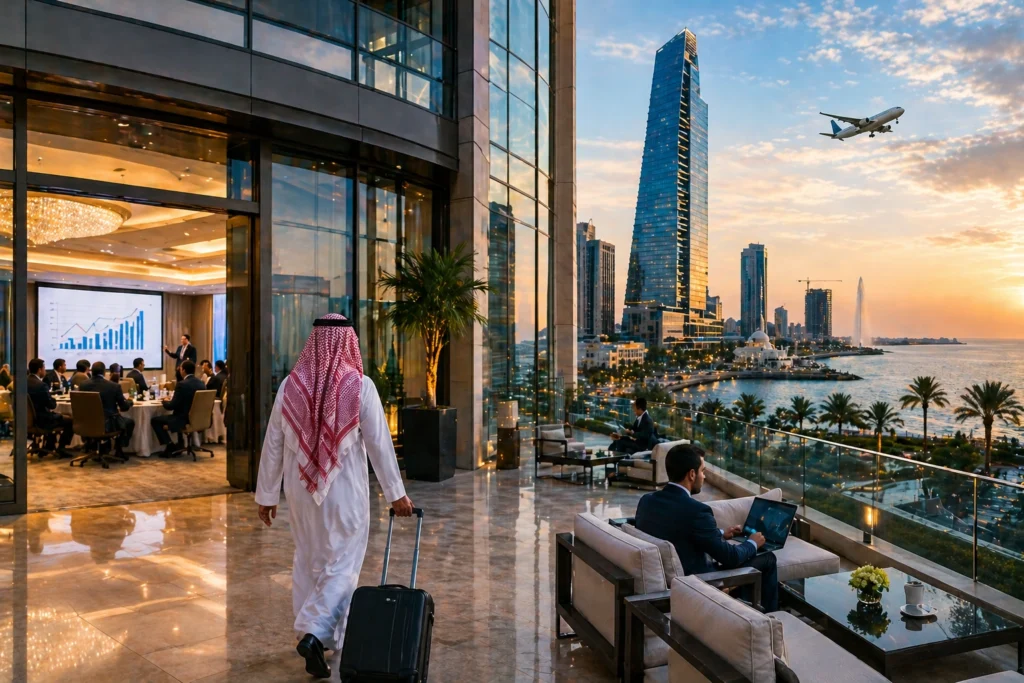
Jeddah is emerging as one of the Middle East’s most dynamic business tourism destinations as shifting corporate travel patterns and growing MICE demand transform the city’s hospitality sector. Strong air connectivity, expanding infrastructure and rising investment activity are driving new waves of business travelers into Saudi Arabia’s commercial gateway, while hotels are rapidly adapting to changing guest expectations, flexible event formats and stronger competition.
The changes reflect Jeddah’s broader evolution from a traditional commercial center into a multi-purpose destination where business, leisure and events increasingly overlap. For hotels, the new environment offers major opportunities but also requires sharper execution in service, technology and revenue strategy.
Business Travel Is Becoming More Specialized
Corporate demand in Jeddah is no longer driven only by routine meetings. Hotels are seeing more purpose-led travel linked to government projects, construction, logistics, infrastructure development and stakeholder engagement. These trips often involve short stays, quick turnarounds and bookings made close to arrival dates.
That shift is changing how hotels manage inventory and guest services. Weekdays are increasingly dominated by transient corporate travelers, project teams and small business groups, while weekends are attracting domestic leisure visitors and regional staycation demand. This creates a two-speed market where properties must serve different customer segments within the same week.
Airport Growth Supports Hotel Demand
Jeddah’s role as a gateway city has been strengthened by growing passenger traffic through King Abdulaziz International Airport, which recorded 53.4 million travelers in 2025. Rising air access makes it easier for companies, investors and event delegates to reach the city, reinforcing its position as a strategic business hub.
For the hospitality industry, stronger connectivity typically translates into higher occupancy potential, more international bookings and greater demand for premium business services such as airport transfers, executive lounges and fast check-in solutions.
MICE Demand Is Raising Standards
Meetings, Incentives, Conferences and Exhibitions are becoming a critical growth engine for Jeddah hotels. Event organizers now expect venues to provide more than meeting rooms. Flexibility, technical reliability and smooth execution have become essential selection criteria.
Hotels are responding by investing in adaptable event spaces that can shift quickly between presentations, networking sessions and private meetings. Audio-visual systems, streaming capabilities and digital attendee support tools are now central to winning corporate contracts.
The market is also seeing more mid-sized gatherings such as leadership retreats, training programs and customer summits. These events may be smaller than major conventions, but they often demand higher levels of personalization and flawless service delivery.
Hybrid Events Are Here to Stay
Even when events are held in person, virtual participation remains an important part of the format. Hybrid meetings allow companies to include remote teams, overseas speakers and international clients without requiring every participant to travel. That trend is pushing hotels to deliver stronger internet infrastructure, broadcast-ready meeting rooms and responsive technical support.
Properties that can seamlessly blend physical and digital experiences are likely to gain a competitive advantage as corporate planners become more selective.
Guest Expectations Are Changing Fast
Modern business travelers want speed, convenience and a sense of place. Fast check-ins, reliable Wi-Fi, transport coordination and efficient room service are now baseline expectations. At the same time, guests increasingly want to experience the destination beyond their meetings.
In Jeddah, that means demand is growing for cultural excursions, waterfront dining, premium restaurants and short leisure experiences that fit around busy schedules. Hotels that package productivity with lifestyle appeal are better positioned to capture repeat business and stronger guest satisfaction scores.
Competition Is Intensifying
As new hotel supply enters the market, competition is expected to rise. More rooms can support growing visitor numbers, but it also means properties must work harder to stand out. Service quality, strong account management, memorable food and beverage offerings and dependable meeting execution will become increasingly important differentiators.
Hotels that understand both corporate and leisure demand patterns will be best placed to maximize occupancy and revenue throughout the week.
Outlook for Saudi Business Tourism
National projects, giga-developments and an expanding events calendar are expected to sustain corporate travel into Jeddah in the years ahead. While global economic and geopolitical conditions can influence travel sentiment, Saudi Arabia’s long-term development strategy continues to support investment and inbound demand.
For travelers, Jeddah now offers more than a stop for meetings. It is becoming a destination where business trips can include culture, hospitality and leisure experiences. For hotels, that transformation marks the beginning of a new era in Saudi business tourism.
For more travel news like this, keep reading Global Travel Wire