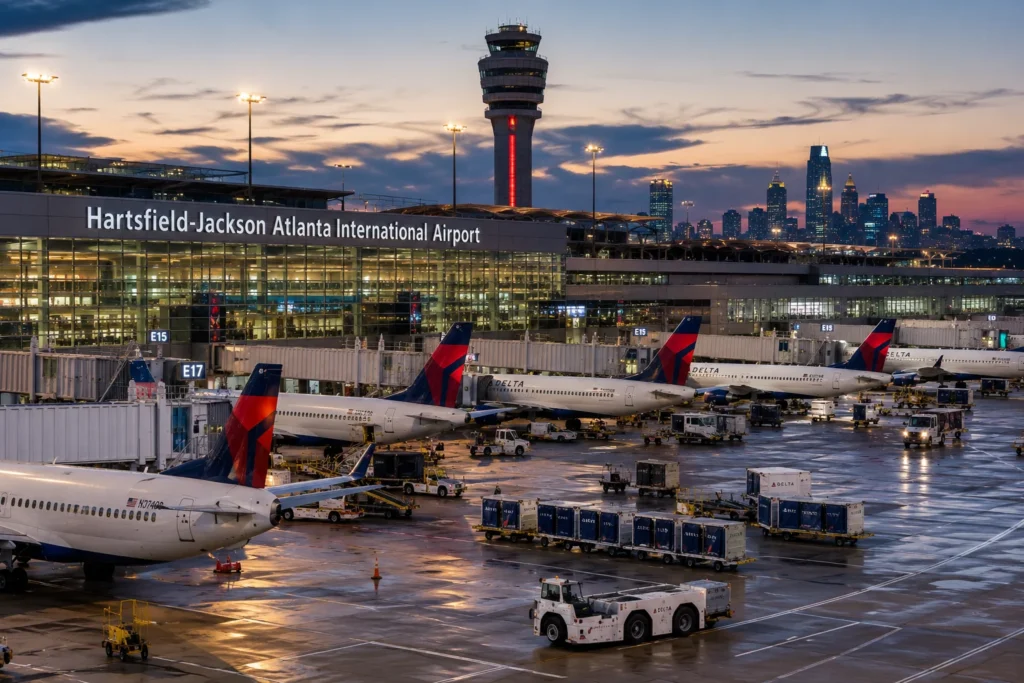
The global commercial aviation network is experiencing widespread operational friction, highlighted by a prolonged period of elevated irregular operations at Hartsfield-Jackson Atlanta International Airport (ATL). Official tracking data from the world’s busiest airport confirms a total of 198 flight anomalies, comprising 190 delays and 8 outright cancellations. Unlike previous operational challenges driven by domestic convective weather systems across the American Midwest or local labor constraints, the current disruption mechanism stems from acute structural challenges thousands of miles away: severe mid-Atlantic airspace bottlenecks.
This international corridor congestion is creating a reverse-cascade effect, translating into significant delays for premium long-haul routes. The disruptions are directly impacting high-volume passenger links connecting North America with Denmark, France, South Korea, the Netherlands, Switzerland, and the Dominican Republic.
The Geopolitical and Structural Origins of Atlantic Airspace Congestion
The primary factor driving today’s international flight disruptions is the sustained traffic displacement across the North Atlantic Organised Track System (NAT-OTS). Following prolonged regional airspace closures and security realignments over major transit corridors in the Middle East earlier this year, international long-haul carriers have systematically rerouted their transcontinental operations.
This shifting of traffic has funneled an unprecedented volume of daily flights into the northern oceanic tracks. The resulting airspace saturation has created a persistent bottleneck, slowing down eastbound and westbound transatlantic traffic. When widebody aircraft—such as the Airbus A350, A330neo, and Boeing 777 fleets—experience routing delays over the Atlantic, the operational impact ripples through major hub networks:
Delayed Inbound Arrivals: Long-haul airliners arriving from destinations like Copenhagen, Paris Charles de Gaulle, and Amsterdam Schiphol are consistently missing their scheduled landing blocks at primary U.S. gateways.
Gate Concourse Congestion: The late arrival of international flights causes extended gate occupancy times at major terminal gates, preventing domestic narrowbody aircraft from positioning on schedule.
Cascading Network Delays: Because major network carriers rely on tightly integrated hub-and-spoke scheduling, a late transatlantic arrival delays subsequent domestic departures, triggering a chain reaction of disruptions across key regional hub cities.
Delta Air Lines Manages Sustained Operational Pressures
As the primary hub tenant in Atlanta, controlling approximately 60% to 75% of total airport movements, Delta Air Lines absorbed the highest raw volume of disruptions, recording 96 flight delays. However, due to the carrier’s massive scale at the airport, this figure represents a highly controlled 8% to 10% delay rate across its total daily schedule. This indicates a steady operational recovery from the acute scheduling challenges experienced during the peak Memorial Day holiday travel rush.
The impact remains split between international widebody operations and subsequent domestic rotations. To minimize passenger inconvenience, the airline has deployed its mobile notification systems to provide real-time gate reassignments and schedule updates.
Furthermore, the disruptions have generated secondary delays at major interconnected network nodes across the United States. Flight monitoring networks have reported downstream delays at key transit points, including Chicago O’Hare, Denver, Dallas-Fort Worth, Orlando, and Minneapolis-St. Paul International Airport.
Consumer Protection Frameworks and Transborder Passenger Rights
With international flight disruptions crossing multiple geopolitical boundaries, passengers caught in today’s delays may be eligible for protection under several distinct consumer aviation frameworks depending on their specific itinerary, ticketing origin, and airline carrier.
United States Department of Transportation (DOT) Mandates
For the passengers affected by today’s eight cancellations at ATL, United States Department of Transportation regulations stipulate that a full cash refund to the original form of payment is mandatory if the traveler chooses not to accept the alternative transport offered by the airline. This statutory requirement applies to all commercial flights operating to, from, or within the United States, regardless of whether the disruption was caused by weather or air traffic control constraints.
European Union (EU261) and United Kingdom (UK261) Regulations
Passengers departing from European or British airports toward North American gateways are protected under EU261 and UK261 legal frameworks. If a transatlantic flight arrives at its final destination three or more hours behind schedule due to airline-controllable factors—such as crew scheduling failures or downstream positioning errors—passengers are entitled to fixed financial compensation ranging up to €600 or £520 per person. Additionally, carriers are legally required to provide immediate duty of care assistance, including meal vouchers, communications access, and hotel accommodations for overnight delays.
Canada’s Air Passenger Protection Regulations (APPR)
For transborder itineraries connecting through Toronto Pearson International Airport (YYZ), Canada’s APPR framework provides a tiered structure of financial compensation for controllable flight delays. Passengers experiencing disruptions are eligible for compensation ranging from CAD $400 for delays spanning three to six hours, up to CAD $1,000 for flight disruptions extending beyond nine hours.
Strategic Recommendations for International Tourists
Aviation authorities and international travel management firms recommend that long-haul passengers implement proactive travel protocols during periods of heightened airspace congestion. Passengers should verify the live physical location of their incoming aircraft using global radar tracking applications prior to departing for the airport, rather than relying solely on standard terminal departure boards.
Additionally, industry experts suggest ensuring a minimum connection window of 90 to 120 minutes for any itinerary involving an international widebody transfer, protecting the journey against the cascading delays currently impacting global transit corridors.
For more travel news like this, keep reading Global Travel Wire