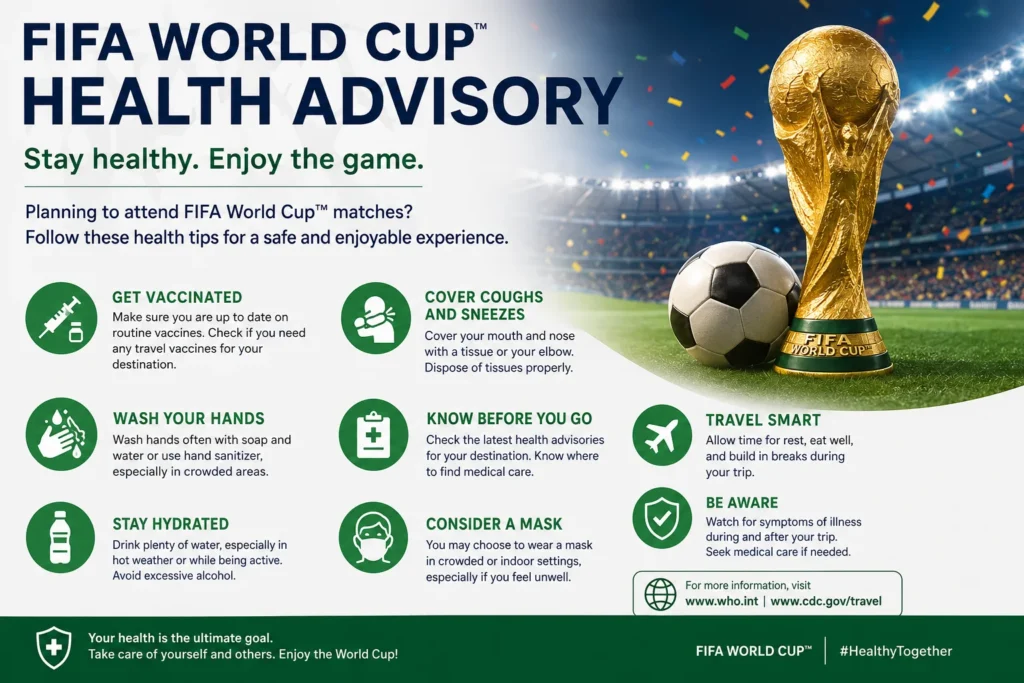
Public health agencies and international tourism bodies have issued a comprehensive health advisory for global travelers planning to attend the upcoming international football tournament. The joint warning comes as regional monitoring networks detect a significant shift in global epidemiological patterns, particularly regarding vaccine-preventable illnesses. With millions of international spectators preparing to cross borders for the month-long tournament spanning Canada, Mexico, and the United States, official agencies are implementing strict surveillance measures at major transit hubs to mitigate potential transmission risks.
The convergence of massive crowds in stadiums, public viewing zones, and mass transit systems presents unique public health challenges. Tourism boards and official health departments are collaborating to distribute standardized safety protocols to hospitality providers, aviation networks, and regional tour operators. The primary goal is to ensure that the influx of global sports fans does not inadvertently accelerate regional transmission rates, preserving both public safety and the economic vitality of the host destinations.
Analyzing Global Transmission Trends and Regional Statistical Data
Official health data compiled by the Pan American Health Organization indicates a notable rise in global caseloads for highly communicable respiratory and rash-inducing illnesses. Epidemiological reports show that over 184,000 cases have been documented across 155 nations in the current cycle, with verified laboratory confirmations rising steadily. Statistical breakdowns reveal that while certain sectors of Southeast Asia and the Eastern Mediterranean represent significant percentages of the global total, the Americas have experienced a noticeable uptick, accounting for a substantial portion of recent international reports.
Within the western hemisphere, regional monitoring has identified a fourfold increase in documented cases compared to the exact same tracking period during the previous calendar year. This sudden shift has already caused current figures to surpass the total cumulative caseload recorded for the entirety of the prior year. Regional health ministries have updated their public registries, with Mexico documenting over 10,000 confirmed cases and Guatemala reporting over 6,000 incidents. Further north, Canadian federal health authorities have confirmed more than 1,000 cases, while the United States has registered nearly 2,000 instances via localized surveillance infrastructure. Additional reports from Central and South American nations, including Belize, Costa Rica, El Salvador, Honduras, and Panama, indicate that current transmission chains are heavily linked to international travel and cross-border importations.
Strategic Pre-Departure Protocols for International Sports Tourists
To maintain a secure environment across all host cities, international health authorities have issued a series of specific, actionable recommendations for individuals coordinating their travel itineraries. The core of the strategy relies on proactive immunization verifications prior to boarding international flights or approaching land border crossings.
Immunization Requirements and Timelines
Official guidelines strongly advise that all travelers aged six months and older who lack documented proof of prior immunity should receive an updated vaccine dose. To ensure maximum biological efficacy, health ministries recommend administering the immunization at least two weeks before entering any municipality hosting tournament events or regions with documented transmission. This timeline allows the body to develop sufficient antibody responses before interacting with dense crowds at international airports, railway terminals, and sports complexes.
Symptom Recognition and Field Awareness
Tourists must familiarize themselves with the primary clinical indicators highlighted in official medical bulletins. These include the sudden onset of high fever, widespread skin rashes, persistent coughing, a runny nose, conjunctivitis, and localized joint discomfort or swollen lymph nodes. Because early symptoms frequently mimic standard seasonal respiratory infections, travelers must maintain a high degree of self-awareness and refrain from dismissing minor physical ailments while traveling.
Operational Response Framework and Transit Hub Surveillance
Federal departments of health, in coordination with transport ministries, are actively upgrading surveillance infrastructure at critical entry points, including international airports, commercial maritime ports, and land border checkpoints. These enhanced border measures are designed to detect symptomatic individuals rapidly without causing extensive delays to standard tourism transit.
If a traveler develops corresponding symptoms during their journey or upon arrival at a host city, official protocol dictates immediate medical evaluation. To prevent secondary transmission within public spaces, symptomatic individuals must utilize a certified medical face mask, avoid close physical contact with others, and remain isolated from public venues, including stadiums and fan zones, for a mandatory period of seven days. Furthermore, upon returning to their home countries, travelers are instructed to provide their local healthcare providers with a comprehensive, chronological history of their international travel and event attendance to facilitate precise contact tracing if necessary.
Long-Term Health Security Infrastructure for Mass Gatherings
The current international health advisory underscores the critical balance between promoting global sports tourism and maintaining robust domestic bio-safety protocols. Regional health departments are deploying dedicated rapid response teams to host municipalities to handle potential clusters swiftly. These specialized units operate under standardized international coordination frameworks, allowing for real-time data sharing and cross-border contact tracing between Canadian, Mexican, and American public health agencies.
By adhering strictly to these verified institutional recommendations, international soccer fans can safely enjoy the cultural and athletic spectacles of the tournament. The implementation of timely vaccinations, continuous symptom monitoring, and disciplined adherence to local health guidance ensures that global tourism can proceed responsibly, safeguarding both the health of visiting fans and the resident populations of the host nations.
For more travel news like this, keep reading Global Travel Wire