The international travel landscape is witnessing an extraordinary structural realignment as destinations shift focus from standard seasonal leisure to high-value travel experiences. At the absolute forefront of this transformation is the Moroccan kingdom. According to recent performance disclosures released by the Ministry of Tourism, Handicrafts and the Social and Solidarity Economy, the nation has achieved an unprecedented surge in visitor volumes during the opening months of the annual calendar.
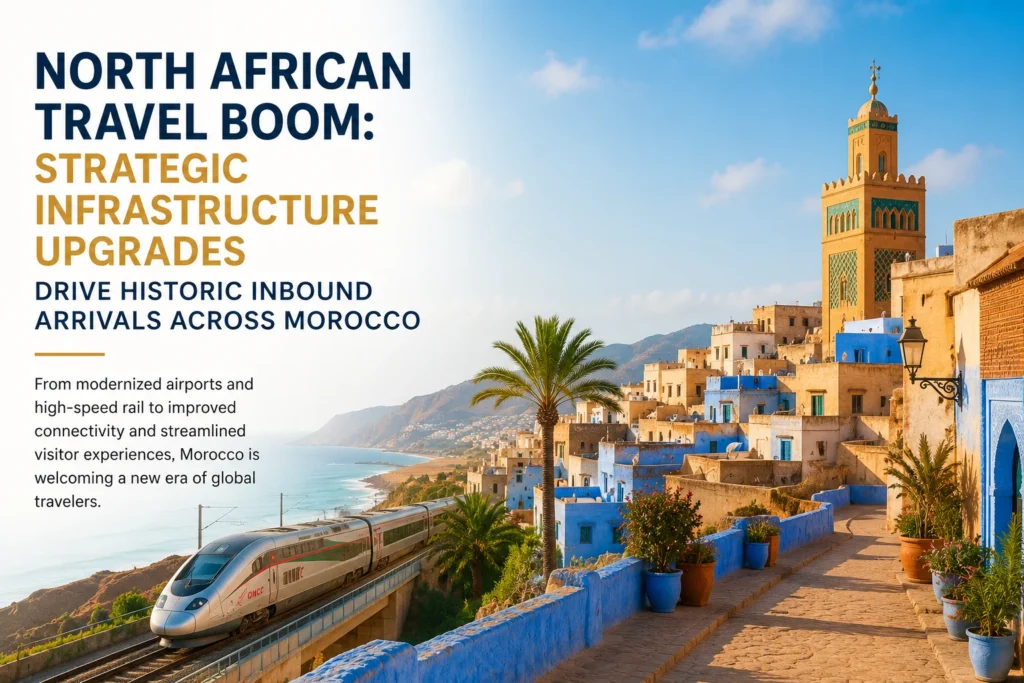
Official ministry evaluations confirm that the territory welcomed more than 7.7 million international travelers between January and the conclusion of May. This performance marks a substantial 7 percent year-on-year escalation compared to the same operational interval from the prior annual cycle, further reinforcing the kingdom’s status as a premier African destination. This growth is a direct consequence of a multi-layered development blueprint designed to enhance global market accessibility and modernize municipal transportation networks.
Orchestrating Growth Through Aviation Expansion and Regional Connectivity
The core engine driving these record arrival numbers is a highly coordinated national aviation strategy. Operational data from transport authorities reveals that the traditional approach of routing inbound visitor traffic primarily through a singular metropolitan gateway has been methodically replaced. The updated framework prioritizes the aggressive expansion of direct international point-to-point flight corridors linking global capital hubs to secondary regional networks, including Agadir, Fez, Ouarzazate, Tangier, and Essaouira.
By deliberately decentralizing transit routes, the state has systematically balanced visitor distribution across diverse provincial economies. To support this influx of air passengers, public capital works are concurrently expanding the high-speed rail network and upgrading specialized transport infrastructure. This deliberate logistics planning allows long-haul international spenders to transition seamlessly from premium coastal zones to cultural historical sites, directly funneling tourism expenditures into domestic artisan and service sectors that previously relied on trickle-down regional commerce.
Mid-Year Acceleration and Rising Fiscal Contributions
The arrival metrics compiled for the late spring period highlight an accelerating growth curve. In the single month of May, international borders recorded roughly 1.7 million tourist arrivals, representing a sharp 13 percent year-on-year surge over the previous baseline. Parallel financial reporting from the ministry indicates that direct travel receipts climbed exponentially during the first third of the annual cycle, contributing vital foreign currency reserves and capital liquidity directly into the domestic market.
Analysis of inbound demographic profiles illustrates a highly diversified consumer base. While historic European source markets—predominantly France—maintain their foundational positions, targeted promotional campaigns have catalyzed a strong influx of premium long-haul travelers originating from North America, the United Kingdom, the Middle East, and key growth corridors across Asia. Long-haul premium travelers are increasingly viewing the North African coastline as a culturally immersive and highly secure alternative to standard maritime resort zones.
Product Diversification: Transitioning to Premium Experiential Sectors
The current growth trajectory reflects a deliberate policy pivot away from legacy mass-volume bus itineraries toward high-value specialized travel segments. This experiential diversification creates institutional economic resilience, insulating the hospitality sector against cyclical market fluctuations:
Cultural and Gastronomy Preservation: Curated heritage circuits, culinary discovery tracks, and deep-medina architectural conservation efforts protect multi-generational handicraft traditions while generating significantly higher per-capita spending.
High-End Sports Logistics: The installation of championship-grade golf courses along with the regulation of prime surfing corridors on the Atlantic coast incentivizes longer average lengths of stay and stabilizes off-season occupancy rates.
MICE and Enterprise Tourism: Extensive convention facility projects in Rabat and Marrakech attract high-value corporate events, effectively securing weekday occupancy for premium hospitality operators.
Furthermore, the enduring travel patterns of the Moroccan diaspora provide an integrated economic safety net. Representing a critical percentage of total inbound arrivals, returning citizens residing abroad maintain a permanent presence during regional holiday seasons, adding structural stability to the national travel economy.
Managing Growth and Safeguarding Service Standards
As the influx of global travelers accelerates, regional tourism monitoring units emphasize the critical necessity of strict regulatory oversight. Sector analysts warn that rapid volume increases put direct operational pressure on municipal management, urban transport networks, and historical medina environments.
In response, regional administrative councils are working alongside the ministry to enforce updated hospitality guidelines. Current initiatives focus on expanding vocational training academies for tourism personnel to protect service quality, updating the unified hotel classification framework, and standardizing consumer protection measures to neutralize unaccredited street operators. Maintaining a premium, authentic brand identity remains an absolute priority as the destination scales its hospitality capacity.
Redefining the Long-Term Strategic Roadmap
The continuous expansion of the inbound tourism pipeline is forcing economic planners to adjust national roadmaps well ahead of initial projections. Following a landmark year that drew 19.8 million annual visitors, the kingdom is positioned to meet its long-standing benchmark of 26 million annual visitors ahead of the original deadline. Updated, highly ambitious administrative scenarios are now evaluating a target of 30 million international arrivals by the turn of the decade.
With the state actively preparing to co-host the prestigious 2030 FIFA World Cup alongside Spain and Portugal, this sustained visitor momentum functions as a critical foundational trial. The airport infrastructure expansions, hotel asset investments, and regional transport developments under execution today ensure the territory possesses the advanced technical capabilities required to manage an international sporting event, cementing its long-term legacy on the global travel stage.
For more travel news like this, keep reading Global Travel Wire