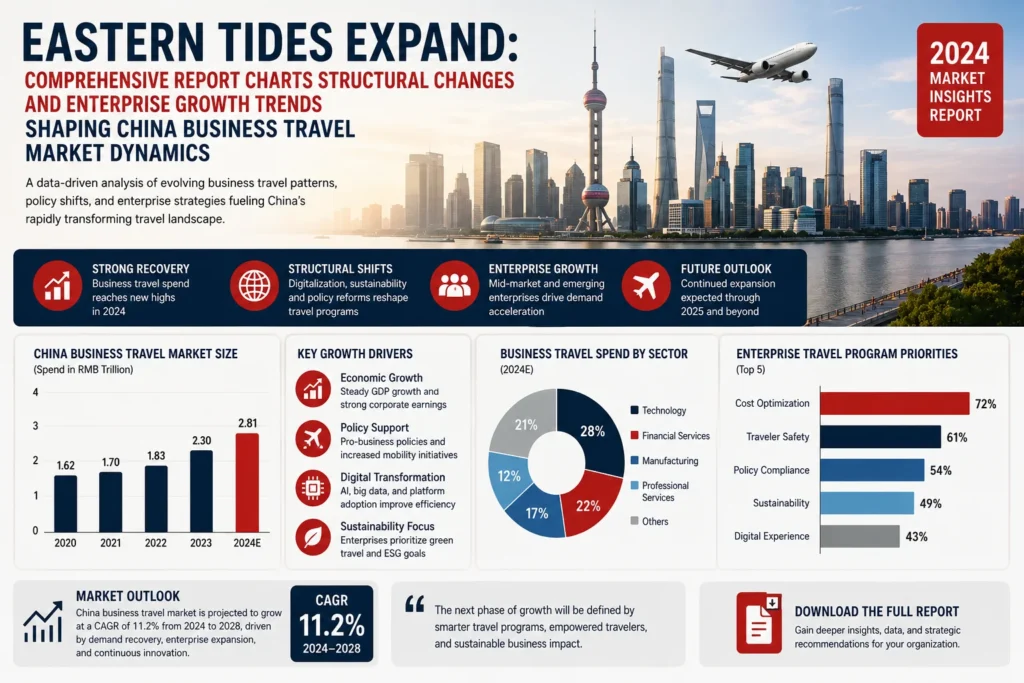
The global landscape for corporate mobility is experiencing an intensive phase of development, characterized by a fundamental shift in how large-scale enterprise travel is structured, managed, and executed. According to newly compiled public research from the TravelDaily Institute, the China business travel market has emerged as one of the most critical structural drivers of global commercial aviation and hospitality demand. Official global indicators, including the latest economic impact research from the World Travel & Tourism Council, place China as a premier force in business travel, tracking at an estimated $192 billion USD in corporate segment spending.
To provide multinational corporations, research institutions, and international business travel stakeholders with an objective framework to navigate this high-volume ecosystem, the institute has introduced the English-language edition of its extensive study, titled Tides Rising in the East: The Expanding Reach of China’s Business Travel. Initially published in its domestic edition earlier this spring, this data-driven publication leverages verified economic indicators, extensive traveler surveys, and senior executive interviews to chart the underlying operational logic of the market.
Structural Changes Transform Corporate Clients Into Platform Operators
The current development cycle of the industry reveals that the region’s story extends far beyond simple numerical scale. A prominent time-defining trend identified within the report is the rapid evolution of large Chinese state-owned and private enterprises. A growing number of these high-volume corporate entities are actively moving past the traditional role of a client; instead, they are investing heavily in building proprietary, localized travel management platforms. By integrating corporate logistics directly with internal enterprise resource planning systems, these corporations are gradually transitioning into direct participants within the travel technology service chain.
Simultaneously, Chinese companies are executing aggressive cross-border expansion strategies. This internationalization is generating a steady, high-capacity surge in overseas corporate travel demand, particularly along primary regional trade and infrastructure corridors. This outward momentum is strongly supported by progressive public policy shifts. State updates confirm that expanded visa facilitation measures now encompass more than 50 countries, systematically lowering administrative friction points and enabling highly efficient, short-notice international corporate scheduling.
A Balanced Multi-Dimensional Look At Corporate Logistics
The research breaks down the structural components of the industry by utilizing an international framework to map out four distinct, interconnected ecosystem perspectives. This multi-dimensional integration evaluates how macroeconomic indicators like gross domestic product, trade indices, and industrial output directly intersect with day-to-day corporate transit.
The comprehensive ecosystem breakdown encompasses several vital operational layers:
The Demand and Traveler Side: An in-depth evaluation of corporate travel managers alongside the specific behavioral changes, end-to-end trip experiences, and scheduling pain points of corporate road warriors.
Travel Management Companies (TMCs): An analysis of how traditional travel service providers are adapting to the rise of enterprise-owned platforms and automated digital compliance tools.
Resource and Supply Infrastructure: Strategic insights tailored directly for commercial airlines, international hotel groups, and regional ground transportation providers managing high-frequency intercity corporate volume.
Technology and FinTech Integrations: A review of advanced payment solution providers, automated expense tracking systems, and the implementation of corporate sustainability mandates.
Grounded Methodology and Executive Interlocking Data
To ensure absolute factual precision and capture the actual operating conditions of the commercial network, the institute implemented a rigorous, multi-tiered research methodology. The data synthesis relies on a broad combination of quantitative field surveys and targeted qualitative executive inquiries conducted across multiple major metro corridors, including primary commercial centers in mainland China and Hong Kong.
The statistical composition of the research framework is illustrated in the data matrix below:
| Research Module Element | Sample Scope and Metrics | Primary Investigated Parameters |
| Business Traveler Survey | 1,305 online quantitative respondents | End-to-end user satisfaction, transit friction points, and digital tool preferences |
| Corporate Manager Input | 48 verified corporate travel managers | Policy compliance parameters, budget allocations, and platform integration goals |
| Service Provider Data | 93 travel management companies | Market competition dynamics, service fee structures, and tech adoption rates |
| Resource Supplier Assessment | 37 airlines, hotel chains, and transit lines | Capacity deployment, inventory management, and premium corporate demand tracking |
| Executive Expert Interviews | 19 one-on-one deep-dive executive sessions | Long-term operational vision, regulatory compliance, and cross-border expansion logic |
The qualitative layer of the study incorporates detailed, structured conversations with senior leadership figures representing major hotel groups, legacy commercial airlines, prominent ground transit networks, and independent financial technology providers. This dual approach pairs broad corporate statistics with real-time operational context, allowing global stakeholders to extract actionable strategic guidance across the entire business travel value chain.
Strategic Guidelines For Global Corporate Stakeholders
As corporate transit structures become more sophisticated and cross-border logistics involve increasingly complex corporate travel management platforms, international travel planners and resource suppliers are encouraged to apply specific operational approaches:
Optimize Digital Platform Compatibility: International suppliers aiming to capture premium market share must ensure their application programming interfaces connect seamlessly with custom enterprise platforms built by large corporations.
Monitor Infrastructure Extensions: Given that domestic business travel accounts for approximately 75 percent of total market volume, hospitality providers should align their property pipelines with primary high-speed rail corridors connecting major hubs like Beijing, Shanghai, Guangzhou, Shenzhen, and Chengdu.
Align With Sustainability Parameters: Corporate travel budgets are increasingly tethered to strict environmental oversight, requiring airlines and ground transit operators to provide clear, certified carbon output tracking data directly to enterprise clients.
The release of this definitive annual report highlights the resilience and long-term potential of the region’s corporate travel sector. By translating intricate macro trends into concrete action recommendations, the publication provides global industry participants with the predictive tools required to successfully integrate with the expanding corporate transit network.
For more travel news like this, keep reading Global Travel Wire