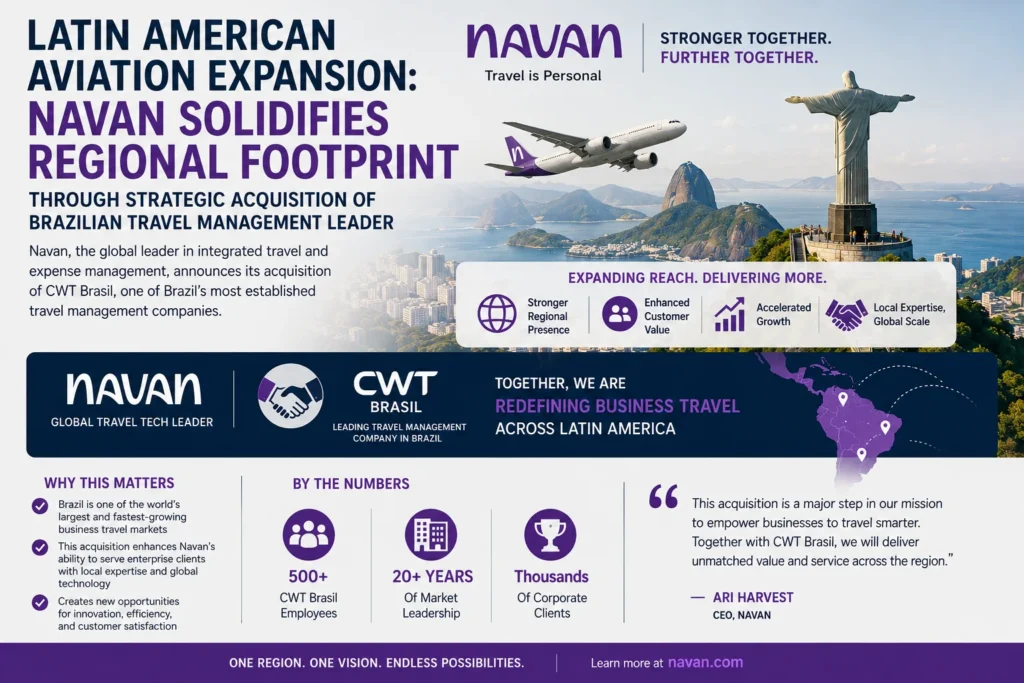
The corporate mobility and corporate travel platform sectors are experiencing a rapid operational consolidation as international enterprise networks expand across South America. In an official corporate filing submitted to the Securities and Exchange Commission, Navan, Incorporated, a prominent global AI-powered business travel and expense platform, announced the signing of a definitive purchase agreement to acquire Smartrips. Recognized as a premier travel technology and logistics provider in Brazil, the strategic integration marks Navan’s initial corporate acquisition since its transition to a publicly traded entity on the NASDAQ exchange.
The cross-border development comes at a time when Latin America’s business tourism indices are exhibiting record-breaking growth. By incorporating Smartrips’ comprehensive regional logistics architecture, domestic operational footprint, and International Air Transport Association (IATA) credentials directly into its centralized tech framework, the global platform aims to systematically dismantle localized booking fragmentation across the largest economy in South America.
Harnessing Latin America’s Premier Business Tourism Corridor
Official public declarations and institutional tourism indicators reveal that Brazil functions as the primary engine for commercial transit throughout Latin America. Data compiled by the Brazilian Tourism Board, Embratur, and the Central Bank of Brazil shows that the country’s broader travel and hospitality sector injected an all-time record of $10.4 billion USD in foreign visitor revenue into the economy during the preceding annual cycle, with initial quarters demonstrating a continued 11.8 percent year-over-year surge.
Within this booming ecosystem, corporate logistics represent a major high-yield vertical. Independent industry audits and regional market research confirm that Brazil represents a massive global market for corporate travel, commanding an estimated 40 percent share of all business transit expenditures across the Latin American region. Enterprise-level spending within the Brazilian corporate sector is projected to maintain a consistent compound annual growth rate of 6.4 percent, positioning the region as a primary destination for global multi-national corporations.
Historically, executing standardized travel policies within Brazil presented complex administrative roadblocks for multinational financial teams. Due to localized ticketing requirements, specific regional airline inventory access, and highly localized tax invoicing structures, global enterprises were frequently forced to divert their local teams to decentralized partner sites or external, off-platform booking software. This fragmentation routinely led to a severe lack of spending transparency, irregular policy compliance, and significant tracking backlogs for corporate accounting departments.
Integrating Localized Procurement With AI-Driven Systems
The operational integration of Smartrips into the core software architecture directly solves these systemic visibility issues. Following the complete technical alignment of the two networks, enterprise clients can seamlessly book, manage, and audit all Brazilian corporate travel from a single, unified interface. This centralized framework automatically aggregates intercity flight paths, regional hospitality inventories, and local ground transportation arrangements into a single data pipeline, delivering real-time financial oversight.
The structural mechanism behind this expansion reflects a long-term international development strategy successfully deployed by the technology firm over the past five years. Rather than constructing regional networks from scratch, the company systematically acquires established, market-leading local operators possessing deep-rooted supplier networks and specialized domestic expertise. This methodology mirrors previous successful operational integrations executed with local industry leaders in other core global markets, including Comtravo in Germany, Tripeur in India, and Reed & Mackay in the United Kingdom.
The technical specifications and strategic parameters governing this regional market consolidation are illustrated in the overview matrix below, utilizing verified public data and corporate announcements:
| Operational Alignment Metric | Smartrips Baseline Framework | Integrated Navan Platform Framework |
| Market Segment Share | Top-tier corporate procurement platform in Brazil | Global AI-powered travel and expense infrastructure |
| Regional Scale Dominance | Manages a core portion of the 40% Latin American spend | Targets a broad global corporate market opportunity |
| Logistical Credentials | Fully accredited via the International Air Transport Association | Unified global distribution and multi-currency accounting |
| Booking Architecture | Localized Brazilian supplier networks and portals | Consolidated, single-interface global booking flow |
| Administrative Horizon | Founded in 2017; trusted by enterprise clients | Transaction scheduled to finalize in fiscal year 2027 |
Preserving Long-Term Financial and Operational Guidance
Official corporate communications indicate that the definitive purchase agreement will not disrupt existing financial parameters or corporate guidance. The transaction is fully projected to close during the second quarter of the 2027 fiscal year, subject to customary regulatory closing conditions and standard administrative verifications. Company executives have confirmed that the financial parameters of the deal do not alter the broader public guidance issued during the mid-June financial presentations.
Furthermore, the operational continuation of Smartrips’ existing executive leadership ensures that the specialized customer care models, regional negotiation leverage, and direct carrier connections that local corporate commuters rely on will remain completely intact. The localized procurement expertise developed by the brand since its founding in 2017 will be augmented by round-the-clock automated support frameworks, smart itinerary matching algorithms, and streamlined expense reconciliation tools.
Tactical Guidelines For Managing Cross-Border Corporate Accounts
As corporate transit infrastructure transitions toward highly automated, single-source global management platforms, corporate travel managers and international operations directors are encouraged to adopt the following operational practices:
Consolidate Regional Accounts: Review current regional software deployments across South American subsidiaries to identify instances where localized teams are using disconnected booking systems, and plan a phased migration to unified platforms.
Align Tax Compliance Metrics: Ensure that corporate expense reconciliation parameters are updated to automatically capture localized Brazilian tax documentation, maintaining seamless global accounting compliance.
Leverage Ground Transit Integration: When organizing large-scale corporate conferences or executive itineraries within major business hubs like São Paulo and Rio de Janeiro, utilize integrated platform options to arrange secure, pre-audited ground logistics directly alongside flight bookings.
The strategic acquisition underscores a permanent shift away from disjointed, regional travel management agencies in favor of unified, technologically advanced systems. By merging deep Brazilian supplier connectivity with world-class cloud infrastructure, the modern corporate travel platform ensures that international organizations can navigate expanding global markets with absolute efficiency, predictable compliance, and total spend transparency.
For more travel news like this, keep reading Global Travel Wire