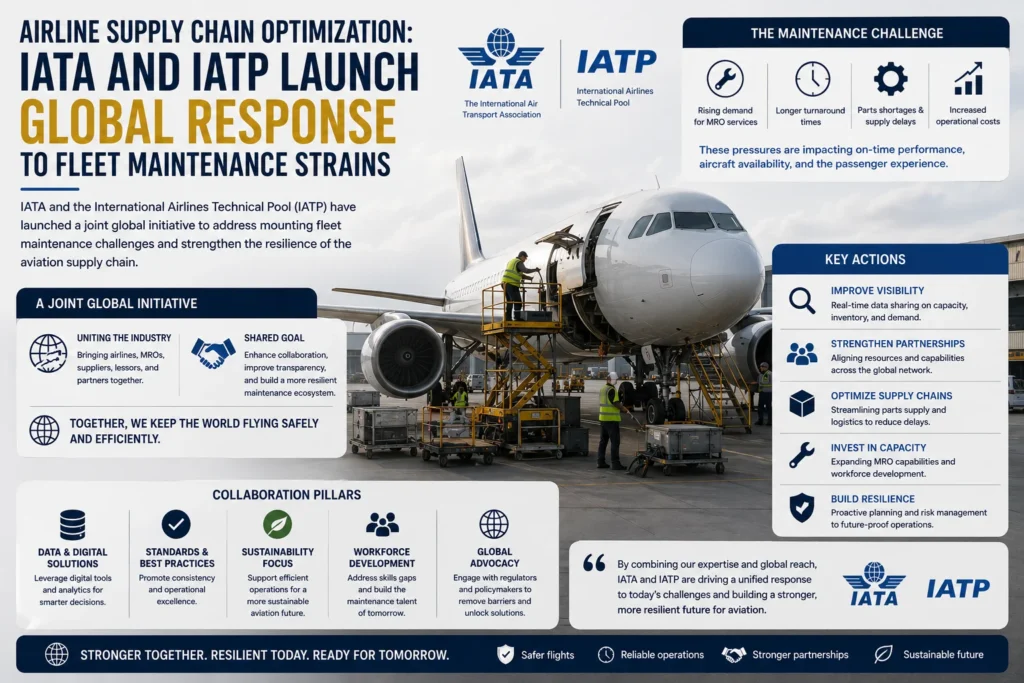
The global aviation sector is executing deep operational reforms to protect commercial flight schedules from compounding international parts shortages and manufacturing delays. In an official joint announcement released in Madrid, Spain, the International Air Transport Association (IATA) and the International Airlines Technical Pool (IATP) finalized a comprehensive cooperation agreement. The unified framework is designed to improve material transparency, streamline part sourcing, and enhance fleet availability across the worldwide air transport network.
The timing of this strategic alignment follows consecutive quarters of severe industrial disruption within the aerospace supply chain. Airlines worldwide are managing acute operational pressures stemming from a shortage of serviceable components, extended maintenance repair times, and rising procurement costs. By integrating IATP’s physical material sharing model with IATA’s digital tracking capabilities, the two organizations are providing a practical mechanism to fortify maintenance resilience, help carriers maintain day-to-day operations, and protect the broader travel and tourism economy from ripple-effect scheduling disruptions.
Dynamic Material Sharing Programs Expanded Across Global Stations
A core pillar of the newly established agreement involves an aggressive scaling of mutual resource sharing. Under the approved framework, IATA will formally support IATP’s technical materials pooling programs, which allow participating airlines to share parts, specialized equipment, and line maintenance capabilities. The collaborative sharing framework provides member carriers with immediate access to a shared safety net, reducing the requirement for individual airlines to store expensive, redundant inventories at every destination they serve.
According to verified operational statistics from the technical pool registry, the active network provides member airlines with direct access to more than 6,600 certified aircraft parts distributed across 350 international transit stations. Additionally, the pool delivers localized line maintenance support at more than 900 global locations alongside comprehensive aircraft recovery coverage. This widespread infrastructure access is critical for maintaining fleet availability during high-demand peak travel seasons, ensuring that an unexpected mechanical fault at a distant airport can be resolved rapidly using parts sourced from local pool partners.
Complementary Digital Platforms Provide Free Inventory Clarity
To maximize the efficiency of these physical part pools, the partnership is linking resource sharing directly to advanced data tracking systems. The collaboration integrates the shared component pools with IATA’s MRO SmartHub, a digital platform dedicated to improving the visibility and valuation of available aircraft materials. By giving maintenance controllers a real-time, comprehensive view of confirmed serviceable items held by accredited suppliers, the platform streamlines material planning and procurement workflows.
To accelerate the adoption of these digital tracking tools during the current supply chain crisis, aviation leaders announced a significant data participation program. Under this initiative, the core analytics features of the MRO SmartHub will be provided at no cost to eligible airlines associated with participating bodies, including IATA, IATP, and the Latin American and Caribbean Air Transport Association. The system, which recently underwent extensive software upgrades, provides deep analytics on parts usage patterns and impending component shortages, allowing airlines to plan scheduled hangar visits with high logistical precision.
Strengthening International Technical Operations and Safety Standards
Beyond optimizing physical part distribution, the cooperation agreement establishes an expanded framework for the exchange of technical expertise and industry best practices. The two organizations have pledged to deepen their alignment across technical operations, fleet maintenance quality, and corporate safety assurance. The shared operational guidance will be structurally reinforced by established international validation programs, such as the IATA Operational Safety Audit framework and the active Safety Connect community platform.
Aviation safety executives have emphasized that keeping pace with modern maintenance challenges requires absolute synchronization on quality control metrics. As repair hubs manage record traffic volumes, standardized technical audits ensure that fleet maintenance resilience is optimized without compromising strict international safety baselines. By combining centuries of collective industry knowledge, the joint initiative creates an operational framework capable of maintaining steady flight frequencies despite ongoing macroeconomic disruptions.
The Long-Term Protection of Global Tourism Connectivity
The collective push toward optimized aviation supply networks carries direct benefits for international hospitality, resort destinations, and global tourism boards. When commercial airlines face unresolved parts shortages, the consequences manifest as unexpected aircraft groundings, sudden route suspensions, and reduced seating capacity, which immediately limits the volume of international visitors able to travel to major holiday destinations. By building an interconnected inventory safety net, the industry can insulate flight reliability from manufacturing delays.
Ultimately, this joint agreement demonstrates that resolving modern aerospace bottlenecks requires structured, industry-wide resource sharing and high digital clarity. As these tracking technologies and shared pools expand across international routes, commercial aviation moves closer to a stabilized operational standard. This structural stability lowers overhead costs for international carriers while preserving the reliable flight connectivity and seamless transit experiences that global vacationers expect.
For more travel news like this, keep reading Global Travel Wire