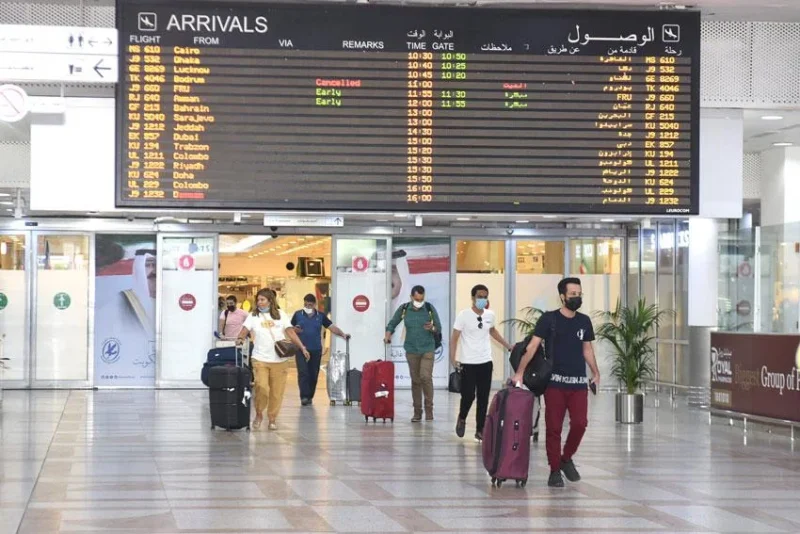
A strategic infrastructure recovery is underway at Kuwait International Airport, signaling a major boost in the nation’s international travel capacity expansion. Following structural restoration and comprehensive safety recertifications, aviation authorities have finalized operational timelines to welcome back a large contingent of international commercial airlines. This coordinated network restoration marks a crucial turning point for Gulf transit liquidity and seasonal tourism infrastructure.
Official public announcements from Kuwait’s Directorate General of Civil Aviation (DGCA) confirm that Terminal 1 is legally cleared to resume passenger processing. The facility has undergone meticulous repairs following localized drone-strike damage and has successfully secured official re-certification under International Civil Aviation Organization (ICAO) safety frameworks. The return of international commercial airlines will follow a highly structured, phased operational blueprint designed by the DGCA to protect technical readiness, manage air traffic control resources efficiently, and uphold strict security benchmarks.
National Carriers Drive Initial Network Volume
Leading up to the terminal reopening, Kuwait’s homegrown aviation sector has aggressively scaled operations from dedicated terminals to satisfy robust regional demand. The national flag carrier, Kuwait Airways, has expanded its flight frequencies significantly out of Terminal 4. Moving from an initial operational phase, the airline currently commands over 420 weekly departures. Under its finalized seasonal itinerary, the legacy carrier is on track to operate up to 728 weekly flights across 58 global destinations, subject to routine ministerial approvals.
This expanded network bridges major European, Middle Eastern, and Asian commerce nodes, including London, Paris, Milan, Cairo, Riyadh, Dubai, Mumbai, and Guangzhou. Furthermore, the carrier is rolling out a dynamic summer aviation program introducing multiple high-demand destinations in phases, including Zurich, Mykonos, Antalya, Sarajevo, and Vienna.
Concurrently, Jazeera Airways has reinstated its full operational schedule out of Terminal 5. The carrier is servicing 27 regional destinations with a heavy emphasis on South Asian and Middle Eastern routes. By re-establishing full connectivity to eight distinct industrial and cultural hubs across India—including Thiruvananthapuram, Ahmedabad, and Kochi—and preparing a new direct European route to Krakow, the airline is injecting substantial seat inventory into the market, offering over two million seats for the current travel block.
Phased Resumption Timelines for International Transport Providers
The structural revival of Terminal 1 permits a rolling re-entry of major regional and global corporations. Transport ministries have outlined explicit target dates for foreign carriers to re-integrate Kuwait into their broader networks.
Regional legacy giants Emirates and Gulf Air initialized the repatriation of Kuwait City routes earlier in the quarter, providing essential connectivity to Dubai and Bahrain. While Emirates has dynamically trimmed its subsequent schedules slightly to manage broader regional fleet allocations, Gulf Air continues to utilize Kuwait as a primary feeder for its newly launching summer routes to destinations like London Gatwick, Baku, and Tbilisi.
To assist corporate planners and international passengers, the following data tracks the official resumption matrix compiled from civil aviation advisories and verified carrier updates:
Carrier Name | Current Operational Status | Confirmed Reopening Timeline Oman Air | Suspended | Service resumption active 4 June 2026 SalamAir | Suspended | Scheduled route return 16 June 2026 Qatar Airways | Suspended | Planned summer network return 16 June 2026 via T1 Etihad Airways | Suspended | Structured phased return commencing 1 June 2026 via T1 flydubai | Suspended | Structured phased return commencing 1 June 2026 via T1 Saudia | Suspended | Structured phased return commencing 1 June 2026 via T1 British Airways | Suspended | Under administrative review; no restart date finalized Air India | Suspended | Fleet allocation restricted; route remains suspended
While Gulf cooperation partners like Saudia and flydubai are initiating active terminal transitions, long-haul Asian and European operators are navigating separate operational equations. Air India has adjusted its international deployments downward through the quarter, citing high fuel overheads and active routing constraints, which keeps its Kuwait operations temporarily on hold.
Airspace Advisories and Long-Term Infrastructure Projections
The primary variable governing the return of European aviation entities remains the Conflict Zone Information Bulletin issued by the European Union Aviation Safety Agency (EASA). The safety directive, which maintains an active tracking status, applies a dual-tiered advisory matrix across Gulf air corridors. The framework designates a lower-tier “exercise caution” protocol for Kuwaiti airspace, distinct from more restrictive mandates applied to adjacent northern corridors.
While the bulletin serves as an administrative recommendation rather than a legal prohibition, commercial insurance underwriters heavily reference these parameters when calculating war-risk premium coverage. As a result, carriers such as Turkish Airlines and British Airways are maintaining flexible rebooking policies for affected routes while waiting for further regulatory adjustments.
Looking toward the future of Kuwaiti tourism and transit commerce, the state is aggressively advancing its primary infrastructure project, Terminal 2. The multi-billion-dollar project, designed to expand long-term capacity, is verified at approximately 81% completion. Once fully integrated into the airport ecosystem, the state-of-the-art terminal will provide 28 advanced passenger gates, scaling the airport’s total capacity to handle between 25 and 50 million passengers annually. This massive logistical expansion ensures that Kuwait remains well-positioned to serve as a major, resilient gateway for global commerce and international tourism.
For more travel news like this, keep reading Global Travel Wire