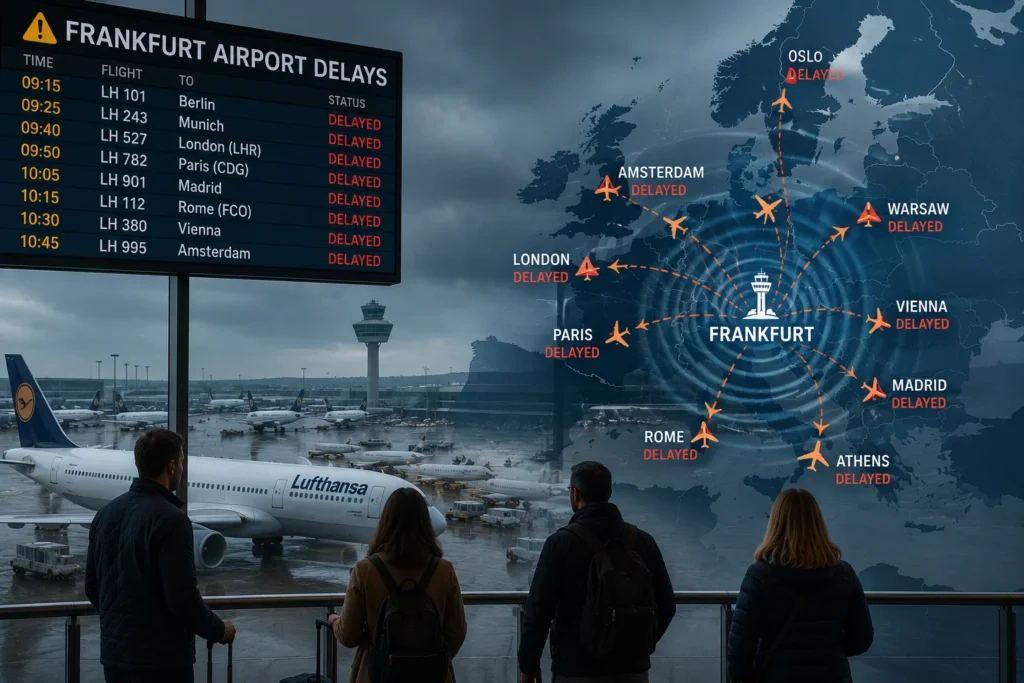
The global travel and tourism economy is facing fresh logistical headwinds as major operational gridlock at Frankfurt International Airport ripples through international airline networks. According to official aviation traffic statistics and airport operational updates, the German mega-hub—the primary base for Lufthansa and a critical gateway for global tourism—has experienced a severe cascade of schedule disruptions.
Because Frankfurt operates as a central nervous system for transcontinental transit, these localized delays have rapidly ballooned into a multi-continent headache. The resulting backlog has compromised tightly timed flight schedules across the United Kingdom, Scandinavia, Western Europe, and major long-haul entry points across North America. For international tourists, holidaymakers, and business travelers, the situation highlights the ongoing vulnerability of the global travel infrastructure during peak seasonal traffic waves.
The Domino Effect on Transatlantic and European Tourism
Aviation infrastructure relies heavily on predictable, synchronized aircraft rotations. Federal data from European aviation authorities reveals that when a primary hub like Frankfurt slows down, the operational shock wave is felt almost immediately by regional partners and international carrier networks alike.
In this latest scheduling crisis, regional feeder flights from vital tourism and commerce hubs—including London, Manchester, Helsinki, and Amsterdam—suffered compounding ground delays. As aircraft were held on tarmac spaces or arrived late into Germany, incoming passengers saw their tight connection windows vanish.
The consequences quickly crossed the Atlantic. Crucial long-haul tourism corridors connecting Europe to North American destinations such as Toronto, Dallas, and Los Angeles began posted significant rolling delays. For international visitors traveling on multi-sector itineraries, a single delay in Germany effectively halted journeys halfway across the globe, illustrating how dependent the modern tourism economy remains on the fluid operation of a handful of core continental hubs.
Ground Reality: Missed Connections and Stranded Vacationers
For tourists caught in the middle of the scheduling bottleneck, the practical impact has been immediate and exhausting. According to official airport traffic disclosures, more than 140 flights were directly impacted during the peak of the disruption. The layout of Frankfurt’s passenger terminals—which utilizes decentralized security screening checkpoints near specific gate areas rather than one centralized zone—became an added hurdle for passengers attempting to make rapid, last-minute transfers between distant concourses.
When inbound short-haul flights from the United Kingdom or neighboring European nations land behind schedule, travelers routinely miss their designated departure slots for the final daily long-haul legs to North America or Asia. Because transatlantic flights are highly optimized around specific evening departure waves, missing a connection frequently leaves travelers with no viable same-day rebooking options. This has forced thousands of international visitors into unexpected overnight hotel stays, overwhelmed airport customer service facilities, and caused travelers to miss the opening days of carefully planned vacation itineraries, cruises, and tour bookings.
Major Carriers Under Operational Strain
The congestion at Frankfurt places an immense operational burden on several of the world’s most prominent airlines. As the dominant carrier at the hub, Lufthansa bears the highest exposure to these irregular operations. The airline’s entire business model is built on an intricate hub-and-spoke network that channels passengers from regional European cities into heavy long-haul aircraft. When the hub experiences ground constraints, the carrier possesses very little buffer room to absorb delays before they impact subsequent flights.
Similarly, regional specialist Air Dolomiti, which feeds passengers into Frankfurt from destinations across Italy and Central Europe, faced severe vehicle positioning challenges. Late departures from Germany meant delayed arrivals at smaller regional airports, creating an ongoing loop of late-running schedules that took days to fully rectify.
Leisure carrier Condor, which provides vital nonstop links to popular global vacation destinations, faced identical hurdles with connecting passengers transferring from partner airlines. On the transatlantic side, global tourism partners American Airlines and Delta Air Lines also faced schedule adjustments, as delayed departures out of Europe forced late-night arrivals into North American hubs, disrupting subsequent domestic flight schedules and crew rest requirements.
Consumer Protection and Smart Travel Contingencies
Under official European consumer protection mandates, specifically the European Union’s EC 261 framework, passengers experiencing severe flight disruptions may be legally entitled to specific protections. This regulation applies to qualifying flights departing from an EU airport, as well as flights operated by EU-based carriers like Lufthansa, Condor, and Air Dolomiti arriving into the EU.
Depending on the root cause of the delay, eligible travelers are entitled to duty-of-care assistance from their airline, which includes meals, refreshments, communication access, and overnight hotel accommodations where necessary. Official tourism and consumer agencies recommend that all travelers retain their physical boarding passes, baggage tags, and official communication from the airline regarding delays to support any subsequent claims.
For those planning to navigate major international hubs throughout the busy summer and winter travel seasons, aviation officials recommend booking wider connection windows of at least two to three hours when transitioning from regional feeder flights to long-haul international departures. By building a proactive time buffer into travel itineraries, tourists can better insulate their travel investments from unexpected hub capacity constraints and safeguard their holiday plans.
For more travel news like this, keep reading Global Travel Wire