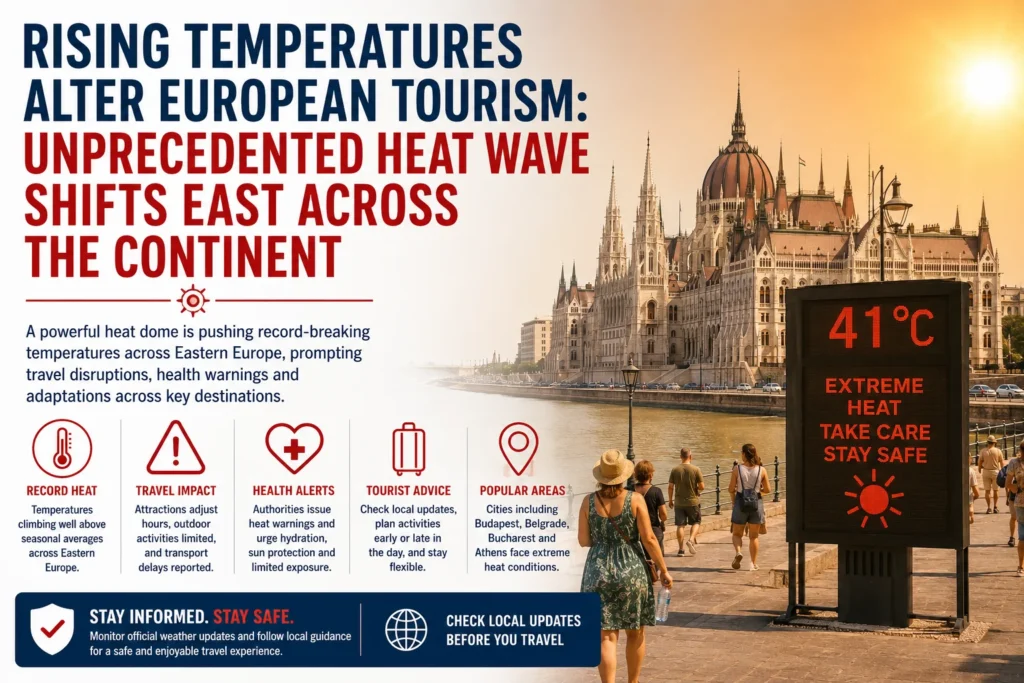
A sweeping environmental system is significantly shifting the landscape of Europe summer travel as an intense, record-breaking heat wave moves from the western regions into central and eastern Europe. National meteorological agencies across the continent have confirmed that historical maximum temperature thresholds were surpassed, causing widespread adjustments to regional transportation infrastructure, healthcare resources, and public holiday gatherings.
As the weather pattern moves eastward, national tourism bureaus are working closely with civil protection departments to issue synchronized public safety guidance. High-level weather alerts are currently active across major municipal centers, with official guidelines recommending that both international visitors and residents minimize non-essential transits during peak afternoon periods to avoid heat-related health risks.
Historical Meteorological Milestones Shattered Across Multiple Nations
Official reports from regional scientific centers highlight the exceptional nature of this weather event, which has penetrated deeply into northern territories where such extreme temperatures are historically rare. The Danish Meteorological Institute officially recorded a maximum temperature of 37.0 degrees Celsius in Ødum, north of Aarhus, and in Beldringe, north of Odense. This landmark measurement establishes the single warmest day recorded in the Scandinavian nation since formal tracking began in 1874, eclipsing previous benchmarks set decades ago.
Further south, the weather system generated similarly unprecedented readings. MeteoSwiss reported a maximum threshold of 38.8 degrees Celsius in the northern city of Basel. In the Czech Republic, the national meteorological office logged a historic peak of 40.8 degrees Celsius in the northern town of Doksany, with regional forecasters warning that additional microclimate shifts could cause localized numbers to escalate further.
In Germany, the Deutscher Wetterdienst issued widespread extreme weather alerts as temperatures approached the 40-degree mark. The prolonged thermal exposure caused physical structural damage to vital transport links, including localized sections of the national Autobahn highway system. Linear expansions in the concrete infrastructure caused road surfaces to fracture and buckle near Berlin, prompting temporary highway closures and immediate engineering interventions.
Transportation Operators and Public Health Authorities Adapt to Thermal Strain
The severe thermal conditions have prompted a series of structural responses from European transit networks. German rail operator Deutsche Bahn, alongside several neighboring state rail administrations, issued official guidance advising travelers to postpone non-essential journeys. The physical infrastructure of many European rail corridors, designed primarily for temperate maritime climates, faces acute operational limits during extended periods of intense heat, requiring speed restrictions to prevent track misalignment.
The lack of widespread architectural cooling systems in residential and commercial properties across northern and central Europe has also heightened local public safety concerns. Municipal emergency management units have completed a series of preventative evacuations, transferring residents from uncooled senior care facilities to regional medical facilities equipped with industrial climate control.
In France, Météo-France maintains the highest-level red alert indicators across more than three dozen administrative departments, stretching from the central territories to the northeastern border zones. The Paris public hospital authority, AP-HP, officially activated its comprehensive emergency response blueprint across 38 regional healthcare facilities. Emergency medical registries in the capital recorded an approximate 30 percent increase in heat-related admissions over a consecutive 48-hour window, with medical emergency dispatch centers managing an 80 percent surge in incoming assistance requests compared to the same tracking period in the previous year.
Impact on Cultural Events and Tourism Activities
The environmental strain has directly intersected with seasonal summer tourism programs and large-scale public gatherings. Out of concern for public health resources and the potential for heat exhaustion among large crowds, municipal authorities in Paris coordinated the postponement of major cultural gatherings, including the annual Pride procession and a scheduled three-day music festival. Public health researchers note that the thermal intensity of this system has surpassed indicators recorded during historic regional heat events, urging travelers to prioritize hydration and seek shade.
In Italy, the Ministry of Health placed 18 major tourist destinations on maximum red alert status, including high-profile cultural centers such as Rome, Venice, Florence, Bologna, and Milan. In the historic centers, international tourists have adjusted their daily sightseeing itineraries, shifting excursions to early morning hours and utilizing municipal public fountains to maintain safety.
A rapid climate attribution analysis published by European scientific consortiums indicates that the frequency and intensity of these extreme seasonal thermal anomalies have shifted substantially over the past two decades, with human-induced atmospheric variations making such events exponentially more likely to occur. As international visitors continue to navigate Europe summer travel, tourism operators are increasingly emphasizing adaptive planning, real-time weather app tracking, and strict adherence to localized civil protection updates to ensure safety across the continent.
For more travel news like this, keep reading Global Travel Wire