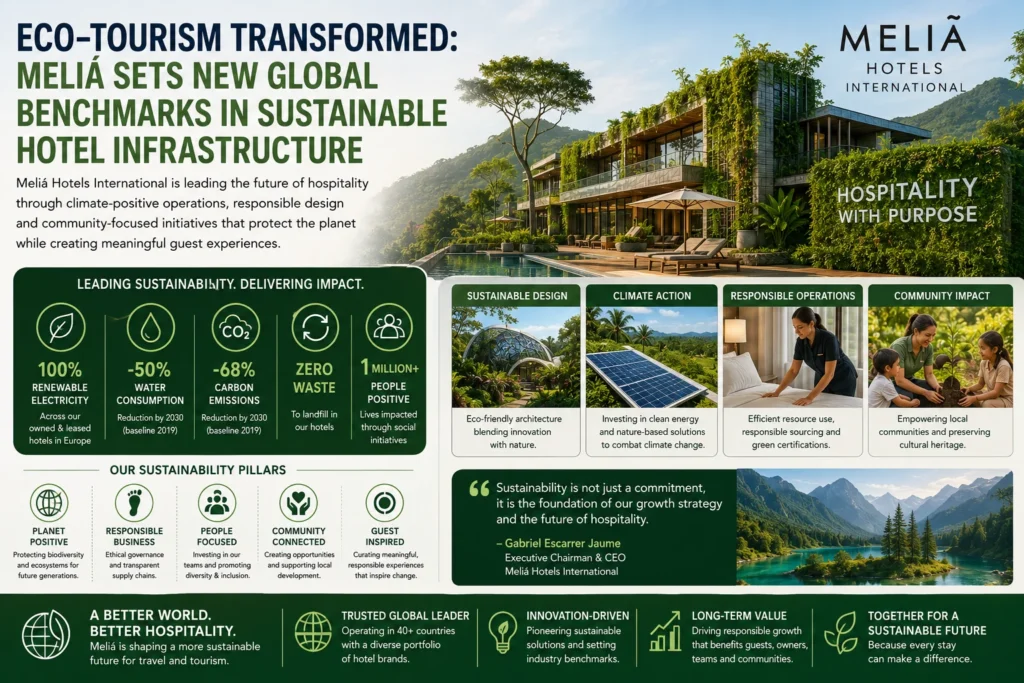
The international hospitality landscape is undergoing a structural transition, driven by incoming regulatory demands and a pronounced shift in traveler preferences. Sustainable hotel infrastructure has transitioned from a localized marketing preference to a core framework governing global operations. Leading this change, international hospitality organizations are establishing advanced carbon-reduction programs and resource-optimization systems across their global portfolios.
In South America, this environmental blueprint is being actively demonstrated within Peru’s high-altitude tourism corridors. The Hotel Cusco La Paccha Affiliated by Meliá has emerged as a regional pioneer, positioning itself as the first fully sustainable hospitality facility in the southern region of the country. By executing an aggressive energy transition model rooted in high-capacity solar technology, the property serves as an active test case for modern carbon mitigation in highly sensitive ecological and cultural destinations.
The Cusco Solar Model and Regional Decarbonization
Operating in the historic capital of the Inca Empire, the Cusco property leverages specialized engineering to reduce its dependence on the municipal electrical grid. The hotel features an advanced 40 kW photovoltaic system comprised of 200 high-efficiency solar panels. This independent clean-energy infrastructure successfully generates enough electricity to offset roughly 25% of the property’s total energy consumption, prioritizing the continuous power requirements of its expansive public spaces.
Beyond immediate utility savings, this configuration provides a scalable model for mitigating the localized carbon footprint associated with long-range heritage tourism. Strategic resource optimization allows the property to operate with minimal environmental friction, demonstrating that heritage destinations can host modern, multi-tier luxury travel accommodations without placing excessive strain on existing local infrastructure.
To ensure long-term accountability, the hotel management team is standardizing its internal environmental monitoring systems. By upgrading its monitoring and data collection metrics, the property plans to deploy a comprehensive dual-materiality auditing matrix by the close of the year. This framework tracks both direct ecological impacts and incoming corporate risk factors, laying the foundation for a measurable circular economy model with transparent, data-driven targets.
Travel for Good: The Metrics of Global Corporate Decarbonization
The localized operational updates in Peru align with the broader corporate mandates of Meliá Hotels International. The group’s comprehensive global strategy, operating under the “Travel for Good” framework, has accelerated its timeline to outpace incoming regulatory adjustments, such as the European Union’s Corporate Sustainability Reporting Directive (CSRD). Published under the institutional mandate “Meliá in Action,” the organization’s verified sustainability performance highlights substantial progress across several critical operational vectors.
Carbon Footprint and Energy Transition
Global performance indexes show a verified 4.6% reduction in the organization’s net carbon footprint calculated per guest stay. This reduction is heavily supported by the fact that 85% of the brand’s global hotel portfolio now operates entirely on renewable energy sources. Furthermore, 88% of all operational properties have successfully secured independent, verified sustainability certifications.
Circular Economy and Waste Reductions
Resource management frameworks have driven the corporate recycling rate to 31.6% across all international properties, alongside a systemic water-preservation program that reuses 15% of all consumed water. Food waste initiatives have achieved notable scale; corporate partnerships dedicated to excess food recovery successfully diverted more than 10,000 kilograms of food from waste streams over a single operational cycle.
Marine and Coastal Biodiversity Programs
Biodiversity initiatives have expanded into major marine protection agreements. In the Mediterranean sector, corporate alliances successfully removed over 20 metric tons of plastic waste, repurposing the recovered ocean plastics into durable, recycled products utilized inside the hotels. In Latin American coastal corridors, specialized environmental teams successfully rescued over 70,000 endangered sea turtle eggs and initiated targeted mangrove reforestation programs to stabilize delicate coastal tourism borders.
Social Impact Metrics and Transparent Governance
The modern execution of sustainable hotel infrastructure stretches beyond raw carbon statistics to encompass rigorous labor standards and localized economic inclusion. The global organization maintains an international workforce of over 31,000 employees, with an emphasis on employment stability reflected by an 87.7% permanent contract rate.
Corporate diversity targets continue to show upward movement, with women currently holding 42.7% of all executive and hotel management positions across the global network. Additionally, the operational supply chain is highly integrated into localized economies, with 86.7% of all corporate suppliers sourced directly from local businesses within each operating destination.
As international travelers—particularly younger demographics—increasingly analyze the environmental and social performance of accommodation brands before booking, the demand for verifiable, certified eco-friendly lodging will continue to grow. Through the continuous rollout of advanced solar configurations in fragile ecosystems like Cusco and the systematic implementation of strict carbon auditing worldwide, the integration of scalable sustainable hotel infrastructure remains the defining variable for the future of responsible global tourism.
For more travel news like this, keep reading Global Travel Wire