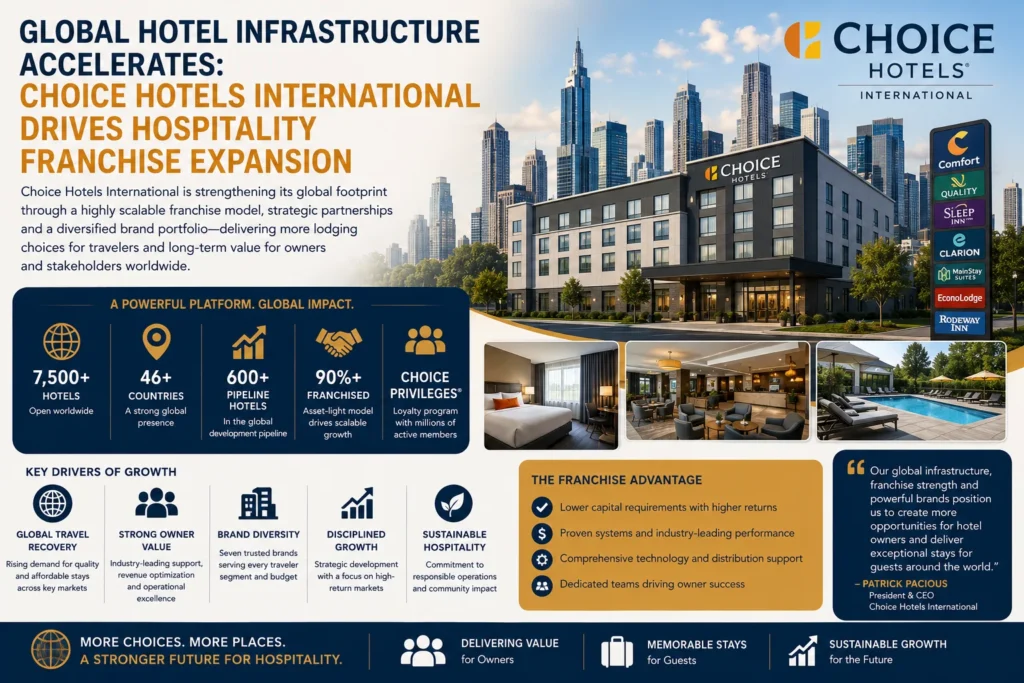
The global tourism and lodging sector is experiencing a period of significant structural development, marked by the strategic reallocation of corporate capital and the steady expansion of international room inventories. Official data from global tourism boards and institutional market disclosures indicates that the hospitality sector is increasingly relying on capital-efficient frameworks to drive growth. At the forefront of this trend, Choice Hotels International continues to expand its footprint, utilizing an asset-light franchising strategy to capture both domestic and international travel demand across multiple brand tiers.
Official quarterly performance statistics released by the organization show a massive surge in developer interest, highlighted by a 72% increase in global franchise agreements awarded during the early months of 2026 compared to the previous year. This substantial acceleration underscores a broader macroeconomic shift within the lodging industry, as institutional investors and local property developers heavily prioritize established, scalable brand frameworks to capture emerging tourism traffic.
Strategic Institutional Backing and System Size Metrics
The financial mechanics behind large-scale hospitality operations remain heavily integrated with institutional investment patterns. Recent regulatory filings with the Securities and Exchange Commission show continued engagement from major institutional bodies, with organizations like Boston Trust Walden Corp maintaining substantial stock positions valued at over $96 million within the lodging enterprise. This systemic capital backing provides the necessary fiscal stabilization that allows major hotel networks to pursue aggressive development pipelines even amidst broader macroeconomic adjustments.
According to verified system-size statistics, the total global pipeline for the hospitality system has exceeded 77,700 rooms. The strategic composition of this pipeline is highly deliberate, with 97% of the incoming inventory strictly concentrated within higher-revenue upscale, extended-stay, and midscale brands. This focused approach allows the hospitality network to elevate its long-term earnings profile while deliberately moving away from lower-economic contribution segments.
Driving International Growth Across Diverse Global Markets
While domestic lodging corridors remain a vital baseline for corporate stability, international travel markets are serving as the primary engines for rapid footprint diversification. Official data highlights that the international net rooms matrix grew by 13% year-over-year, supported by a 59% increase in active room openings across key global regions. This brings the international operational system to approximately 160,500 rooms, showcasing powerful operational momentum across Canada, Europe, the Middle East, and Africa.
A major milestone in this global diversification strategy includes a major development commitment within the EMEA sector, targeting the establishment of 100 hotels in sub-Saharan and southern African regions over the coming decade. Initiated via localized partnerships in East Africa, this targeted expansion brings recognized midscale and upscale service lines to major urban centers and high-growth experiential leisure destinations. By embedding these new regional properties into centralized reservation networks and global loyalty structures, the hospitality framework seamlessly captures emerging corporate and leisure travel demand.
Extended Stay and Midscale Segments Anchor Domestic Performance
Domestically, the extended-stay segment continues to stand out as a primary growth driver within the modern tourism economy, fueled by sustained developer demand and strong unit economics. The domestic extended-stay room segment experienced an 11.8% expansion compared to previous operational periods, backed by a robust forward pipeline of over 30,300 specialized rooms. This segment serves as a critical buffer against economic volatility, providing consistent occupancy levels driven by long-term business travelers, remote workforce components, and transitional relocation segments.
Simultaneously, the midscale lodging segment is seeing historic deployment velocities. Domestic room openings within midscale brands experienced a 57% increase compared to the same operational window last year. This rapid acceleration reflects improving returns for property owners who utilize cost-efficient, modernized architectural prototypes that lower initial construction overhead while maximizing guest satisfaction indexes.
Transitioning Toward Capital-Efficient Development Layouts
The ongoing transformation of the global lodging landscape is further characterized by a disciplined shift toward highly capital-efficient development strategies. Institutional financial updates reveal that net capital outlays for direct hotel development-related activities are projected to decline significantly throughout the year, moving to a targeted range of $20 million to $45 million. This structural shift reflects a mature transition toward a pure-play franchising model, minimizing direct corporate exposure to real estate risk while optimizing recurring royalty streams.
By focusing corporate resources on upgrading central digital distribution channels, enhancing global sales architectures, and rolling out modernized brand identities across thousands of domestic and international locations, hospitality franchisors are able to deliver enhanced value directly to individual property owners. As international tourism demand continues to stabilize around multi-tiered travel preferences, the continuous integration of conversion properties, the optimization of extended-stay options, and the aggressive expansion of international franchised pipelines will remain foundational to shaping the global hospitality landscape.
For more travel news like this, keep reading Global Travel Wire