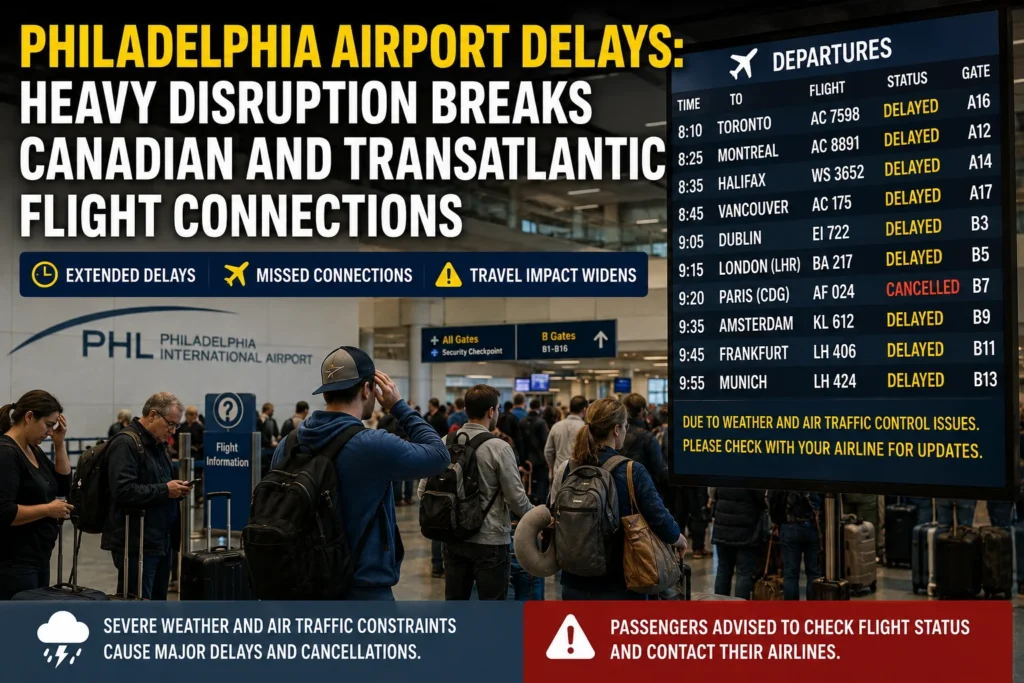
An operational breakdown has rippled through Philadelphia International Airport (PHL), triggering widespread travel headaches for thousands of passengers. A major regional and international gateway, the airport logged a significant surge in scheduling issues, including dozens of outright cancellations and hundreds of flight delays. Because Philadelphia serves as a primary transatlantic hub, the localized operational friction quickly snowballed, severing vital flight corridors to Canada and major European transit hubs.
The widespread disruption across the airfield has disproportionately harmed regional commuter traffic. This specific segment functions as the lifeblood of the airport, ferrying passengers from smaller regional airfields into mainline terminals to catch long-haul international flights. When these initial regional legs collapse, travelers are left stranded at the gates, missing their subsequent connections to destinations overseas.
Inside the Flight Disruption Metrics
Data compiled from official transport logs paints a stark picture of the airfield’s operational struggles. The scheduling gridlock heavily penalized specific airlines, with regional operators bearing the brunt of the cancellations.
Piedmont Airlines: The regional feeder carrier registered the highest volume of dropped routes, logging 10 total cancellations.
American Airlines: The mainline carrier recorded 5 cancellations, leaving several high-capacity aircraft grounded.
Frontier Airlines: The low-cost carrier dropped 4 flights from its daily schedule.
JetBlue: The airline announced 2 cancellations amidst the escalating gridlock.
Jazz / Air Canada Express: The cross-border regional operator scrubbed 1 flight, complicating international itineraries.
The cascading delays severely fractured connectivity across several vital geographical zones. Cross-border business and leisure travel between the United States and Canada faced immediate friction, with major routes into Montreal and Toronto bearing the brunt of the cancellations. On the transatlantic side, scheduled services to Zurich, Switzerland, and Copenhagen, Denmark, suffered deep delays, jeopardizing onward connections for travelers utilizing global airline alliances. Domestically, the ripple effects extended far beyond Pennsylvania, impacting outbound and inbound flights to Boston, Salt Lake City, Los Angeles, San Juan, Charlotte, Rochester, and Houston.
Why Feeder Carrier Disruption Escalates Travel Friction
The high cancellation volume posted by Piedmont Airlines highlights a major vulnerability in modern hub-and-spoke aviation networks. As an official regional feeder for mainline operations, Piedmont utilizes smaller regional aircraft to funnel travelers from local secondary markets directly into the primary international terminal at Philadelphia.
When a feeder carrier experiences systemic cancellations, the operational damage is rarely contained to short-haul domestic corridors. Instead, it creates an immediate domino effect. A passenger stranded at a regional departure point because of a cancelled introductory flight will inevitably miss their connection to a high-capacity transatlantic flight departing from Philadelphia.
Compounding the issue is the fact that long-haul summer flights to European destinations routinely operate near maximum seating capacity. A traveler who misses their flight to Zurich or Copenhagen due to a regional delay faces an incredibly complex rebooking scenario, often resulting in multi-day delays before a replacement seat becomes available on a partner airline.
Passenger Rights Under the Department of Transportation Rules
For travelers caught in the middle of airfield gridlock, understanding official United States Department of Transportation (DOT) mandates is critical to securing proper remedies. Passenger entitlements depend heavily on the underlying cause of the scheduling change and whether the traveler decides to proceed with their trip.
Automatic Refund Rights
Under federal rules, passengers are legally entitled to a full, automatic refund to their original form of payment if their flight is cancelled or significantly delayed and they choose not to accept the airline’s alternative transport offers. The DOT explicitly defines a significant delay as three hours or more for domestic routes and six hours or more for international flights. This refund includes the base airfare plus any pre-paid ancillary fees, such as checked baggage charges or seat selection fees.
Cash vs. Vouchers
Airlines are legally prohibited from forcing passengers to accept travel credits or vouchers in lieu of a cash refund. If a customer rejects an alternative itinerary or chooses not to travel on a significantly delayed flight, credit card refunds must be processed electronically within seven business days, while cash or check transactions must be returned within 20 calendar days.
Compensation Constraints
It is vital for passengers to distinguish between ticket refunds and mandatory cash compensation for inconvenience. While the DOT guarantees a complete refund of the ticket cost if a passenger cancels a disrupted trip, US federal law does not mandate extra cash payouts for delays caused by severe weather or air traffic control restrictions. If the delay is deemed controllable—such as airline staffing shortages or mechanical maintenance issues—individual carrier customer service plans dictate provisions for meal vouchers, ground transport, and overnight hotel accommodations.
For more travel news like this, keep reading Global Travel Wire