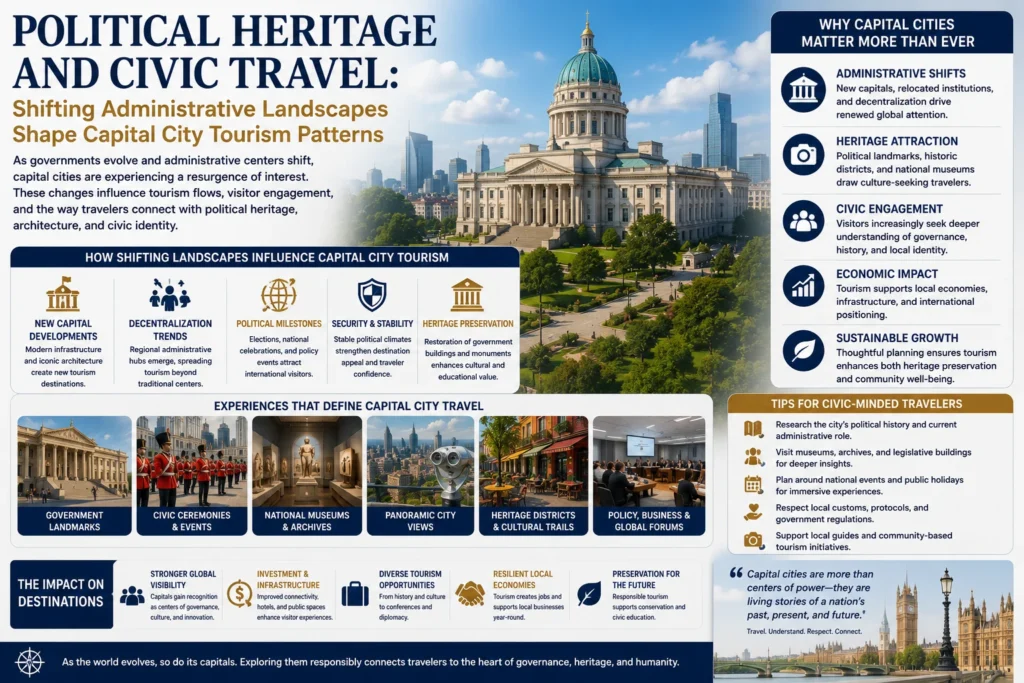
The intersection of national governance and international leisure travel continues to serve as a major driver for the domestic hospitality sector. Official data published by municipal convention bureaus and national park services indicates that civic landmarks, federal districts, and historical monuments consistently anchor regional tourism economies. When significant administrative structural adjustments occur within a nation’s capital, the ripple effects extend far beyond the halls of government, fundamentally altering visitor demographics, convention bookings, and the general flow of educational and heritage-based travel.
In an official series of administrative transitions within the executive branch, federal leadership announced a comprehensive restructuring of independent regulatory bodies, specifically involving the leadership parameters of the United States Election Assistance Commission. While these institutional adjustments primarily influence federal regulatory oversight and state administrative coordination, their timing just months before a major midterm election cycle is generating a noticeable shift in travel patterns, security infrastructure, and civic-focused tour group reservations throughout the national capital region.
Federal Structural Modifications and the Impact on Capital Infrastructure Flow
According to official organizational declarations from the executive branch, the current administration has exercised its expanded personnel management authority to fully reset the leadership matrix of the independent commission. Citing recent judicial milestones regarding the scope of executive oversight over independent federal boards, official personnel offices confirmed the immediate vacancy of multiple long-standing commissioner seats.
For the regional tourism ecosystem of Washington, D.C., and its surrounding historical corridors, large-scale changes within independent federal agencies traditionally signal a corresponding influx of specialized business travel. Official regional tourism statistics show that structural agency transitions regularly stimulate a high volume of institutional travel, bringing state-level administrative delegations, legal experts, and civic organizations to the capital city. This influx heavily compresses hotel room availability across the metropolitan core and drives up seasonal occupancy rates for premium lodging properties adjacent to the National Mall and the federal enclave.
Concurrently, municipal transit and security bureaus are adjusting their operational posturing to accommodate heightened public interest and increased foot traffic. With the upcoming midterm election cycle serving as a focal point for national attention, historical tourism providers are observing an elevated demand for educational itineraries that highlight the structural history of American governance, constitutional architecture, and the evolution of federal independent agencies.
Evolving Domestic Travel Patterns and the Rise of Historical Civic Excursions
As national focus sharpens on the operational mechanisms of federal oversight, destination marketing organizations are actively updating their strategic programming to leverage the heightened visibility of the capital district. Travel registration metrics compiled by regional heritage foundations show a distinct spike in enrollment for specialized, deep-dive historical tours that explain the creation and legislative evolution of administrative entities like the Help America Vote Act framework.
Rather than focusing solely on traditional aesthetic monuments, contemporary travelers are showing an increased preference for itineraries that incorporate active civic education. Educational tour operators, student travel groups, and international political tourism delegations are focusing heavily on sites that showcase the operational balance between federal authority and municipal governance. This specialized travel segment provides prolonged economic benefits to local museum networks, archival libraries, and independent historical sites that rely heavily on dedicated, high-engagement visitor groups.
This shift is characterized by several distinct structural travel trends:
Extended visitor stays centered around historical research institutions and public gallery spaces.
Elevated reservation volumes for corporate and governmental meeting facilities within the legislative district.
Increased demand for professional guide services specialized in constitutional history and administrative law frameworks.
Balancing Visitor Security Protocol with Expanded Public Landmark Access
With an intense legislative and electoral season unfolding across the capital city, federal law enforcement and regional park authorities are implementing updated public safety and crowd management protocols. Official safety briefs from municipal police departments emphasize that maintaining an optimal balance between robust security measures and open public accessibility is vital to preserving the integrity of the capital city tourism experience.
Travelers planning visits to key legislative buildings, federal agency headquarters, and historic squares will encounter updated checkpoint systems, temporary traffic re-routing, and enhanced pedestrian perimeters designed to handle large public gatherings and sudden administrative changes smoothly. Tourism boards are proactively distributing updated digital travel planners to advise domestic and international visitors on how to navigate these fluid security perimeters without disrupting their broader vacation schedules.
Furthermore, despite vacancies at the executive levels of specific commissions, the operational staffs of these federal entities continue to maintain their public clearinghouse functions, ensuring that official educational displays, historical publications, and public research archives remain fully accessible to visiting scholars, student groups, and curious citizens.
Long-Term Capital Hospitality Forecasts Amid Shifting Political Seasons
As the regional hospitality sector prepares for the upcoming midterm cycle, long-term booking forecasts remain highly resilient. Data from official convention registries indicates that the alignment of administrative structural changes with active national campaigns historically acts as a major catalyst for seasonal tourism growth. Corporate hospitality networks are reporting strong multi-month forward bookings, driven by an interconnected matrix of political assemblies, civic conferences, and standard leisure travelers drawn to the unique atmosphere of a capital city in transition.
By shifting traditional marketing approaches to highlight the educational and structural elements of federal governance, regional tourism authorities ensure that the capital city remains a vital, highly relevant destination for travelers seeking a deeper understanding of national history. As the administrative landscape continues to adjust to new leadership frameworks and legislative realities, the enduring appeal of civic heritage ensures a steady stream of global travelers eager to witness history unfolding in real time.
For more travel news like this, keep reading Global Travel Wire