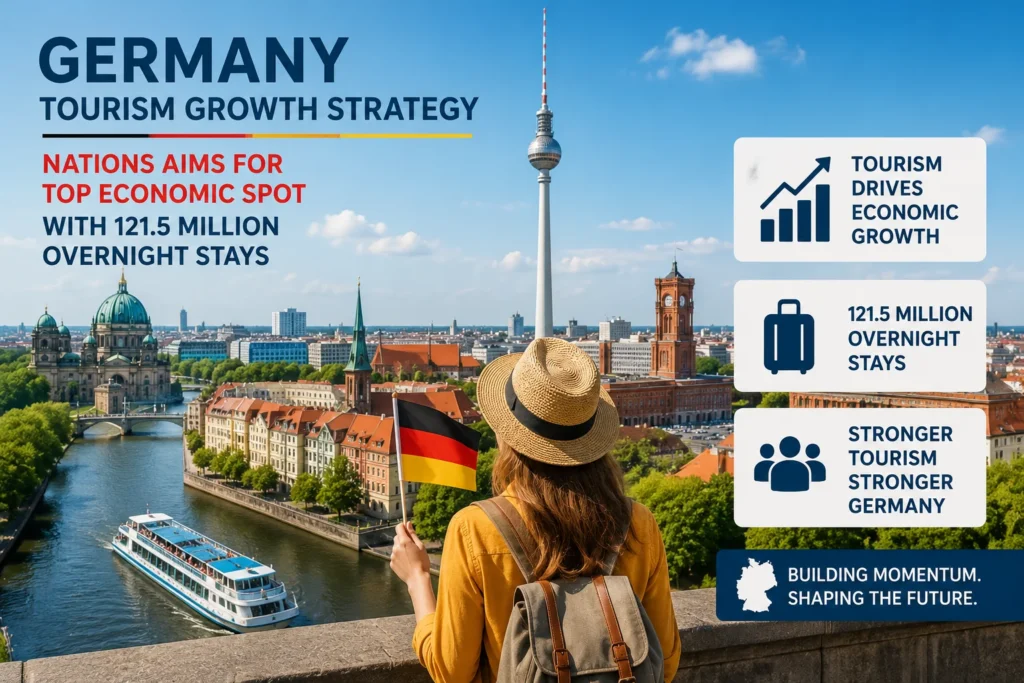
The Federal Cabinet of Germany has implemented an aggressive expansion framework designed to scale its international hospitality sector and position the country as a leading global travel market by 2030. This comprehensive federal tourism strategy leverages record-breaking cross-border arrivals and substantial structural gains within major city hubs. Backed by coordinated public sector investments, the long-term roadmap aims to secure 121.5 million international overnight stays across the country by the end of the decade.
Official data released by the Federal Statistical Office (Destatis) demonstrates a resilient upward trajectory in international visitor metrics. Driven by the highly lucrative economic travel lanes connecting the European Union and the United States, cross-border inbound transit has achieved significant short-term momentum. Rather than concentrating tourism volume in a single region, the federal initiative utilizes a decentralized economic model that relies on specialized regional urban engines to distribute visitor traffic smoothly across the country.
Strategic Urban Hubs Driving Inbound Momentum
Four primary municipal gateways serve as the structural pillars for the national tourism growth model, each targeting distinct travel segments:
Berlin: The federal capital remains the premier international magnet for leisure tourism and cultural exploration. Utilizing its globally recognized cultural landmarks, extensive museum infrastructure, and expanding corporate startup ecosystem, Berlin anchors high-volume inbound arrivals.
Munich: Operating as a highly successful dual-purpose transit hub, the Bavarian capital effectively balances large-scale leisure travel with high-yielding corporate commerce. Munich plays a critical role in maintaining the nation’s position as the leading destination for European business travel, blending historic seasonal festivals with industrial conventions.
Hamburg: Capitalizing on its historic maritime identity, extensive port infrastructure, and status as a critical commercial transit nexus, Hamburg drives consistent year-round visitor arrivals.
Cologne: Benefiting directly from expanded Western European rail corridors, Cologne serves as a primary access point for sustainable regional travel, capturing large volumes of short-haul European tourists.
Shifting Source Markets and Hyper-Regional Mobility
A notable demographic shift has materialized within the nation’s inbound travel profiles. Official statistics compiled by the German National Tourist Board (GNTB) confirm that the Netherlands has officially emerged as the single largest international source market for visitor arrivals, surpassing traditional long-haul regions such as the United Kingdom and the United States.
This hyper-regional trend is strongly supported by high-performing cross-border mobility networks. Direct high-speed rail integration between major Dutch municipalities and German urban centers has reduced travel friction considerably, resulting in a stable influx of neighboring European travelers. With inbound travel indicators pointing toward a projected 3.2 percent increase in international arrivals over the current fiscal cycle, the federal government is successfully building a balanced portfolio that insulates the domestic hospitality industry from the volatility of long-haul aviation corridors.
Implementation of Smart Tourism and Environmental Mandates
At the core of the federal modernization push is the deployment of the nationwide Smart Tourism initiative by the GNTB. This institutional strategy leverages advanced technological architecture to enhance visitor experiences while adhering strictly to statutory ecological guidelines.
Key public sector modernization projects include the integration of artificial intelligence systems dedicated to real-time destination flow management. These algorithmic monitoring tools allow municipal authorities to distribute visitor densities evenly across historic sites and high-traffic landmarks, mitigating the risks of overcrowding while maintaining the structural integrity of cultural heritage locations.
Furthermore, the federal government is piloting the implementation of secure digital identity wallets across primary international entry points. This technological protocol is designed to streamline border-crossing verification for international arrivals, significantly reducing processing bottlenecks at major airports and rail hubs. By prioritizing frictionless travel architecture, the state is establishing a competitive precedent for regional mobility within the wider Schengen area.
Capitalizing on High-Value and Extended Stays
The updated National Tourism Strategy signals a clear evolutionary shift from pursuing raw visitor quantities toward capturing higher-value, sustainable tourism expenditures. By positioning cities like Munich and Frankfurt as specialized corporate hubs alongside culturally dominant capitals like Berlin, the state is successfully capturing the growing “bleisure” market—professionals who extend mandatory business itineraries into multi-day leisure excursions.
To support this economic goal, the GNTB has successfully expanded its “Stay Longer” initiative. This targeted campaign incentivizes city-break travelers to venture beyond standard metropolitan limits to explore neighboring wine regions, protected lake districts, and designated nature parks. By actively promoting the nation’s 300,000 kilometers of signposted hiking trails and 76,000 kilometers of dedicated cycling routes, the federal framework successfully matches global demand for eco-certified travel while spreading economic benefits directly to rural communities.
As the country advances toward its 2030 target of 121.5 million overnight stays, continuous public funding and inter-state policy coordination ensure that Germany’s tourism infrastructure remains resilient, technologically advanced, and highly competitive on the world stage.
For more travel news like this, keep reading Global Travel Wire