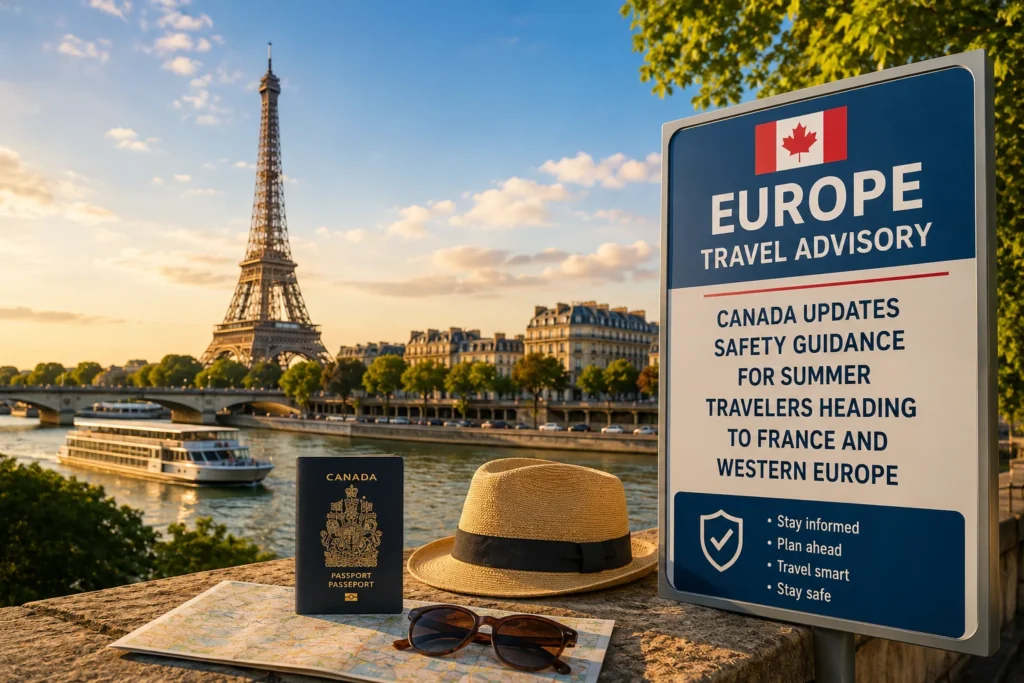
Global Affairs Canada has issued an updated health and security advisory for citizens traveling across Western Europe this summer season. The federal agency has designated a Level 2 travel warning for several highly frequented destinations, including France, Spain, Italy, Germany, and the United Kingdom. The revised government instructions advise international tourists to exercise a high degree of caution due to a combination of persistent atmospheric heatwaves, elevated wildfire risks in vulnerable Mediterranean forested regions, and active domestic security protocols.
The core adjustments to the transit framework highlight environmental challenges and national defense precautions. In France, the Ministry of the Interior continues to maintain an elevated position within its national security architecture, utilizing Level 2 of the Vigipirate system. This specific classification, known as the enhanced vigilance phase, authorizes a highly visible security presence across public areas. Travelers navigating through major international entry points will experience increased patrol protocols at major airports, international railway terminals, public transport networks, and commercial lodging districts.
Environmental Thresholds and Major Landmark Operations
Simultaneously, the European continent is managing an intense seasonal thermal pattern, with localized afternoon temperatures climbing to approximately 40°C. This period of extreme summer heat has prompted public administrative bodies to implement flexible management strategies to protect the health of visitors and employees alike. In metropolitan centers like Paris, prominent cultural facilities, including the Louvre Museum, the Eiffel Tower, and the Musée d’Orsay, have coordinated operational schedules to incorporate cooling protocols and temporary ventilation adjustments.
The protracted dry spell and elevated thermal metrics have also affected seasonal cultural activities. Several regional and municipal offices throughout France adjusted or scaled back scheduled public celebrations, including local community events and fireworks displays, to minimize accidental fire ignition risks during the peak summer dry period.
Regional Risk Profiles and Specific Security Classifications
The structural landscape of safety parameters varies across the monitored European travel zones, requiring distinct levels of awareness depending on the destination:
In France, the Level 2 status emphasizes both tactical security vigilance and severe heat management. Travelers crossing through transport hubs are advised to prepare for systematic checks.
In Southern France and the island of Corsica, the environmental designation shifts to a high-risk category for seasonal wildfires. Public safety ministries have instituted strict fire prevention laws, which include a comprehensive ban on smoking within all public forests and any locations situated within 200 meters of wooded territories.
In Spain and Italy, the Level 2 guidance focuses primarily on generalized seasonal caution. Government health ministries in these regions have issued high-temperature alerts, urging the public to prepare for localized service adjustments and potential travel delays related to infrastructure strain during peak mid-day hours.
In Germany and the United Kingdom, the Level 2 alerts represent standard protective caution. Authorities are focusing on monitoring high-density tourist areas, urban shopping zones, and managing seasonal weather changes to maintain public order.
Essential Safety Protocols and Urban Logistics for International Visitors
To maintain seamless transit and ensure compliance with European municipal regulations, travelers are encouraged to incorporate specific behavioral protocols into their daily travel routines.
When managing transit schedules, the heightened Vigipirate security parameters mean that screening processes at SNCF high-speed railway stations and municipal airports require additional processing time. International travelers are officially advised by transport authorities to budget an extra 30 to 60 minutes for standard station checkpoints. It is recommended to keep physical identity papers and digital documentation easily accessible within secure travel gear.
Regarding environmental compliance in Mediterranean woodlands, adhering to local forestry laws is critical to avoiding heavy administrative fines. Travelers planning excursions into rural or mountainous zones must consult daily regional forest weather indexes provided by local meteorological services before attempting wilderness trails. For individuals traveling with pre-existing respiratory issues, tracking regional air quality updates is strongly advised, as smoke from active regional brush fires can migrate into broader geographic corridors.
Within major urban centers, municipal safety divisions remind tourists to remain alert to common city hazards, such as pickpocketing and minor property crimes in crowded public spaces. Foreign ministries recommend avoiding common street distraction techniques in high-traffic metro stations and near global historic landmarks. Using secure, anti-theft cross-body bags and keeping high-value mobile electronics concealed while in dense shopping plazas significantly mitigates safety risks.
Infrastructure Performance and Global Tourism Volume
Despite the implementation of active safety protocols and changing climate factors, the European tourism infrastructure demonstrates sustained operational capacity. Official national tourism board statistics show robust global engagement, building on recent historic milestones. The French National Institute of Statistics and Economic Studies confirmed that the country welcomed over 102 million international arrivals, continuing an upward trajectory from the previous baseline of 100 million annual visitors. The capital region alone successfully managed over 18 million international arrivals during the same reporting period.
The continuous availability of the high-speed TGV rail network provides travelers with reliable transport alternatives, enabling efficient relocation away from heat-heavy urban centers to coastal or northern geographic regions. While the implementation of enhanced vigilance measures requires travelers to adapt to longer wait times and increased health awareness, the overarching transport and hospitality networks remain fully operational, proving that advanced state security and climate adaptation measures can successfully preserve international travel continuity.
For more travel news like this, keep reading Global Travel Wire