A sudden flare-up in regional airspace dynamics has prompted high levels of vigilance across major transit hubs in the Middle East. Security networks in Saudi Arabia, the United Arab Emirates, and wider regional airspace frameworks have increased their proactive monitoring protocols. This collective operational response follows a cross-border incident involving the interception of projectile threats directed toward the southern territories of Saudi Arabia.
According to a formal public statement issued by the Official Spokesperson of the Saudi-led Coalition to Restore Legitimacy in Yemen, Major General Turki al-Malki, national air defense assets successfully intercepted and neutralized ballistic missile threats. Official defense reports indicated that the inbound trajectory targeted the southern region of the kingdom, specifically tracking near the vicinity of Abha International Airport in the Asir province. The Coalition affirmed that defensive counter-measures functioned systematically, resulting in zero reported commercial disruptions, damage, or casualties at the civil facility.
Operational Flight Status Across Major Gulf Hubs
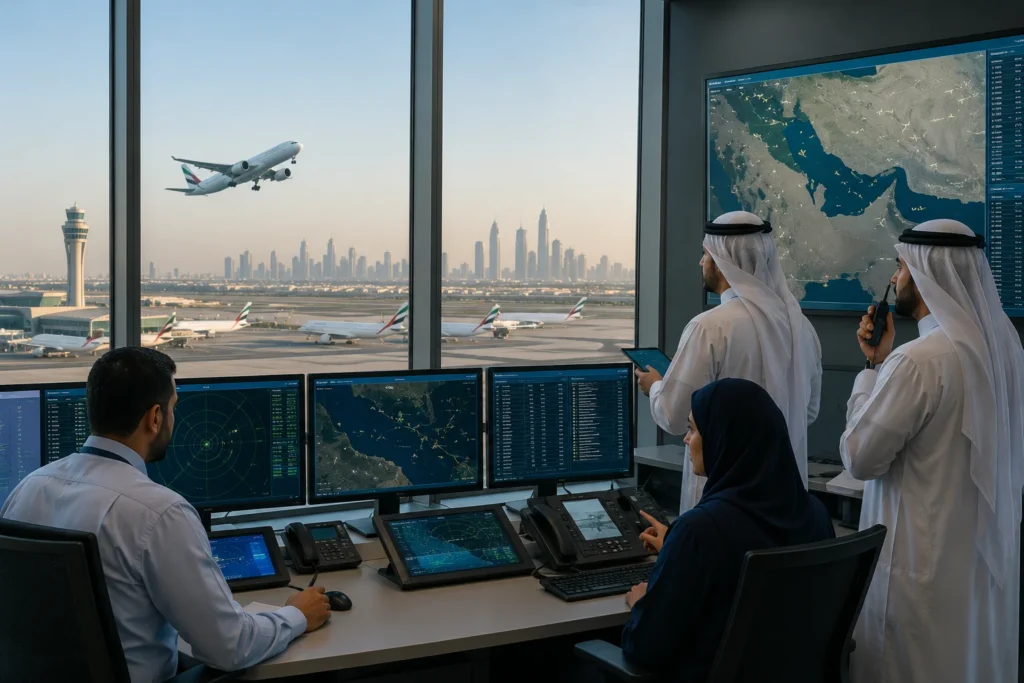
Despite the sudden elevation in geopolitical monitoring, international civil aviation corridors spanning the Arabian Peninsula continue to manage scheduled global transit robustly. National civil aviation boards and international safety compliance networks confirm that primary international air hubs remain fully functional. Travelers navigating cross-continental itineraries are experiencing orderly operations, with standard flight routing parameters remaining firmly intact across major administrative zones.
Major regional carriers, including Saudia, Emirates, Etihad Airways, Qatar Airways, and flynas, are maintaining their ordinary commercial networks without implementing emergency cancellations or structural schedule adjustments. Airline operations managers are working in direct coordination with the Saudi General Authority of Civil Aviation (GACA) and parallel international airspace regulators. Flight dispatch teams are utilizing standard, pre-established tactical routing to bypass restricted administrative corridors, ensuring that commercial passenger lanes remain entirely separated from shifting security perimeters in the lower Red Sea zone.
Impact on Regional Travel Corridors and Tourism Infrastructure
The timing of the security alert intersects directly with a high-volume travel season for the southern territories of the kingdom. Abha International Airport serves as the central gateway to the Aseer region, which is currently hosting its prominent summer tourism season. Data published by the regional airport operations agency, Cluster2 Airports Company, indicates that the facility is projected to handle roughly 10,000 scheduled flights and manage over 1.8 million passenger seats between June and August. This growth is anchored by extensive year-round connections linking Abha to domestic cities like Riyadh and Jeddah, as well as international hubs including Dubai, Sharjah, Doha, Cairo, and Istanbul.
Civil tourism authorities have confirmed that local infrastructure, hospitality sectors, and seasonal cultural exhibitions in the mountainous Asir region continue to welcome visitors without operational setbacks. While regional safety alerts inevitably draw attention from global travel insurance underwriters and aviation risk groups, the immediate resilience of the domestic transport sector underscores the efficacy of the modern air defense umbrellas protecting the primary urban and cultural corridors of the Gulf Cooperation Council (GCC) nations.
Evolving Regional Context and Institutional Safety Frameworks
The airspace defense incident follows a complex administrative dispute involving civil aviation access in neighboring Yemeni territories. The internationally recognized government of Yemen, based out of the southern port of Aden, confirmed that its sovereign defense forces had previously restricted access to the runway at Sana’a International Airport. According to official statements from the Yemeni Ministry of Defence, the tactical runway restriction was enforced to prevent unauthorized international flights from entering the national territory outside the legal, statutory frameworks governing international civil aviation agreements.
In response to the subsequent cross-border responses launched from Houthi-controlled zones, international institutions have moved swiftly to preserve general civil stability. At an emergency assembly convened by the United Nations Security Council in New York, Assistant Secretary-General for Political Affairs Khaled Khiari emphasized that regional transit channels must remain insulated from localized friction. The UN envoy’s office has called on all regional actors to engage constructively under established international diplomatic auspices to preserve the relative systemic calm that has characterized the Arabian Peninsula’s main travel and trade lanes since the initial truce agreements established in 2022.
Proactive Guidance for International Passengers
For global passengers scheduled to traverse the vital European-Asian aviation corridors, maintaining verified information streams is paramount. International aviation safety boards recommend several standard precautionary steps to guarantee seamless transit through the region:
Direct Schedule Verification: Passengers should check real-time flight status logs directly through their operating airline’s official digital portals prior to traveling to departure terminals.
Aviation Authority Notifications: Travelers are encouraged to review formal civil aviation updates distributed by regulatory bodies such as GACA or the UAE General Civil Aviation Authority.
Flexible Itinerary Planning: Maintaining open communication channels with registered travel agencies ensures passengers are immediately notified of any proactive tactical rerouting.
Insurance Review: Transit travelers should cross-reference policy coverages with active home country consular advisories to confirm compliance with international transit criteria.
The global aviation sector remains heavily reliant on the Middle East as a central transit powerhouse, and local civil authorities continue to enforce rigorous, multi-layered defensive frameworks to guarantee the uncompromised flow of international commerce and leisure travel.
For more travel news like this, keep reading Global Travel Wire