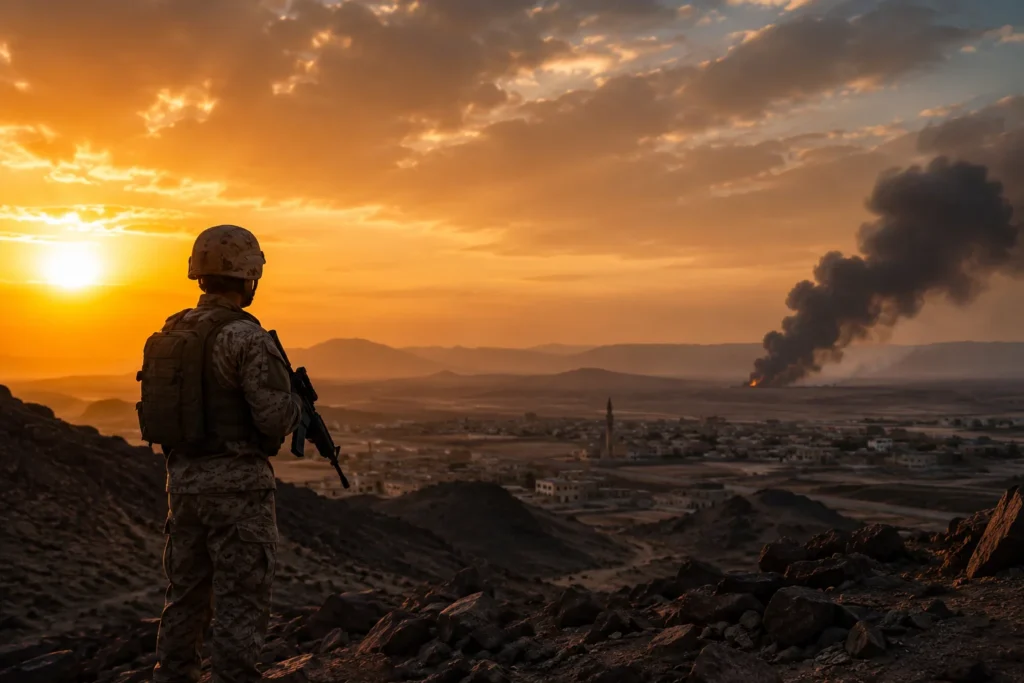
The internationally recognized government of Yemen has officially placed its military forces and domestic security services on the highest level of readiness. This emergency declaration follows a significant security operation at the Houthi-controlled Sana’a International Airport, where tactical intervention disabled the primary runway to intercept an unauthorized flight arriving from Iran. The directive underscores a heightened defensive posture across all national land, maritime, and air corridors as public safety authorities respond to the evolving regional situation.
In a comprehensive formal address convened by the Presidential Leadership Council, the President of Yemen and Supreme Commander of the Armed Forces, Dr. Rashad Mohammed Al-Alimi, detailed the strategic necessity behind the defensive actions. The executive declaration emphasized that the state framework will not tolerate sovereign airspace compromises. Government ministries have reiterated that protecting the nation’s entry ports, maritime lanes, and civil aviation architecture remains a fundamental legal obligation, necessary for safeguarding national security and the long-term well-being of the population.
Disruption at Sana’a International Airport and Airspace Management
The recent operational disruption centered entirely on the runway infrastructure of Sana’a International Airport, an aviation facility currently under Houthi administrative control. According to formal briefings from the Ministry of Defence, the pre-emptive measures were executed to prevent an inbound Iranian aircraft from landing within the capital territory outside of standard civil aviation protocols. Official communications indicate the aircraft bypassed established tracking protocols, creating severe regulatory and physical risks to regional air traffic management.
State authorities noted that prior to the runway intervention, extensive mediation efforts were pursued by regional allies to defuse the brewing civil conflict peacefully. The Yemeni government introduced multiple regulatory alternatives, which included a proposal to utilize the national flag carrier, Yemenia Airways, to transport all passengers under legitimate civil guidelines. These sovereign options were rejected by Houthi personnel, prompting the defensive airfield operations to enforce international civil aviation laws and prevent unauthorized entries.
Comprehensive Military Readiness and Port Monitoring
Following the escalation at the Sana’a facility, the Presidential Leadership Council formally instructed the Ministry of Interior, local security Directorates, and the Armed Forces to maximize domestic vigilance. Border enforcement operations, coastal patrol divisions, and defensive air networks have initiated coordinated surveillance strategies to detect and neutralize any further violations of state sovereignty. Special emphasis is being directed toward maintaining rigorous oversight across all maritime shipping lanes and alternate landing infrastructure along the Red Sea coast.
The Presidential Council stated that the deliberate bypass of sovereign frameworks represents a direct effort to entangle Yemen in broader, external conflicts that undermine local stability. In response, the state has bolstered localized security perimeters around commercial assets, government institutions, and vital population hubs. Despite the heightened security protocols within military sectors, domestic administrative offices, vital supply corridors, and authorized regional transportation lines in government-secured sectors continue to function systematically under strict state monitoring.
International Civil Aviation Directives and Institutional Appeals
The sudden disruption of runway access at Sana’a International Airport has prompted immediate diplomatic and regulatory actions from international bodies. The United Nations Special Envoy to Yemen, Hans Grundberg, issued an official public briefing expressing deep concern regarding the operational stability of Yemeni airspace and associated commercial infrastructure. The UN office has initiated direct dialogue with military representatives across all domestic factions, urgin formal restraint to prevent a prolonged cycle of structural violence and to safeguard the relative calm maintained since the initial 2022 truce frameworks.
Simultaneously, the Yemeni government has formally petitioned the international community and the United Nations Security Council to implement strict enforcement of standing international mandates. The administration called for a transition from diplomatic condemnation toward active, pragmatic deterrence by enforcing UN Security Council Resolutions 2140 and 2216. Government statements underscore that a structured global enforcement strategy is essential to guarantee the regular operation of civilian transport, protect humanitarian corridors, and preserve the statutory independence of Yemeni civil institutions.
Essential Safety Information for Transiting Travelers
Given the fluid nature of the security environment and the closure of specific regional runways, international aviation authorities recommend that all travelers carefully review current flight routes crossing the southern Arabian Peninsula. The State Department and global civil aviation boards advise against arbitrary transit through non-government-sanctioned air fields within the region. Because unauthorized flight routes remain a focal point for interception, international passengers are urged to consult directly with registered global air carriers regarding alternative flight paths.
Prospective visitors and commercial logisticians must verify that all planned movements utilize verified airports that operate strictly under the legal jurisdiction of the internationally recognized Yemeni state and its regional security partners. Regional travel advisories remain elevated, and travelers should continuously monitor updates from the General Civil Aviation Authority alongside official safety briefs issued by their respective home ministries to guarantee alignment with current travel insurance mandates and border security protocols.
For more travel news like this, keep reading Global Travel Wire