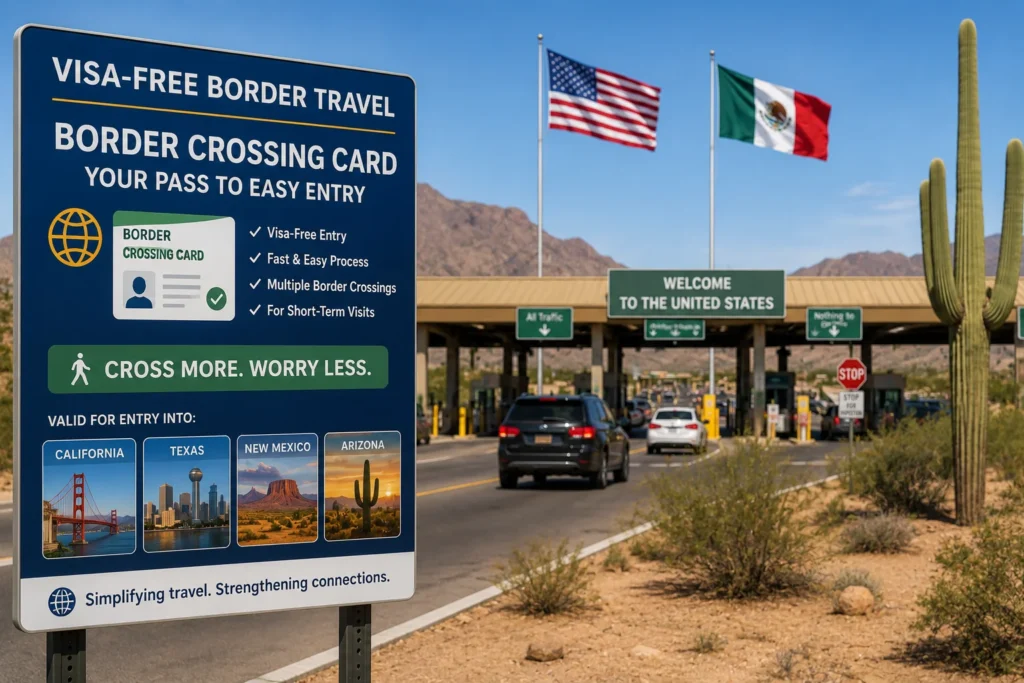
For millions of international travelers, securing a traditional physical passport and a standard visitor visa represents a mandatory, multi-step preparation phase before embarking on a journey to the United States. However, for qualifying Mexican citizens planning short-term trips to the southwestern United States, a specialized government program offers a highly streamlined alternative.
According to official regulations outlined by the U.S. Department of State and U.S. Customs and Border Protection, travelers who possess a valid Border Crossing Card can legally cross the southern land border without needing to present a traditional passport book or a standard visa stamp. This unique credit-card-sized document, officially referred to as Form DSP-150, serves as a powerful tool to facilitate cross-border tourism, retail commerce, and family visits.
Understanding the specific rules, geographic boundaries, and application requirements is essential for travelers looking to maximize the convenience of this specialized travel credential.
Understanding the Border Crossing Card and How It Functions
The Border Crossing Card is a laminated, high-tech identity card that serves a dual purpose. Created in cooperation between the U.S. Department of State and the Department of Homeland Security, the modern version of the card functions simultaneously as a B1/B2 visitor visa and a localized border crossing permit.
Designed with advanced security features, including biometric identifiers and integrated contactless technology, the card is specifically crafted to make inspections at southwestern ports of entry faster and more secure.
When used as a standalone document—meaning the traveler does not present a passport alongside it—the card permits eligible individuals to enter the United States directly from Mexico. However, this standalone privilege is strictly limited to entries made via land ports, pleasure vessels, or passenger ferries.
Geographic and Temporal Limits in the Four Border States
While the Border Crossing Card offers unparalleled convenience, U.S. Customs and Border Protection maintains strict boundaries regarding how far and how long a traveler can visit using the card alone. Standalone entry is intended specifically for short-term visits within the designated “border zone.”
The geographic limitations vary slightly depending on which border state you enter:
California: Visitors entering through California ports of entry must remain within 25 miles of the international border.
Texas: Travelers crossing into Texas are likewise restricted to a maximum distance of 25 miles from the border.
New Mexico: The 25-mile limit also applies to entries made along the New Mexico border corridor.
Arizona: Recognizing the unique geographic layout of the region, federal guidelines permit travelers entering through Arizona to venture up to 75 miles north of the border.
In addition to these geographical boundaries, standalone cardholders are permitted to remain in the United States for a maximum duration of 30 days per visit.
Unlocking Greater Travel Flexibility with a Valid Passport
One of the most significant advantages of the Border Crossing Card is its versatility. While it functions beautifully as a standalone card for quick shopping trips or local family visits within the border zone, it can easily be upgraded to act as a full-fledged B1/B2 visa.
If a traveler presents their valid Border Crossing Card in tandem with a valid Mexican passport, the geographic and transport limitations are immediately lifted. When accompanied by a passport, the card meets all legal requirements for entry via air travel and allows the holder to travel anywhere within the United States.
Furthermore, travelers wishing to stay longer than 30 days or venture beyond the 25-mile or 75-mile boundaries can request an electronic Form I-94 (Arrival/Departure Record) from CBP officers at the port of entry. With an approved Form I-94, cardholders can typically remain in the country for up to six months for temporary business or leisure travel.
Key Eligibility and Application Requirements
Because this program is designed to support regional cross-border communities, the U.S. government restricts eligibility to specific applicants. To successfully qualify under the official Border Crossing Card requirements, applicants must meet the following criteria:
Citizenship and Residence: The applicant must be both a citizen of Mexico and a current resident of Mexico.
Passport Possession: All applicants must have a valid Mexican passport at the time they submit their application.
Ties to Mexico: Just like standard B1/B2 visa applicants, individuals must demonstrate strong binding ties to Mexico—such as employment, property, or family—that would compel them to return home after a temporary stay.
Applications must be submitted through the official consular sections of the U.S. Embassy and Consulates located throughout Mexico. For adult applicants, the issued card is generally valid for a period of ten years, providing long-term, hassle-free travel access. Reduced application fees and custom validity periods are also available for qualifying children under the age of 15.
By offering a highly efficient path for short-term tourism, the Border Crossing Card program continues to serve as an invaluable bridge, bolstering the local economies of California, Texas, New Mexico, and Arizona while honoring the deep cultural and familial ties shared across the border.
For more travel news like this, keep reading Global Travel Wire