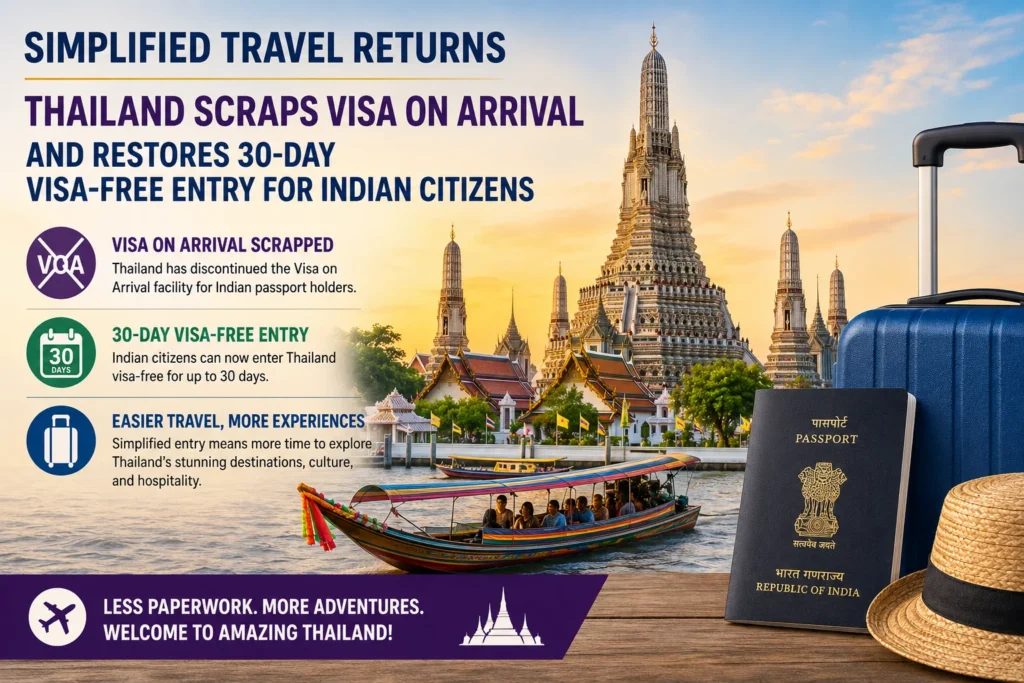
The landscape of Southeast Asian tourism has witnessed a series of rapid policy adjustments over the past few months, as governments work to strike a delicate balance between welcoming high-value holidaymakers and maintaining robust border security. In a highly anticipated move, the Thai Cabinet officially reversed its previous decision to end visa exemptions for Indian passport holders.
Following an brief transition toward a paid Visa on Arrival (VOA) system in May 2026, Thailand has restored its popular visa-free entry policy for Indian citizens, though with a newly adjusted stay limit of 30 days. This major policy update removes financial and administrative hurdles for short-term holidaymakers, making quick tropical getaways to Bangkok and Phuket remarkably easy once again.
Why the Thai Government Restored Visa-Free Access
In May 2026, a sweeping proposal was approved by the Thai Cabinet to reduce the number of visa-exempt nations from 93 down to 54. Under that initial framework, Indian travelers lost their generous 60-day visa-free entry and were reassigned to the paid Visa on Arrival category, which required paying a 2,000 THB (approximately ₹5,000 INR) fee at the airport.
However, official data from the Ministry of Tourism and Sports quickly revealed a noticeable drop in arrivals from India, which represents Thailand’s third-largest global tourism market behind only China and Malaysia. Recognizing the immense economic impact of this drop, tourism officials moved quickly to reverse course.
The revised, Cabinet-approved policy scales back the previous 60-day visa-free stay window to a more manageable 30-day limit. According to ministry statements, the new 30-day stay limit is designed to better align with the natural travel behaviors of Indian tourists, who typically plan vacations lasting between 5 and 14 days.
At the same time, shortening the stay window from 60 to 30 days helps the government address domestic concerns regarding visa misuse, such as foreign nationals working without authorization or border-hopping to continuously reset their tourist stamps.
The Role of the Thailand Digital Arrival Card (TDAC)
While travelers no longer need to pay for a visa at the border, they must still comply with mandatory digital arrival procedures. The Thailand Digital Arrival Card (TDAC), which has been in active use since its rollout on May 1, 2025, has been given renewed priority as a critical tool for border management.
The TDAC is not a visa, nor does it guarantee entry; rather, it is a digital pre-arrival registration system designed to phase out old-fashioned, paper-based TM6 arrival cards. All foreign travelers entering Thailand by air, land, or sea must complete this electronic declaration prior to their arrival.
To complete the form, travelers must log onto the official Thai immigration portal within 72 hours of their departure. The registration requires basic personal details, flight data, passport details (valid for at least six months beyond the return date), and confirmed accommodation details in Thailand.
Upon submission, the system generates a digital QR code, which travelers must save or print to present to immigration officers upon arrival. The TDAC is completely free of charge when accessed through the official government portal.
Boosting Year-Round Travel and Flight Connectivity
The restoration of visa-free entry is expected to help the Tourism Authority of Thailand (TAT) meet its ambitious goal of welcoming 2.55 million Indian tourists annually. To support this massive influx, airlines are aggressively expanding direct flight capacity between the two nations.
Aviation data indicates that flight capacity between India and Thailand has expanded by 15 percent over the last year, with ten commercial airlines currently operating active routes. National carrier Thai Airways has also announced plans to launch and scale up direct routes connecting Bangkok with major Indian regional cities, including Amritsar, Jaipur, and Kochi.
To encourage repeat visits, the TAT is heavily promoting experiential, wellness, and destination weddings, alongside lesser-known, culturally rich cities beyond traditional hubs like Pattaya and Bangkok.
How Other Southeast Asian Destinations Are Managing Entry
Thailand is not alone in utilizing digital solutions to manage rising visitor numbers. Neighboring nations across Southeast Asia have introduced similar digital travel cards to streamline entry, automate health monitoring, and safeguard borders:
Malaysia: Offers a convenient 30-day visa-free stay, backed by the mandatory digital registration of the Malaysia Digital Arrival Card.
Cambodia: Has unified its immigration, customs, and health screening protocols into a single, cohesive e-Arrival Card.
Vietnam: Requires travelers to submit digital arrival declarations at major aviation gateways, including Hanoi’s Noi Bai Airport and Ho Chi Minh City’s Tan Son Nhat Airport.
Indonesia: Under its unified “All Indonesia System,” the nation requires travelers to secure a visa on arrival alongside a mandatory digital health and customs declaration. Indonesian immigration authorities are also intensifying monitoring to clamp down on foreign nationals attempting to engage in unauthorized commercial activities or illegal online operations.
For Indian travelers planning their next getaway, the return of visa-free access to Thailand provides welcome flexibility. By completing the digital TDAC registration 72 hours before their flight, travelers can ensure a seamless, paperless immigration experience at the border, allowing them to make the most of their tropical escape.
For more travel news like this, keep reading Global Travel Wire