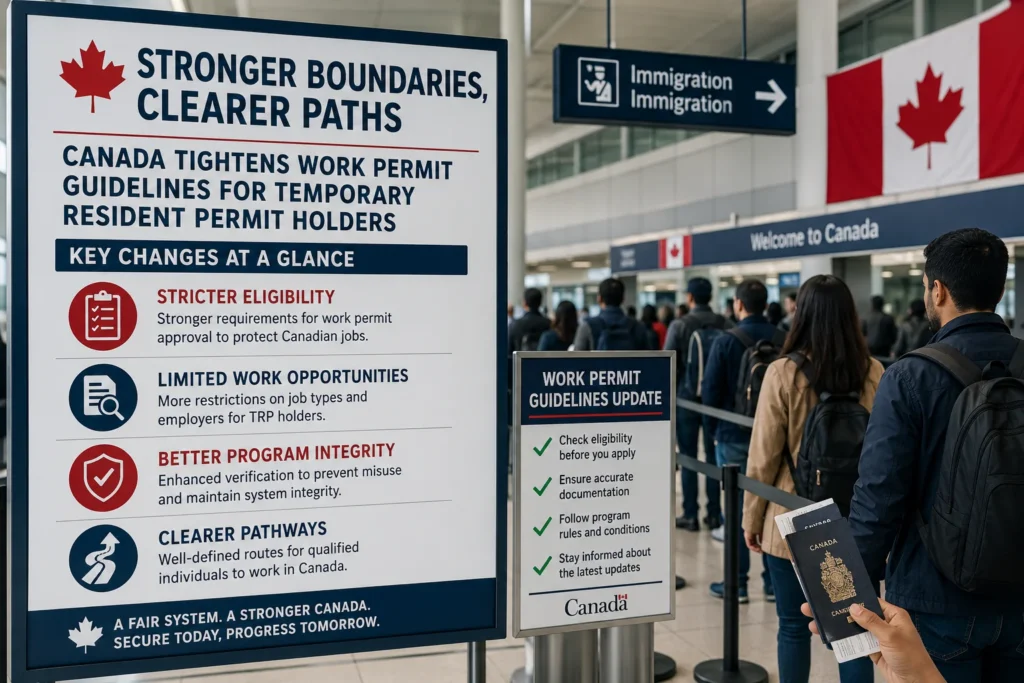
The regulatory framework governing temporary immigration in Canada is undergoing targeted refinement to ensure consistency, transparency, and administrative integrity. In a significant administrative development, Immigration, Refugees and Citizenship Canada (IRCC) has issued an official program-delivery update that reshapes how immigration officers process open work permit applications submitted by Temporary Resident Permit (TRP) holders.
The updated guidance directly impacts individuals applying under Immigration Regulation 208(b), specifically utilizing administrative code H82. Designed to bring greater clarity to both applicants and employers, the new operational directives establish a strict standard for permit validity, outline clear rules for family members, and simplify the financial and documentary processes involved in transitioning temporary residents into the Canadian labor market.
Implementing the Strict Six-Month Single Permit Rule
The most significant change introduced by the immigration update is the strict enforcement of the six-month validity threshold. Under the updated guidelines, stacking or combining multiple shorter-duration TRPs to meet the minimum stay requirement is no longer permitted.
To qualify for an open work permit, the single humanitarian-based TRP currently held by the applicant must be valid for at least six months on the exact date their work permit application is officially received by IRCC. This policy modification ensures that only those with a stable, mid-term authorized stay are granted access to the Canadian workforce, reducing short-term administrative turnover and ensuring a more secure pathway for vulnerable or transitional residents.
Individual Assessment Mandatory for Family Members
In a bid to maintain rigorous case-by-case processing, the IRCC update explicitly clarifies that spouses, common-law partners, and dependants are not automatically covered under the principal applicant’s TRP status.
Should family members of a TRP holder wish to seek employment in Canada, they cannot ride on the coattails of the primary permit. Instead, each family member must independently qualify for their own status and submit separate applications. This independent qualification requirement prevents umbrella approvals and ensures that every individual residing and working in Canada meets the federal government’s specific entry, identity, and security benchmarks.
Correct Fee Strategies and Proactive Refund Instructions
Recognizing the administrative delays caused by incorrect payment submissions, the new directives provide explicit processing instructions regarding government fees. Because applications filed under administrative code H82 are legally exempt from the standard CAD 100 open-work-permit-holder fee, IRCC is guiding applicants to follow a precise financial strategy.
To prevent processing bottlenecks, officers have been instructed to automatically refund the CAD 100 fee if an applicant pays it in error. To ensure the fastest possible processing times, the official guidelines recommend that applicants pay the mandatory CAD 155 processing fee “outside the portal” and manually upload the receipt to their online application package. This proactive approach helps avoid the technical delays often associated with standard payment processing systems.
Flexible Proof of Support and Accountable Decision-Making
On an operational level, the update provides immigration officers with broader discretion regarding the types of documentation they can accept as proof of financial need. To qualify for an open work permit under this stream, applicants must demonstrate that they cannot reasonably support themselves without gaining active employment in Canada.
Under the new directives, officers can now accept a wider, more realistic range of supporting evidence, including:
Comprehensive personal bank statements
Official letters confirming the receipt of social assistance
Detailed, legally sworn affidavits outlining the applicant’s financial circumstances
While this flexibility is designed to make the system more accessible to genuine applicants, it is balanced by a parallel demand for administrative accountability. Officers are now required to record highly detailed notes in the Global Case Management System (GCMS) for any application that results in a refusal. This requirement ensures absolute transparency and provides a robust, legally defensible paper trail in the event of future judicial reviews or appeals.
Promoting Compliance and Faster Labor Market Integration
For Canadian businesses, legal counsel, and community organizations—particularly those assisting victims of human trafficking or individuals in unique humanitarian circumstances—the clarified guidelines provide a highly anticipated roadmap. By replacing discretionary, unpredictable criteria with clear, objective rules, qualifying TRP holders can now expect realistic processing timelines of approximately eight to ten weeks to secure an open work permit.
This operational efficiency allows corporations and local support groups to seamlessly transition skilled and motivated individuals into the formal workforce. This structured pathway not only strengthens compliance for employers but also provides temporary residents with the vital financial stability, independence, and dignity required to successfully navigate their transition into Canadian society.
For more travel news like this, keep reading Global Travel Wire