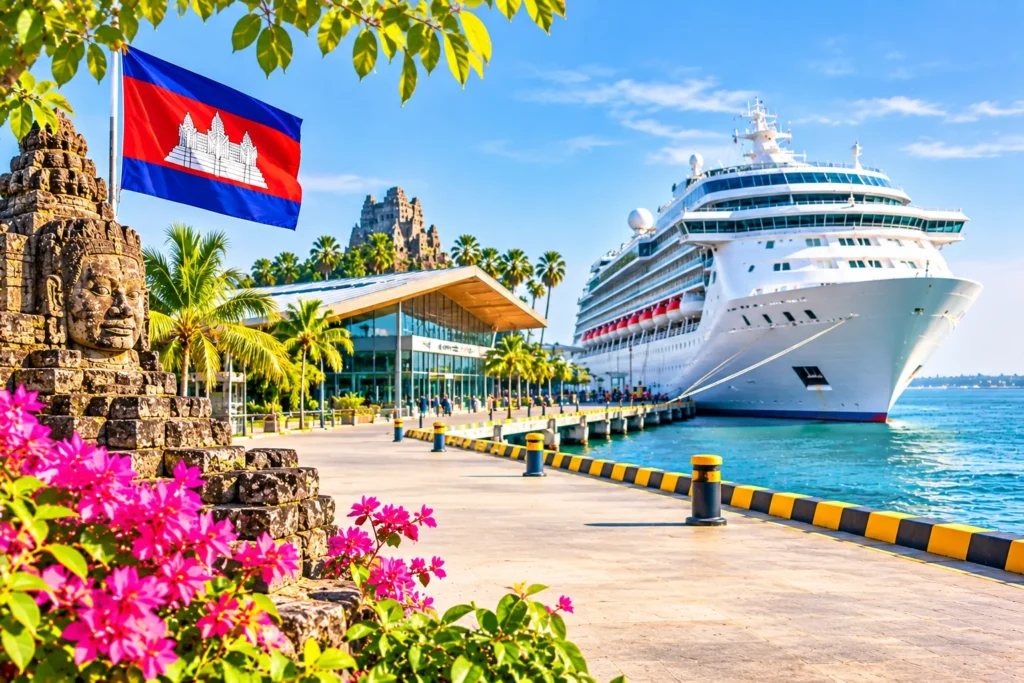
Cambodia’s coastal visitor infrastructure has demonstrated remarkable operational capacity following the sudden operational suspension of an international residential cruise vessel at the deep-water port of Sihanoukville. The maritime vessel, identified as the MV Odyssey and managed by United States-based operator Villa Vie Residences, departed Cambodian sovereign waters with only operational personnel aboard, having concluded its scheduled itinerary along the Gulf of Thailand under extraordinary commercial circumstances. Official administrative releases from regional government directorates and provincial port bodies confirm that local tourism infrastructure responded swiftly, ensuring that arriving international travelers received immediate civic coordination, accommodation options, and seamless transit assistance.
Official public statements delivered by the Tourism Department of Preah Sihanouk province confirmed that the vessel set sail from Sihanoukville after disembarking more than two hundred international passengers. While maritime logistics and global supply chain pressures abruptly halted the ship’s intended multi-year global voyage, Cambodian regional authorities took proactive measures to ensure the welfare of international travelers on domestic soil. Provincial tourism leadership stated that approximately one hundred passengers elected to extend their stay in coastal Sihanoukville to experience regional hospitality, while numerous others transitioned smoothly toward inland heritage destinations or coordinated forward regional departures through international aviation gateways.
According to official briefings provided by provincial tourism administrators, national authorities treated the unexpected disembarkation as an opportunity to demonstrate the agility and hospitality of the kingdom’s tourism sector. Sihanoukville, which serves as Cambodia’s premier international deep-sea maritime gateway, has undergone substantial modernization under national tourism master plans. The municipal area features expanded multi-lane coastal road networks, modern hospitality accommodations, and streamlined border administration designed to handle cruise ship passenger flows efficiently. Provincial tourism officials noted that municipal visitor service desks assisted departing cruise guests with logistics, local lodging options, transport connections, and regional guided tour opportunities.
The operational disruption stemmed directly from acute global economic pressures within the commercial maritime sector. Formal company disclosures released by the vessel’s management explained that unprecedented escalations in international marine fuel costs made the continuation of the residential itinerary economically untenable. Operating assessments indicated that monthly fuel allocations per residential suite, which historically averaged approximately eighteen hundred US dollars, escalated dramatically to between six thousand and eight thousand US dollars in Asian maritime corridors. In commercial statements addressing the operational pause, company leadership noted that conservation strategies, including speed reductions and prolonged berthing intervals, were insufficient to counter the regional surge in marine fuel expenses.
Despite the commercial challenges facing the vessel’s operator, the presence of the international travelers provided an immediate boost to Cambodia’s regional visitor economy. Official government tourism statistics published by the Ministry of Tourism emphasize that international visitor arrivals represent a vital pillar of national economic development. The coastal zone of Preah Sihanouk province, alongside the cultural epicenter of Siem Reap and the capital of Phnom Penh, forms a primary strategic triangle for inbound holidaymakers. Government statements indicate that many disembarked cruise travelers chose to redirect their travel plans into cultural heritage excursions, booking domestic transit to explore the archaeological wonders of Angkor Archaeological Park and regional ecotourism reserves in the Cardamom Mountains.
Cambodia’s official maritime tourism strategy has prioritized the development of port facilities capable of hosting diverse passenger vessels, ranging from boutique expedition ships to large-scale global cruisers. Ministry of Tourism directives underline that cruise tourism generates high direct expenditures for local transport operators, registered artisanal markets, community dining venues, and certified national tour guides. The seamless handling of the MV Odyssey passengers by local immigration officers and provincial tourism departments underscores the effectiveness of inter-agency crisis management protocols established across the kingdom’s commercial ports.
Furthermore, national authorities highlighted that coastal Cambodia offers a tranquil, modern destination for long-stay visitors and retirees seeking warm-weather travel. With miles of sandy beaches along the Gulf of Thailand, pristine offshore islands such as Koh Rong and Koh Rong Sanloem, and newly opened luxury resort enclaves, the coastal belt is actively promoted by the government as a sustainable marine tourism hub. The willingness of dozens of international passengers to remain in Preah Sihanouk province following the vessel’s departure reflects positive visitor confidence in local safety, administrative hospitality, and regional lifestyle appeal.
As international maritime shipping continues to navigate volatile global fuel markets and shifting operational economics, Cambodia’s coastal tourism sector has proven its capability to handle complex transit contingencies with professional grace. By combining modern port facilities, transparent civic management, and warm traditional hospitality, the kingdom has reaffirmed its position as a reliable, welcoming destination for international maritime travelers navigating the waters of Southeast Asia.
For more travel news like this, keep reading Global Travel Wire