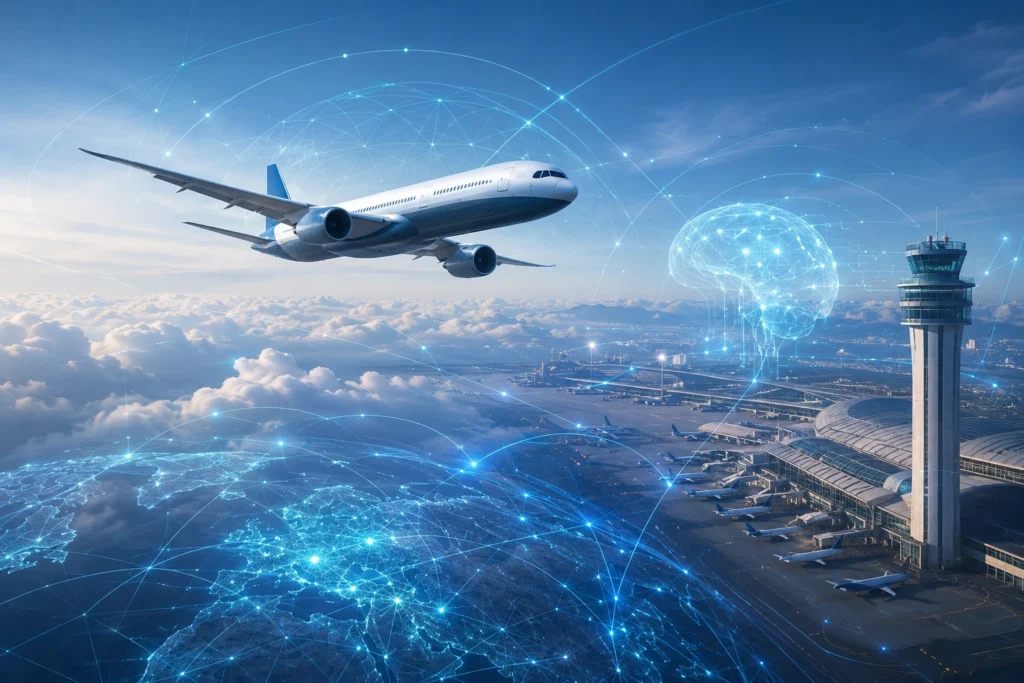
AI flight monitoring is rapidly becoming one of the most important forces in global aviation, quietly changing how airlines, airports, and aviation authorities manage the passenger journey from departure planning to arrival. While travelers still focus on tickets, baggage, security, gates, and boarding times, artificial intelligence is increasingly working behind the scenes to analyze flight performance, forecast disruptions, support maintenance decisions, and improve operational reliability.
The transformation marks a major shift for international air travel. Instead of relying only on historical records and manual decision-making, airlines and airports are moving toward predictive systems that can process large volumes of aviation data in near real time. For passengers, the change may feel subtle. For the travel industry, however, it could reshape punctuality, safety oversight, airline efficiency, airport capacity, and the overall traveler experience.
Airlines Move Toward Predictive Operations
For decades, airline operations depended heavily on fixed schedules, human analysis, and reactive responses to delays or technical issues. Today, artificial intelligence is helping carriers move faster by examining aircraft, airport, weather, crew, and traffic data together.
This matters because modern aviation is a tightly connected global system. A late aircraft in one city can affect connecting passengers, crew rosters, hotel arrivals, airport transfers, cruise embarkations, and onward domestic flights. By identifying early signs of disruption, AI-supported systems can help airlines make decisions before passengers feel the full impact.
Aviation authorities have also recognized that artificial intelligence is becoming part of the future aviation ecosystem. Current official aviation safety frameworks continue to emphasize human oversight, reliability, transparency, and careful assurance before advanced AI tools become deeply embedded in critical operations.
Flight Data Becomes a Powerful Travel Tool
Modern aircraft generate extensive operational information during every journey. Data linked to speed, altitude, fuel use, engine performance, weather, route conditions, navigation patterns, and airspace congestion can now be reviewed far more quickly than in the past.
AI systems use this information to detect patterns that may not be visible through traditional monitoring alone. Airlines can assess whether a flight is operating efficiently, whether a route could be improved, or whether a later schedule could be affected by conditions building elsewhere in the network.
For the tourism sector, this has wider value. More reliable air operations support hotel occupancy, destination planning, meetings and events, airport retail, ground transport, and visitor satisfaction. When flights operate with fewer surprises, destinations gain stronger confidence in visitor flows.
AI Helps Predict Delays Earlier
Delay prediction is one of the clearest ways AI is changing passenger travel. Instead of waiting until a disruption has already affected the departure board, airlines can use data models to evaluate weather forecasts, aircraft rotations, airport congestion, air traffic conditions, and crew availability.
This allows carriers to anticipate where pressure may build in the system. They can adjust schedules, move aircraft, update passengers earlier, and coordinate airport resources more effectively.
For travelers, earlier information can reduce stress. A family connecting to an international holiday, a business traveler heading to a conference, or cruise passengers trying to reach a port city all benefit when airlines can identify risks sooner and offer clearer options.
Predictive Maintenance Strengthens Reliability
AI is also changing aircraft maintenance. Traditional maintenance programs remain essential, but predictive tools can add a new layer of insight by analyzing aircraft sensor data for early signs of wear or performance changes.
This can help maintenance teams address potential issues before they cause schedule disruptions. The result may include better aircraft availability, fewer unexpected technical delays, and stronger operational resilience during peak travel seasons.
For airlines, this supports cost control and fleet planning. For passengers, it can mean fewer last-minute aircraft changes, fewer cancellations, and a smoother journey through busy aviation hubs.
Smarter Routes Support Efficiency and Sustainability
Fuel remains one of the largest operating costs for airlines, and route efficiency is central to aviation economics. AI-supported systems can evaluate wind patterns, weather movement, airspace congestion, and flight paths to recommend more efficient routing.
Even small improvements can matter across thousands of flights. Better route planning can support lower fuel consumption, improved on-time performance, and reduced operational waste. As governments and aviation authorities place greater focus on sustainability, intelligent route optimization is becoming more important for airlines and destinations alike.
This also affects tourism competitiveness. Destinations with efficient air access are better positioned to attract international visitors, support stopover traffic, and strengthen aviation-linked economic growth.
Airports Become Smarter Travel Hubs
The impact of AI extends well beyond aircraft. Airports are increasingly using intelligent systems to manage passenger flow, baggage handling, gate allocation, runway use, security queues, and terminal congestion.
These systems are especially valuable during holiday peaks, major events, weather disruption, or sudden surges in passenger demand. By detecting bottlenecks earlier, airports can move staff, adjust gates, improve baggage operations, and support smoother terminal experiences.
Smart airport development is now an important part of global aviation competition. Travelers increasingly judge destinations not only by attractions and hotels but also by the ease of arrival and departure.
Passenger Experience Enters a New Phase
AI is also influencing how airlines communicate with travelers. Data tools can help identify passengers at risk of missed connections, recommend alternative flights, improve disruption messaging, and provide more accurate journey updates.
However, this shift also brings responsibility. Passenger data must be handled transparently and in line with privacy rules. Aviation’s future will depend not only on smarter systems but also on public trust.
The Future of Air Travel Is Predictive
Artificial intelligence is not replacing pilots, controllers, engineers, or airline professionals. Instead, it is becoming a powerful support system that helps aviation teams anticipate problems, improve decisions, and manage complex travel networks more effectively.
For global tourism, the implications are significant. More predictive aviation can support stronger destination access, smoother visitor movement, better airline performance, and improved confidence across hotels, airports, attractions, cruise operators, and local economies.
Much of this transformation will remain invisible to passengers. Yet when a flight avoids a delay, a maintenance issue is solved early, a route becomes more efficient, or an airport moves travelers more smoothly, AI flight monitoring may already be helping shape the journey.
For more travel news like this, keep reading Global Travel Wire