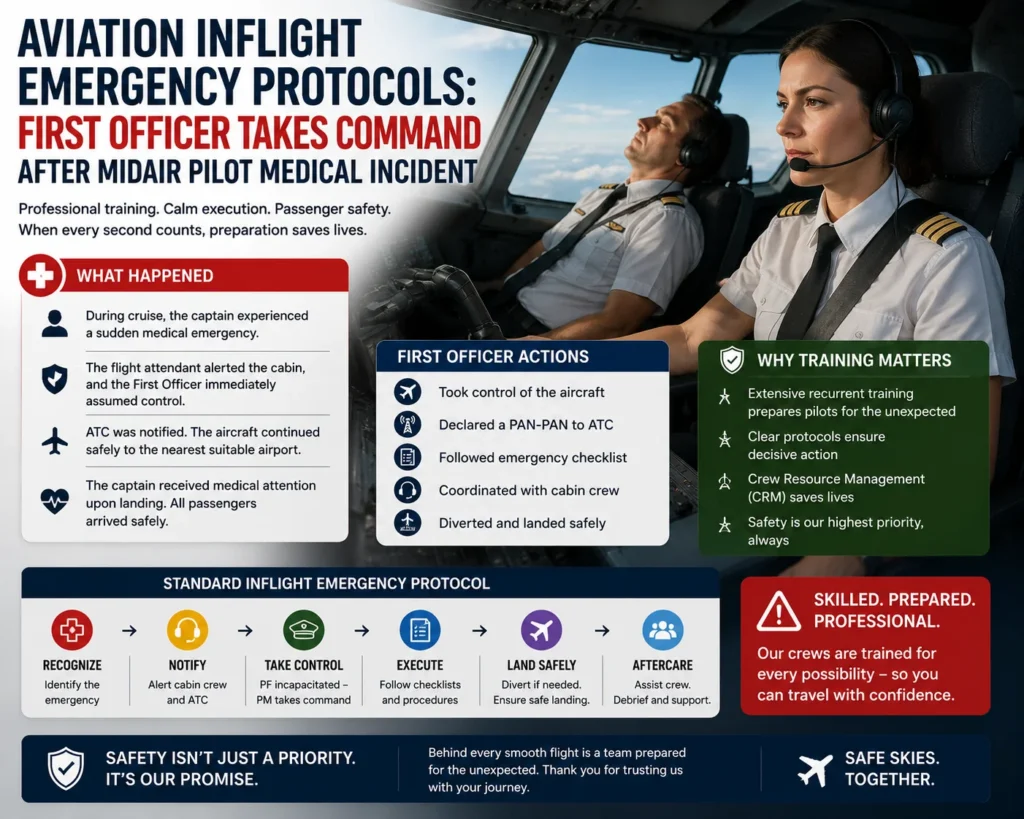
A commercial regional flight operating under the Air Canada network was forced to execute an immediate emergency diversion to Boston Logan International Airport following a sudden medical crisis in the cockpit. Official safety reports released by aviation authorities confirm that the captain of the aircraft became incapacitated mid-flight, requiring the first officer to assume sole control of the flight deck. The sudden incident activated rigid emergency operating frameworks designed to protect passenger transit networks and maintain high safety standards across the international aviation corridor.
The aircraft, a De Havilland Q400 turboprop operating as Flight AC7664, was en route from Newark Liberty International Airport in New Jersey to Halifax Stanfield International Airport in Nova Scotia, Canada. The regional flight, which was being operated by Air Canada’s regional partner PAL Airlines, was carrying 61 passengers and four crew members. Approximately 30 minutes after its standard midday departure, while cruising along the Atlantic coast, the flight deck environment changed dramatically when the commanding pilot experienced a severe, unpredicted medical episode that rendered him unable to perform piloting duties.
Immediate First Officer Intervention and Flight Deck Evacuation Procedures
According to formal statements released by airline representatives and verified by federal transport logs, the flight crew moved swiftly to implement mandatory emergency handling procedures. As soon as the captain exhibited symptoms of acute physical distress, cabin crew members rushed to the flight deck to assist. In strict compliance with international safety mandates, the incapacitated captain was carefully removed from the primary flight controls and escorted out of the cockpit into the forward cabin galley.
A registered nurse who happened to be traveling as a passenger on the flight volunteered to assist the onboard crew, providing immediate first-aid evaluation and stabilizing the stricken pilot in the aisle. With the captain removed from the controls, the first officer took absolute operational command of the twin-engine aircraft. Commercial airline pilots undergo exhaustive simulator testing to ensure they can manage high-density terminal environments completely unaided, a design redundancy that proved vital to ensuring a safe outcome for the 61 travelers on board.
Air Traffic Control Reroutes Regional Traffic for Urgent Priority Landing
The first officer immediately broadcast an urgency declaration to regional air traffic control centers, requesting an immediate diversion to the nearest high-capacity airport facility. Federal Aviation Administration logs indicate that Boston Logan International Airport was selected as the optimal diversion hub due to its advanced emergency infrastructure and proximity to world-class medical centers. Air traffic controllers at the Boston facility responded by initiating wide-scale traffic separation protocols, clearing a direct approach path for the incoming regional turboprop.
To facilitate an unobstructed arrival, tower controllers temporarily closed Runway 27 to all standard commercial departures and arriving international traffic. Ground controllers issued radio warnings to neighboring aircraft, advising them that a priority emergency vessel was inbound and might require extended runway occupancy time upon touchdown. The first officer successfully hand-flew the aircraft through the descent profile, managing the descent checklists, mechanical configurations, and radio communications without external assistance.
Emergency Medical Mobilization and Passenger Accommodations on the Ground
The aircraft touched down safely at Boston Logan International Airport at approximately 2:00 p.m. Eastern Daylight Time, roughly one hour after its initial departure from New Jersey. The emergency diversion triggered an immediate, highly coordinated ground response from local public safety agencies. Massport Fire Rescue vehicles and specialized Boston EMS crews were already stationed at emergency standby positions along the runway, trailing the aircraft as it completed its deceleration roll.
Paramedics boarded the aircraft immediately after it came to a halt on the taxiway, stabilizing the captain before transferring him via stretcher to a waiting ambulance. He was rushed to Massachusetts General Hospital for specialized professional care. Following the medical evacuation, the aircraft was towed to a designated passenger terminal gate, where the remaining 61 passengers safely deplaned into the transit lounge. Because the diversion represented an unscheduled international stopover between the United States and Canada, station managers worked in tandem with border protection agencies to process the passengers cleanly while preserving federal customs integrity.
Strict Training Mandates Protect Public Trust in Global Air Travel
The successful resolution of Flight AC7664 serves as a strong demonstration of the extensive pilot screening and dual-crew safety policies that govern global commercial aviation. Transport ministries maintain rigid medical qualification baselines for commercial pilots, requiring biannual physical checkups to minimize the risk of midair health failures. When rare medical anomalies do occur, the presence of a fully qualified, multi-engine certified co-pilot guarantees that the aircraft remains under expert control.
Air Canada confirmed that a specialized replacement crew was mobilized to Boston later that afternoon, while ground staff arranged alternative itineraries and catering services for the stranded passengers. The original aircraft departed Boston later that evening, delivering the customers to their final destination in Halifax. While the sudden medical event caused understandable anxiety and travel delays for the passengers onboard, the flawless execution of the emergency landing highlights the structural resilience and safety emphasis embedded within modern commercial tourism networks.
For more travel news like this, keep reading Global Travel Wire