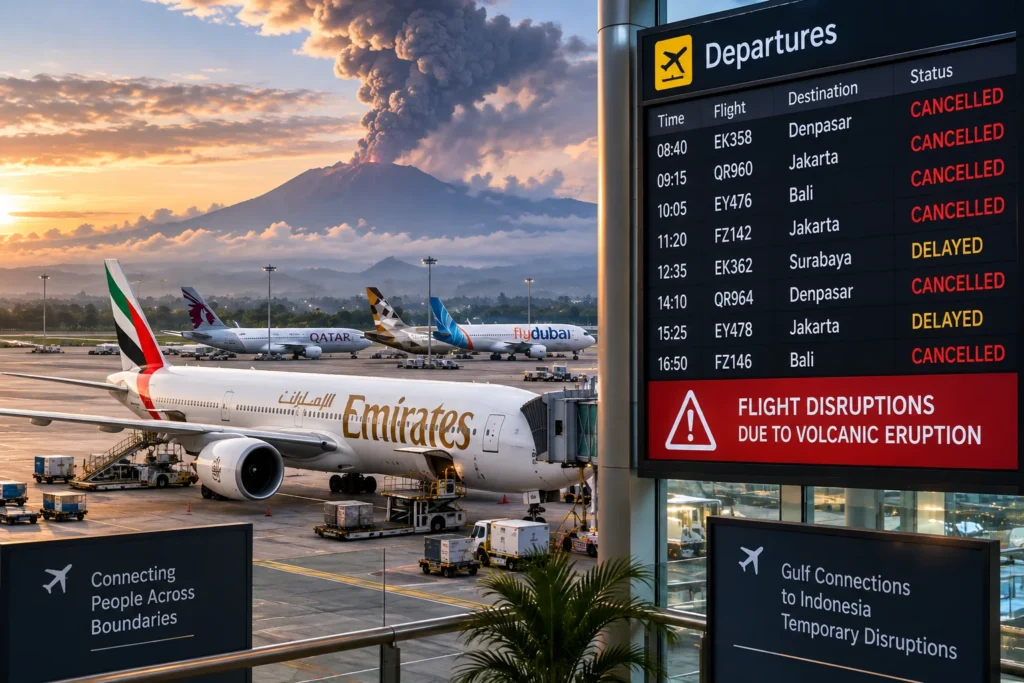
Volcanic Ash Plumes Force Flight Closures Across Major Hubs
A major volcanic event at Mount Anak Krakatau has triggered widespread disruption for long-haul air traffic connecting the Middle East and Southeast Asia. The Ministry of Transportation of Indonesia announced temporary operational suspensions across eight commercial airports, including Soekarno-Hatta International Airport in Tangerang and Halim Perdanakusuma Airport in Jakarta, after dense volcanic ash plumes drifted across key flight paths.
Satellite surveillance from the Meteorology, Climatology, and Geophysics Agency (BMKG) and the Darwin Volcanic Ash Advisory Centre detected airborne particulate clouds rising up to 50,000 feet (15,200 meters) into the atmosphere. Because microscopic volcanic ash and silicate glass can cause catastrophic engine damage and obscure flight deck visibility, civil aviation regulators initiated immediate safety closures across affected air corridors.
Airports temporarily closed or restricted under emergency safety orders include:
Soekarno-Hatta International Airport (Tangerang, Banten)
Halim Perdanakusuma International Airport (Jakarta)
Husein Sastranegara International Airport (Bandung, West Java)
Radin Inten II Airport (Bandar Lampung, Sumatra)
Secondary Regional Facilities: Pondok Cabe, Budiarto, Taufik Kiemas, and Atung Bungsu airports.
Middle Eastern Carriers Adjust Long-Haul Schedules to Jakarta
The operational suspensions have directly impacted long-haul connections operated by major Middle Eastern carriers linking transit hubs in Dubai, Abu Dhabi, and Doha with the Indonesian capital. With Soekarno-Hatta International Airport serving as a vital international gateway, scheduled intercontinental services faced cancellations, re-routings, and extended ground holds.
Emirates (Dubai International Airport): Flight operations between Dubai and Jakarta experienced schedule adjustments and flight holds, with connecting passengers from European and North American networks being advised to verify flight statuses before traveling to the airport.
Etihad Airways (Zayed International Airport, Abu Dhabi): Services operating between Abu Dhabi and Jakarta were subjected to delays and cancellations following formal notices from Indonesian air navigation authorities. Affected passengers were provided self-service rebooking options and updates via digital channels.
Qatar Airways (Hamad International Airport, Doha): The carrier issued travel advisories for several Doha–Jakarta flight sectors, warning travelers of delays, potential aircraft re-allocations, and revised departure times stemming from restricted airspace.
Official Operational Impact and Passenger Logistics
According to official press briefings from the Ministry of Transportation, the airspace closure impacted over 467 total flights and affected approximately 150,000 passengers during the disruption period. A total of 58 international services and 409 domestic routes were canceled, delayed, or diverted.
Indonesian transportation authorities directed commercial airlines to fulfill passenger rights in strict compliance with aviation service regulations. Guidance issued to airlines operating international routes requires carriers to provide:
Timely Information: Frequent and transparent status updates regarding schedule changes, expected delays, and route reassignments.
Rebooking and Refunds: Fee-free flight modifications, ticket re-issuances, or full refund options for canceled intercontinental segments.
Ground Support: Assistance with meal vouchers, refreshment distribution, and temporary hotel accommodations for stranded transit passengers.
To absorb displaced air traffic, the Directorate General of Civil Aviation designated alternative international gateways—including Juanda International Airport in Surabaya, Kertajati International Airport in Majalengka, and Yogyakarta International Airport—as primary diversion points where local atmospheric conditions remained clear.
Continuous Safety Assessments and Airspace Restoration
Indonesian aviation authorities emphasized that safety protocols dictate all operational decisions. AirNav Indonesia, in coordination with geological agencies and airport operators, is executing regular physical runway paper tests and atmospheric evaluations to monitor ash settlement levels.
The National Disaster Management Authority (BNPB) confirmed that while Mount Anak Krakatau remains at a heightened alert level, there is no tsunami risk associated with the current eruptive sequence. A strictly enforced 3-kilometer exclusion zone surrounds the active volcanic island in the Sunda Strait. Flight operations across impacted airports, including long-haul routes connecting the Gulf region, are being systematically restored as joint atmospheric testing validates safe conditions across flight corridors.
For more travel news like this, keep reading Global Travel Wire