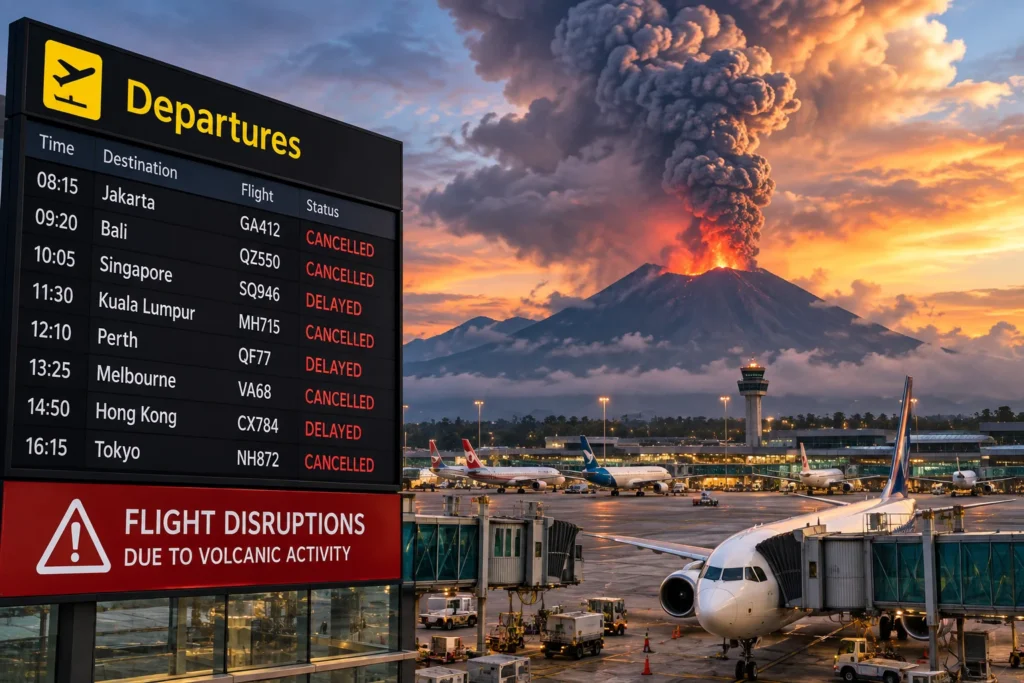
Mount Anak Krakatau Eruption Forces Widespread Airspace Closure
A significant volcanic eruption at Mount Anak Krakatau has caused severe Indonesia aviation travel disruption, leading to the temporary suspension of flight operations across key aviation gateways. Officials from the Ministry of Transportation confirmed that six regional airports halted movements after volcanic ash drifted into low and high-altitude flight corridors, creating critical safety hazards for commercial airliners.
Soekarno-Hatta International Airport in Tangerang, the country’s primary international hub, was forced to implement operational suspensions. Official data released by airport operator InJourney Airports and the Ministry of Transportation indicated that over 300 flights were impacted by early cancellations, delays, and ground holds, stranding thousands of domestic and international passengers.
Airports subjected to temporary operational closures include:
Soekarno-Hatta International Airport (Tangerang, Banten)
Halim Perdanakusuma International Airport (Jakarta)
Radin Inten II Airport (Bandar Lampung, Sumatra)
Husein Sastranegara International Airport (Bandung, West Java)
Pondok Cabe Airport (South Tangerang)
Budiarto Airport (Curug, Banten)
Volcanic Ash Dispersion Creates Critical Hazards for Commercial Aircraft
According to technical bulletins issued by the Meteorology, Climatology, and Geophysics Agency (BMKG) and the Center for Volcanology and Geological Hazard Mitigation (PVMBG), Mount Anak Krakatau experienced heightened volcanic activity culminating in sustained ash emissions. Satellite imagery captured two distinct ash plumes rising into key transit altitudes:
Java Sector Plume: Reached altitudes up to 20,000 feet (6,000 meters), spreading northeast over Banten province, Greater Jakarta, and parts of West Java.
Sumatra Sector Plume: Ascended up to 50,000 feet (15,000 meters), drifting west and northwest across Lampung province and the southern Sunda Strait.
Volcanic ash presents severe operational risks to modern jet engines. Microscopic glass and silicate particles can melt in high-temperature combustion chambers, coating internal turbine blades, reducing thrust, and potentially causing engine failure. Standard international aviation protocols dictate mandatory airspace closures whenever volcanic ash concentrations exceed safety thresholds.
Official Operational Impact and Service Recovery Actions
Figures released by InJourney Airports detailed that 301 total flights were directly impacted during the initial disruption window. The affected movements comprised:
Domestic Flights: 233 departures and arrivals canceled or delayed across regional routes.
International Flights: 58 services affected, including key long-haul and regional links to Singapore, Kuala Lumpur, Hong Kong, Guangzhou, and Sydney.
Cargo Operations: 10 dedicated freight flights suspended.
To assist affected passengers, airport authorities activated Service Recovery Activation protocols. Dedicated service desks were established at terminal facilities, while airport management, in coordination with ground handlers, distributed food and light refreshments to stranded travelers. Command posts were set up across terminals to manage crowd flow, process passenger refunds, and coordinate shuttle transportation to local accommodation.
The Ministry of Transportation designated alternative regional airfields, including Juanda International Airport in Surabaya and Ahmad Yani International Airport in Semarang, as prospective diversion points for incoming long-haul aircraft where safety conditions permitted.
Government Advisory and Mitigation Interventions
The National Disaster Management Authority (BNPB) issued a public statement reassuring travelers and residents that there is no imminent tsunami threat resulting from the current eruption phase. However, a exclusion zone remains enforced within a 3-kilometer radius of the active volcanic crater in the Sunda Strait. Maritime transport authorities confirmed that Sunda Strait ferry services between Java and Sumatra remain operational but have been instructed to maintain safe distances from the volcano.
To accelerate the clearing of suspended airborne particulate matter, the BNPB announced plans to conduct cloud-seeding weather modification operations. By inducing rainfall over affected areas in Banten and Greater Jakarta, authorities aim to wash away lingering volcanic ash, improve atmospheric visibility, and allow safe air traffic restoration.
Aviation safety authorities continue to conduct physical paper tests on airport runways to detect residual ash. Operations across the impacted facilities will resume progressively as atmospheric conditions stabilize and formal safety clearances are granted by aviation regulators.
For more travel news like this, keep reading Global Travel Wire