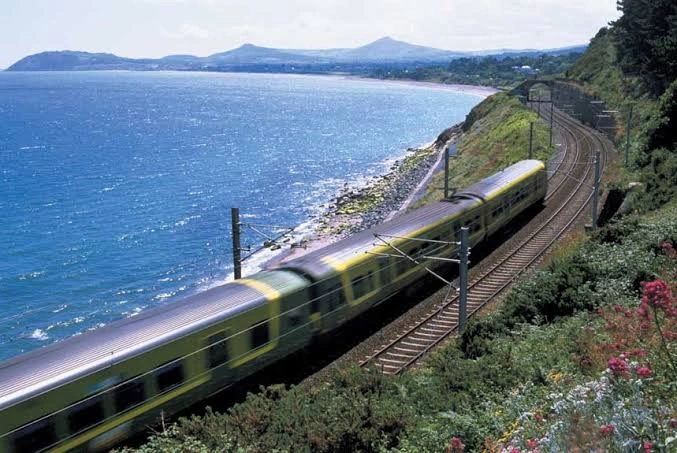
Ireland’s capital offers much more than historic streets, museums and lively city districts. One of Dublin’s most rewarding travel experiences begins on the DART railway, where passengers can leave the city centre and quickly reach harbours, beaches, seaside villages and dramatic coastal scenery.
The DART network connects central Dublin stations such as Connolly, Tara Street and Pearse with communities along Dublin Bay and farther south into County Wicklow. This makes it possible to create a flexible coastal itinerary without hiring a car.
Travelers can choose a short seaside escape, combine several stops in one day or follow the railway south for a longer scenic journey.
The greatest attraction is the contrast. Within a relatively short rail journey, urban Dublin gradually gives way to marinas, waterfront promenades, historic villages and open views across the Irish Sea.
Dún Laoghaire brings Dublin’s maritime character to life
Dún Laoghaire is one of the most convenient coastal stops for travelers seeking a strong maritime atmosphere.
The town is known for its large harbour, sailing activity, waterfront architecture and long piers extending into Dublin Bay.
The East Pier is a popular place for a relaxed walk, offering broad views across the harbour and coastline. Visitors can combine the waterfront with cafés, restaurants and cultural attractions in the nearby town centre.
Because Dún Laoghaire is well connected by rail, it can also serve as a practical starting point for exploring several southern coastal destinations.
Travelers should avoid treating the experience as a rapid station-hopping exercise. The real value comes from stepping off the train, walking beside the water and allowing time to experience each destination.
Dalkey combines heritage with coastal charm
A short journey farther south brings travelers to Dalkey, one of Dublin’s most attractive historic coastal villages.
The area combines narrow streets, heritage buildings, independent shops and a distinctive village atmosphere.
Dalkey’s location near the sea also provides access to elevated viewpoints and coastal scenery. From parts of the surrounding landscape, visitors can enjoy views toward Dalkey Island and the Irish Sea.
The destination works particularly well for travelers who want to combine history, food and walking.
Some routes around the area involve steeper terrain, so visitors should consider weather conditions and personal fitness before planning longer walks.
The rail connection makes Dalkey especially appealing because visitors can reach the compact village without worrying about parking or driving.
Killiney delivers some of Dublin Bay’s finest views
Killiney offers another striking change in scenery.
The area combines beach access with hillside landscapes and panoramic viewpoints.
Travelers seeking elevated views can explore the area around Killiney Hill, where clear conditions can reveal sweeping perspectives across Dublin Bay and toward the Wicklow landscape.
Appropriate footwear is advisable for visitors planning uphill walks.
The railway journey itself is also part of the attraction.
Along sections of the southern DART route, trains run close to the coast, allowing passengers to enjoy changing views from the carriage even when they do not leave the train at every station.
This makes the journey a sightseeing experience in its own right.
Bray extends the adventure into County Wicklow
Bray marks an important transition from Dublin’s coastal communities into County Wicklow.
The town retains a classic seaside character with a long promenade, beach and views toward Bray Head.
Visitors looking for an easy experience can enjoy a level walk along the seafront, while more active travelers may consider routes around Bray Head when conditions and access allow.
Restaurants and cafés around the town and promenade make Bray suitable for a longer stop or full-day visit.
Its inclusion on the DART network demonstrates how easily travelers can move from central Dublin into a completely different coastal environment.
Walking conditions and trail access can change, so travelers planning longer routes should check current local guidance before departure.
Greystones creates a memorable southern finale
Greystones provides a fitting final destination for travelers continuing farther south.
The journey toward the town offers attractive coastal scenery, while Greystones itself has a harbour, seafront and walkable town centre.
For many visitors, the destination provides a quieter conclusion to a full-day coastal rail itinerary.
Travelers should not assume that the well-known cliff walking route between Bray and Greystones is fully open at all times.
Closures and restrictions can occur for safety reasons, so official local information should always be reviewed before planning any walking itinerary.
Even without completing a cliff route, the rail journey between the two towns remains one of the most scenic sections of the wider coastal experience.
Rail travel makes Dublin’s coastline easy to explore
The greatest advantage of the DART is flexibility.
Travelers can leave central Dublin in the morning, enjoy a harbour walk, stop for lunch in a seaside village and continue farther south without needing a rental car.
The railway also allows visitors to design journeys around weather, energy levels and personal interests.
A relaxed itinerary might focus on Dún Laoghaire and Dalkey. A longer day could include Killiney, Bray and Greystones.
This flexibility makes the route attractive to international visitors, families, solo travelers and anyone interested in experiencing more of the Dublin region.
A different side of Ireland’s capital emerges
Dublin is internationally famous for its literary heritage, Georgian architecture, museums and entertainment.
Yet following the railway toward the coast reveals another identity.
Harbours replace busy streets. Beaches appear beside the railway. Historic villages offer slower travel experiences, while the Irish Sea provides a constant backdrop.
The DART turns these contrasting destinations into one connected journey.
For travelers seeking an easy way to combine city tourism with coastal scenery, the Dublin rail corridor offers one of Ireland’s most accessible and rewarding day-trip experiences.
The result is a journey where transportation becomes part of the attraction and where some of Dublin’s finest sea views, seaside communities and hidden coastal gems can be discovered one railway stop at a time.
For more travel news like this, keep reading Global Travel Wire