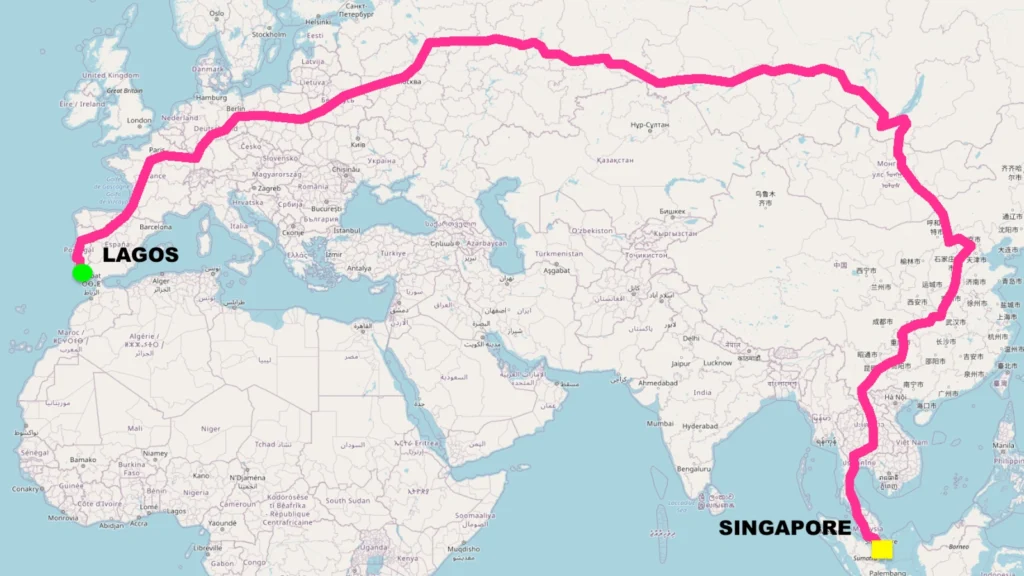
An extraordinary overland travel concept stretching from Portugal to Singapore is capturing the imagination of slow-travel enthusiasts seeking an alternative way to experience Europe and Asia through railways, changing landscapes and multiple cultures.
Spanning roughly 11,000 miles in its broadest proposed form, the journey can connect up to 13 countries through a complex combination of international trains, domestic railway networks and border transfers.
However, travelers should understand one critical fact: there is no single direct Portugal-to-Singapore train.
Instead, this is an ambitious multi-stage expedition that must be carefully assembled around available railway services, visas, border rules and current geopolitical conditions.
Its appeal lies precisely in that complexity. Rather than treating transportation as something to complete quickly, the journey turns movement itself into the main travel experience.
Portugal opens the European adventure
Portugal provides a dramatic Atlantic starting point for an eastbound transcontinental journey.
Travelers can begin in Lisbon before moving through Portugal’s domestic railway network and connecting toward Spain.
Portugal’s national railway operator maintains international Celta services between Porto and Vigo in Spain, providing one existing cross-border rail connection into the wider European network.
From there, an overland itinerary can be constructed through European railway systems toward Central and Eastern Europe.
Possible country combinations can include Portugal, Spain, France, Germany and Poland before travelers consider routes farther east.
Unlike a conventional flight itinerary, every stage introduces another city, landscape and culture.
Legendary Eurasian railways inspire the route
The romantic idea behind the journey draws heavily from legendary Eurasian railway corridors, particularly the Trans-Siberian and Trans-Mongolian routes.
Historically, these railways created some of the world’s most celebrated long-distance overland journeys, linking European Russia with Siberia, Mongolia and China.
A classic conceptual itinerary could continue through Belarus, Russia and Mongolia before reaching China.
However, travelers planning such a journey in 2026 cannot assume that the historic route operates as one seamless tourist corridor.
International border restrictions, visa requirements, service availability and geopolitical conditions can significantly affect itinerary planning.
Therefore, the famous Portugal-to-Singapore route should be viewed as an adaptable travel concept rather than a fixed ticket that can simply be purchased from beginning to end.
China becomes the crucial Asian bridge
China plays a central role in making the Southeast Asian section increasingly practical.
Its enormous railway system allows travelers to cross major distances while connecting historic cities, modern metropolitan centers and regional tourism destinations.
The most transformative development for southbound overland travel has been the China-Laos Railway.
Opened in 2021, the railway directly connects China’s railway network with Laos. International passenger services later strengthened cross-border travel, creating easier access between destinations in southwestern China and Laos.
By 2026, international tourist train products were also operating across the corridor, connecting destinations including Xishuangbanna, Luang Prabang and Vang Vieng.
Laos unlocks new Southeast Asian possibilities
For adventurous travelers, Laos has become one of the most exciting components of the wider overland journey.
The railway gives visitors easier access to Luang Prabang, Vang Vieng and Vientiane while creating a stronger north-south tourism corridor.
This development has changed how travelers can imagine a Europe-to-Southeast-Asia adventure.
Instead of relying entirely on lengthy road journeys after China, rail now forms a much stronger part of the experience.
Travelers can combine railway segments with required border connections before continuing toward Thailand.
Thailand and Malaysia lead toward Singapore
Thailand adds another major tourism dimension.
Bangkok can become an important stop, offering temples, cultural attractions, markets and one of Southeast Asia’s most celebrated food scenes.
From Thailand, travelers can continue south through rail connections toward Malaysia.
Malaysia’s railway network provides services linking major destinations and the northern border region with Kuala Lumpur and southern Malaysia. KTMB also operates the cross-border Shuttle Tebrau between Johor Bahru and Woodlands in Singapore, creating the symbolic final railway step into the city-state.
Arriving in Singapore after crossing continents would complete one of the most ambitious slow-travel journeys imaginable.
The journey becomes the destination
The greatest attraction is not simply traveling from Portugal to Singapore.
It is watching the world transform gradually.
Atlantic Europe gives way to continental landscapes, historic railway corridors, vast Asian territories, tropical Southeast Asia and finally Singapore.
Travelers experience changing languages, food, architecture and traditions instead of flying over them.
The journey can also spread tourism spending across smaller destinations, railway towns, hotels, restaurants and local businesses far beyond conventional aviation hubs.
Careful planning remains essential
Anyone attempting such an expedition must research every segment independently.
Train schedules can change. Some international railway links may not operate continuously. Visas and border-entry requirements differ by nationality, while geopolitical developments can make historically famous routes impractical or inadvisable.
Travelers should therefore build flexible itineraries and verify each international crossing immediately before travel.
The dream of traveling from Portugal to Singapore largely by rail remains one of global tourism’s most fascinating bucket-list concepts.
Modern links such as the China-Laos Railway are making sections of the journey easier, but the real adventure remains its complexity: thirteen countries, thousands of miles and an unforgettable transition from Europe to Southeast Asia where the journey itself becomes the destination.
For more travel news like this, keep reading Global Travel Wire