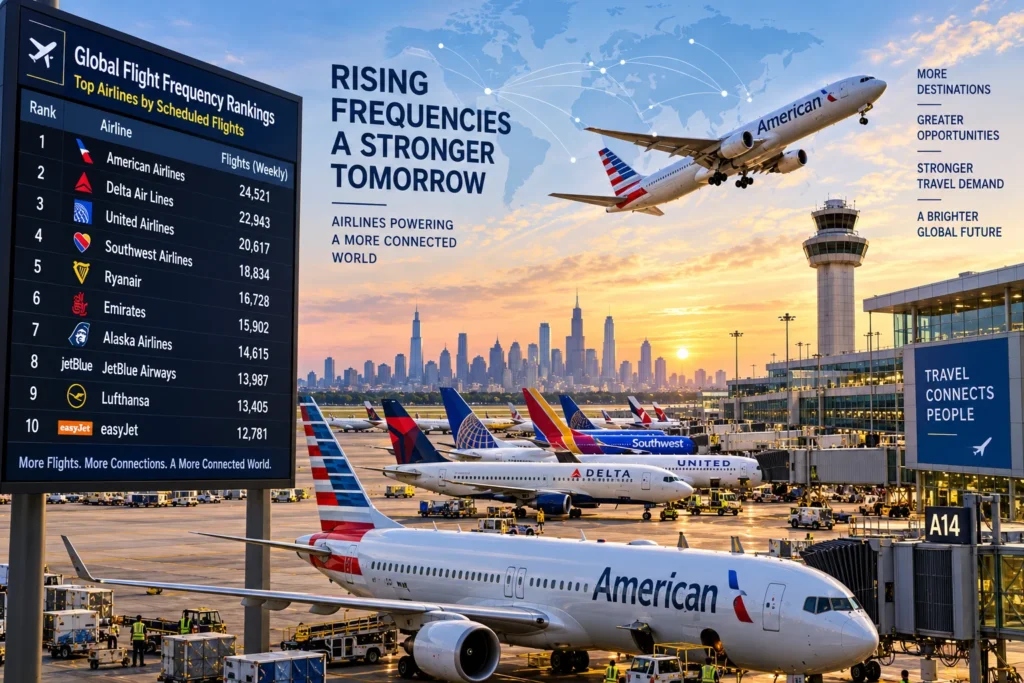
US Legacy Carriers and Budget Operators Drive Worldwide Aviation Volume
The hierarchy of commercial aviation reveals a structural divergence in how global travelers navigate continents. Official flight statistics published by the International Air Transport Association (IATA) and aviation analytics provider OAG confirm that sheer domestic market scale, coupled with rapidly expanding low-cost business models, dictates worldwide operational leadership.
Legacy carriers in North America rely on high-capacity hub-and-spoke networks to maintain raw departure counts, while point-to-point budget disruptors across Europe and Asia are reshaping global aviation through high aircraft utilization and rapid fleet expansion.
American Airlines Retains Position as World’s Busiest Commercial Carrier
American Airlines maintains its position at the top of the global flight frequency rankings, operating over 2.2 million scheduled flights. This operational scale is rooted in the immense domestic passenger traffic of the United States, which IATA reports handles over 890 million total passenger journeys annually. American Airlines channels this demand across five core operational hubs:
Dallas/Fort Worth International Airport (DFW): Serves as the primary operational fortress handling over 80 percent of airport traffic and anchoring transcontinental and Latin American connections.
Charlotte Douglas International Airport (CLT): Acts as the high-volume transfer point for East Coast regional air traffic.
Miami International Airport (MIA): Functions as the primary international gateway connecting North America to the Caribbean and South America.
Chicago O’Hare International Airport (ORD): Facilitates high-density Midwest commercial and cross-country routes.
Phoenix Sky Harbor International Airport (PHX): Manages regional passenger flows across the Western United States.
This hub network is reinforced by regional partners under the American Eagle brand, operating high-frequency regional jets to feed passengers into major mainline hubs.
Top Global Airlines by Scheduled Operations
American Airlines (United States): ~2.2 Million Flights | Legacy Multi-Hub Network & Regional Feeder
Delta Air Lines (United States): ~1.8 Million Flights | Premium Business and Leisure Hub-and-Spoke
United Airlines (United States): ~1.7 Million Flights | Transcontinental Trunk Routes & Long-Haul International
Southwest Airlines (United States): ~1.4 Million Flights | High-Density Point-to-Point Domestic Network
Ryanair (Ireland): ~1.1 Million Flights | Point-to-Point Ultra-Low-Cost European Carrier
IndiGo (India): Rapidly Growing Regional Leader | High-Frequency Single-Aisle Airbus Fleet
Budget Airlines Transform Regional Air Travel Markets
Global departure frequency is increasingly driven by budget operators utilizing point-to-point network structures:
Ryanair: Operating over 1.1 million annual flights across Europe, the carrier relies on secondary airport utilization, standardized Boeing 737 fleets, and strict 25-minute aircraft turnarounds to maximize daily flight hours per airframe.
IndiGo: Representing one of the fastest-growing airlines in South Asia, IndiGo has deployed a massive fleet of Airbus A320neo family aircraft to dominate domestic Indian aviation while expanding regional international routes into Southeast Asia, Central Asia, and the Middle East.
Chinese State-Owned Carriers: China Southern, China Eastern, and Air China generate massive departure figures driven primarily by high-density domestic travel corridors linking major economic hubs.
Fleet Modernization Reduces Carbon Footprints Across High-Volume Routes
To balance high operational frequency with environmental targets, the world’s busiest carriers are accelerating fleet renewal programs. According to IATA fleet statistics, legacy and budget operators are transitioning toward fuel-efficient, next-generation narrowbody and widebody platforms:
Fuel Efficiency Gains: New-generation airframes including the Boeing 737 MAX series and the Airbus A320neo family deliver a 15 to 20 percent reduction in fuel burn and carbon emissions compared to previous aircraft generations.
Noise Reduction: Modern engine technologies reduce noise contours by up to 50 percent near high-density airports.
Sustainable Aviation Fuel (SAF): Major aviation groups are committing to increased SAF blending ratios across primary operational hubs to meet international civil aviation decarbonization goals.
Strategic Practical Tips for International Travelers
Optimizing Hub Connections: When connecting through mega-hubs like Dallas/Fort Worth, passengers should utilize airside automated transit systems to transfer between terminals without exiting secure areas.
Understanding Airport Geography: Travel planners using low-cost European carriers should verify the location of secondary airports relative to city centers to properly budget ground transportation time and fees.
Utilizing Biometric Transit: Travelers connecting through major Indian airports can leverage government biometric passenger processing platforms to clear security checkpoints faster during peak departure times.
Driven by rising middle-class travel demand in Asia and sustained domestic movement in North America, high-frequency competition guarantees international travelers expanded route options, greater regional access, and competitive fares across global destinations.
For more travel news like this, keep reading Global Travel Wire