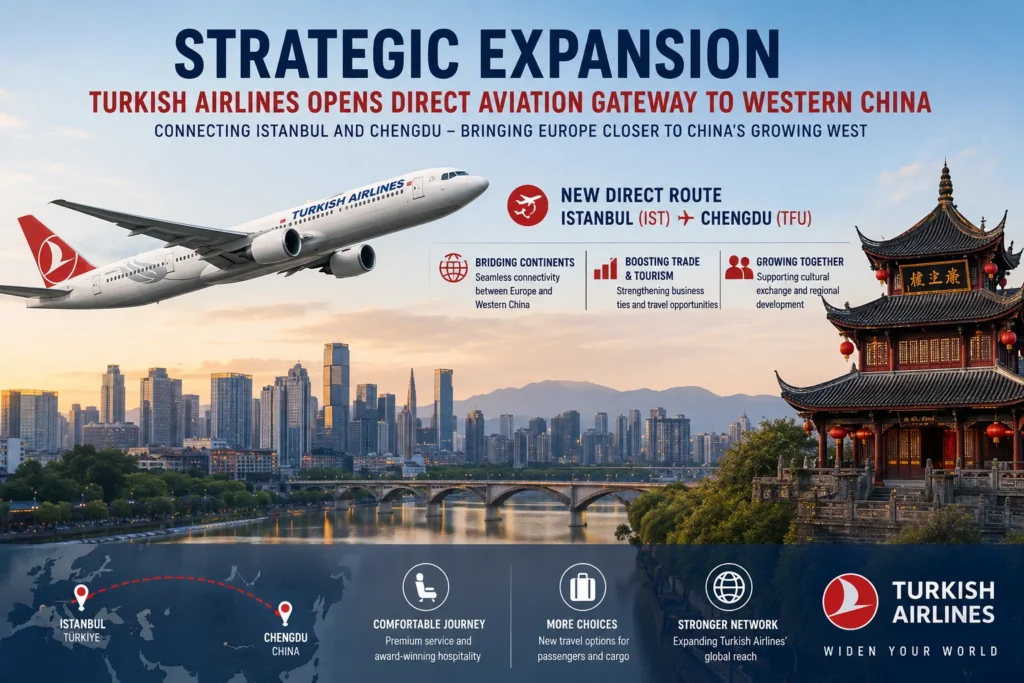
Global aviation infrastructure is experiencing a major strategic shift as major international carriers expand direct long-haul routes beyond traditional coastal hubs. Establishing new direct links into secondary megacities, Turkish Airlines has officially confirmed the addition of direct flights connecting Istanbul Airport with Chengdu Tianfu International Airport.
By establishing direct connectivity between major transit hubs in Europe and Western China, the route eliminates intermediate transfers through traditional coastal gateways such as Beijing, Shanghai, or Guangzhou. The expansion expands international access across long haul aviation corridors, connecting travelers from Europe, the Middle East, and Africa directly to the commercial and cultural capital of Sichuan Province.
Realigning Long Haul Aviation Corridors into Sichuan
The inauguration of scheduled service to Chengdu Tianfu International Airport forms part of a broader expansion of international flight schedules across Southwest China. Global carriers continue to expand capacity into Chengdu, transforming the facility into a major international transit hub for regional trade, academic exchange, and long-haul travel.
Primary international route developments expanding access to Sichuan include:
Turkish Airlines: Scheduled service connecting Istanbul Airport directly to Chengdu Tianfu, providing seamless single-stop transit across extensive European, Middle Eastern, and African flight networks.
Southeast Asian Carriers: Expanded regional flight schedules connecting Malaysia, Singapore, and Thailand to Chengdu, facilitating multi-destination itineraries into inland China.
Gulf State Aviation Links: Active direct routes connecting Abu Dhabi and Doha with Chengdu, expanding business travel and tourism connections with the Arabian Peninsula.
National Flag Carriers: Expanded long-haul international routes operated by domestic airlines, including direct links connecting London and European capitals with Chengdu.
This expanding international route network provides long-haul travelers with alternative flight options, lowering travel times and improving schedule flexibility for both leisure and business itineraries.
Cultural Immersion and Eco-Tourism Ecosystems
Direct access to Chengdu enables travelers to plan slow-travel itineraries focused on the cultural heritage and biodiversity of the Sichuan basin. Positioned as a premier eco-tourism destination, the region provides unique access to ancient engineering landmarks, wildlife conservation projects, and mountain sanctuaries.
| Destination / Asset | Ecological & Cultural Significance | Travel Logistics & Features |
| Dujiangyan Irrigation System | UNESCO World Heritage site built in 256 BC; ancient damless hydraulic engineering | Accessible via high-speed rail from central Chengdu |
| Dujiangyan Panda Valley | Conservation facility focused on wild training and habitat protection for giant pandas | Conservation-first alternative with managed visitor caps |
| Mount Qingcheng | Sacred mountain recognized as a primary birthplace of Taoist culture | Direct rail connections to mountain trailheads |
| Mengding Mountain | Historical tea cultivation region showcasing centuries-old agricultural practices | Guided botanical and cultural tea tours |
| Jiuzhaigou Valley | Protected national park famous for multi-tiered waterfalls and colorful alpine lakes | Direct regional flight and high-speed rail links from Chengdu |
By utilizing high-speed rail networks directly connected to Chengdu Tianfu International Airport, international visitors can explore rural conservation zones while maintaining a low carbon footprint during their journey.
Essential Practical Tips for Exploring Sichuan
To maximize comfort and navigate local destinations responsibly, regional travel specialists recommend adopting several essential travel guidelines:
Select Optimal Travel Windows: Plan visits during the spring (March to June) or autumn (September to November) months to experience mild weather and optimal conditions for outdoor trekking.
Utilize High-Speed Rail Infrastructure: Avoid long-distance highway transfers by taking advantage of Sichuan’s high-speed rail network. Trains connect central transit stations directly to trailheads at Mount Qingcheng and UNESCO sites at Dujiangyan in under an hour.
Engage in Local Teahouse Culture: Visit historic municipal parks to experience traditional slow living. Ordering regional green teas at local bamboo tables provides an authentic perspective on community heritage.
Choose Certified Conservation Reserves: Prioritize wildlife facilities that focus on scientific research, habitat rewilding, and strict daily visitor caps to support responsible animal welfare standards.
Manage Regional Culinary Preferences: When sampling authentic Sichuan cuisine, communicate spice preferences clearly to local kitchens to ensure dishes match your personal comfort level.
Long-Term Outlook for Southwestern China Transit
The continuous arrival of international carriers at Chengdu Tianfu International Airport reinforces the long-term growth trajectory of Southwestern China’s travel sector. Government investments in sustainable transport infrastructure, high-speed rail integration, and environmental protection ensure that the region remains well-positioned to host international visitors.
As global aviation corridors continue to diversify away from traditional single-gateway models, Chengdu’s expanding international flight network ensures that Western China remains directly accessible to global trade, cultural exchange, and sustainable eco-tourism for years to come.
For more travel news like this, keep reading Global Travel Wire