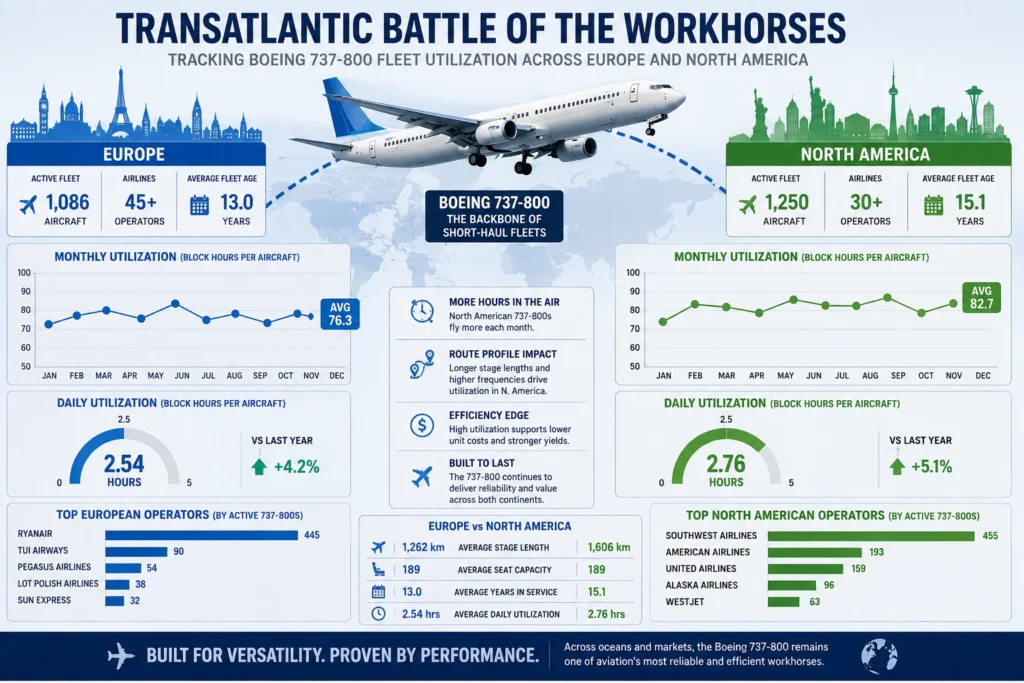
In the global low-cost airline sector, maximum fleet utilization serves as the core operational foundation for profitability. A real-world performance tracking analysis comparing two single-operator Boeing 737-800 aircraft—one managed by European ultra-low-cost carrier Ryanair and the other by U.S.-based Southwest Airlines—reveals how transatlantic operating models shape daily aircraft efficiency.
The empirical tracking exercise evaluated two nearly identical airframes over a seven-day summer schedule. Both aircraft were delivered in September 2018, utilize CFM International CFM56 turbofan engines, and maintain dedicated single-class cabin layouts. However, operational variations across European point-to-point networks and North American domestic hub connections highlight distinct approaches to scheduling, route distance, and passenger throughput.
Comparative Operations: European Short-Haul vs. U.S. Continental Transit
Over the seven-day observation period, both airframes operated intensive flight schedules without encountering mechanical cancellations or operational delays. Despite navigating different airspace structures and ground management environments, the final total distance covered differed by only 251 nautical miles.
| Operational Metric | Ryanair (EI-GSH) | Southwest Airlines (N8582Z) | Variance |
| Total Sectors Operated | 48 sectors | 38 sectors | +10 sectors |
| Total Distance Flown | 31,205 nautical miles | 30,954 nautical miles | +251 nautical miles |
| Total Flight Time | 77 hours, 1 minute | 67 hours, 26 minutes | +9 hours, 35 minutes |
| Average Daily Sectors | 6.85 sectors | 5.42 sectors | +1.43 sectors |
| Average Daily Distance | 4,458 nautical miles | 4,422 nautical miles | +36 nautical miles |
| Average Daily Flight Time | 11 hours, 1 minute | 9 hours, 38 minutes | +1 hour, 23 minutes |
| Average Sector Length | 650 nautical miles | 815 nautical miles | -165 nautical miles |
| Airports Visited | 19 airports | 17 airports | +2 airports |
| Total Revenue Seat Capacity | 9,072 seats | 6,650 seats | +2,422 seats |
Key Factors Driving Network Efficiency and Fleet Productivity
The weekly operational data highlights several structural differences in how short-haul networks maximize aircraft productivity and seat capacity:
Turnaround Management and Sector Count: The European low-cost model relies heavily on rapid 25-to-30-minute ground turnarounds. This enabled the Ryanair airframe to complete 48 total flight sectors—averaging 6.85 daily legs—compared to 38 sectors completed by the Southwest aircraft.
Stage Length and Airspace Routing: Southwest Airlines recorded a higher average sector length (815 nautical miles versus 650 nautical miles). Longer average stage lengths across the continental United States allowed the Southwest aircraft to cover nearly equivalent total distance despite completing ten fewer flights.
Cabin Configuration and Seat Capacity: Seating density directly impacts overall passenger volume. Configured with a single-class layout of 189 seats, the Ryanair 737-800 generated 9,072 total available seats over the week, outperforming Southwest’s 175-seat configuration by 2,422 revenue seats.
Geographic Network Diversity: The Ryanair airframe connected 19 airports across Western Europe, Central Europe, and North Africa. In contrast, the Southwest aircraft operated strictly within the continental United States across 17 regional hubs and destination airports.
Operational Takeaways for Aviation Infrastructure and Logistics
The data confirms that European point-to-point networks prioritize high sector density and rapid airport turnarounds to maximize daily flight hours. Meanwhile, North American domestic carriers leverage longer stage lengths between major metropolitan centers to maintain comparable daily mileage.
Both operating strategies highlight the structural reliability of modern narrowbody aircraft, proving that disciplined fleet utilization remains the primary driver of operational productivity across global low-cost aviation.
For more travel news like this, keep reading Global Travel Wire