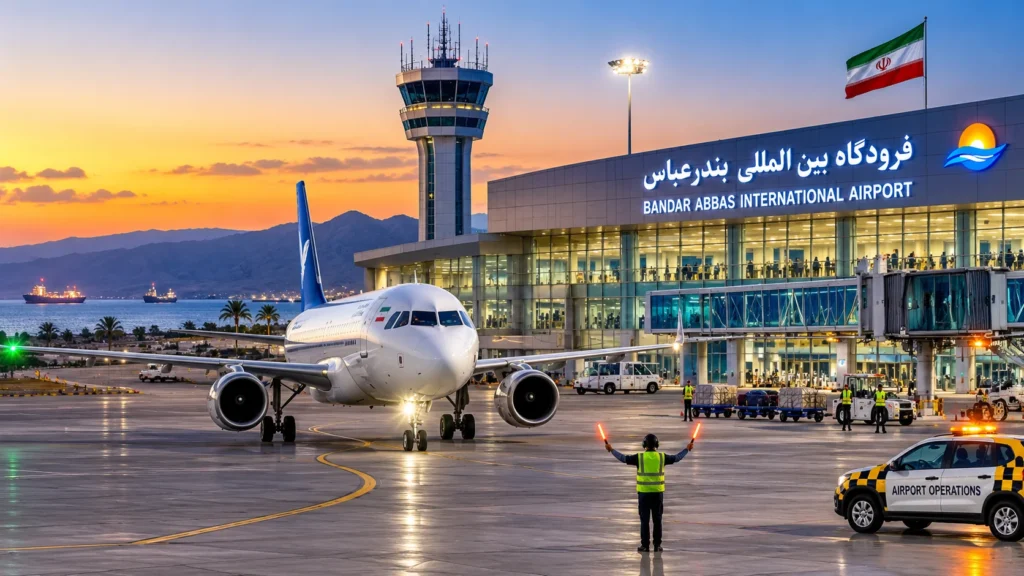
Domestic aviation routes and regional air transit received a major operational boost following the official resumption of full scheduled passenger services at Bandar Abbas International Airport. Official aviation authorities confirmed that regular commercial operations have returned across major high-density air corridors, reconnecting the coastal trade and tourism hub of Hormozgan province with key national urban centers.
The resumption comes after extended operational disruptions and temporary security closures across regional airspace. According to official statements from provincial airport management, full flight schedules were officially reinstated following a phased transition period that initially allowed limited non-scheduled and priority air movements.
Official Aviation Announcements and Route Network Restoration
Kazem Tavassoli, Director General of Airports for Hormozgan Province, announced through official state channels that scheduled commercial flights at Bandar Abbas International Airport have returned to standard multi-city scheduling. The normalization of flight operations permits national carriers and commercial aviation operators to immediately reopen ticketing and seat allocations for crucial domestic travel channels.
Travelers can now reserve bidirectional travel across primary domestic routes, including:
Tehran–Bandar Abbas–Tehran: Restoring the primary political, financial, and administrative air corridor between the capital city and the Persian Gulf coast.
Mashhad–Bandar Abbas–Mashhad: Re-establishing essential long-distance connectivity between the northeastern cultural and pilgrimage center and southern maritime ports.
Isfahan–Bandar Abbas–Isfahan: Reconnecting central industrial and historical tourism hubs with southern coastal trade sectors.
Prior to operational interruptions, official transportation statistics indicated that Bandar Abbas International Airport maintained a daily capacity of 35 to 40 combined domestic and international flight movements. The restoration of regular flight schedules marks a critical step toward rebuilding base-level transport metrics and operational volume across regional air networks.
Economic Impact and Regional Connectivity Reconstruction
Bandar Abbas functions as one of the country’s main maritime gateways and economic lifelines along the Persian Gulf. Aviation infrastructure in Hormozgan province plays a crucial role in facilitating commercial trade, regional business travel, maritime logistics transfers, and domestic leisure tourism.
The closure of regional airspace and civilian air terminals creates immediate operational bottlenecks across trade supply chains, regional administration, and local economic development. Re-establishing commercial flight operations directly addresses these disruptions by restoring reliable transit for business professionals, logistics personnel, public sector administrators, and domestic holidaymakers.
By maintaining open commercial air corridors, municipal authorities, regional trade organizations, and public transportation departments can ensure uninterrupted mobility between island destination ecosystems—including nearby Qeshm and Hormuz Islands—and inland population centers. The return of scheduled aviation links provides vital support to local hospitality providers, transportation networks, and coastal eco-tourism sectors reliant on steady passenger inflows from major metropolitan regions.
Safety Standards, Air Traffic Management, and Operational Protocols
National civil aviation safety authorities confirmed that airport infrastructure, runway assets, navigation equipment, and air traffic management facilities at Bandar Abbas International Airport underwent complete operational verification prior to approving schedule resumptions.
Civil aviation administration protocols for the current flight phase focus on several key operational priorities:
Airspace Surveillance and Coordination: Enforcing updated civil-military air traffic coordination protocols to guarantee complete navigational safety across coastal flight corridors.
Terminal Operations Management: Rebuilding standard terminal throughput procedures to efficiently manage check-in, passenger screening, and baggage logistics during peak scheduling windows.
Flight Schedule Stability: Coordinating directly with domestic passenger airlines to ensure reliable flight dispatch rates, minimizing unexpected schedule delays or short-notice cancellations.
Passenger Information Services: Maintaining transparent communication protocols through official airport information systems, ensuring traveling public access to real-time flight status data.
With passenger ticketing active across all primary domestic aviation routes, local airport authorities remain focused on maintaining steady flight frequencies, expanding route options, and ensuring high standards of passenger safety and operational continuity across regional transportation networks.
For more travel news like this, keep reading Global Travel Wire