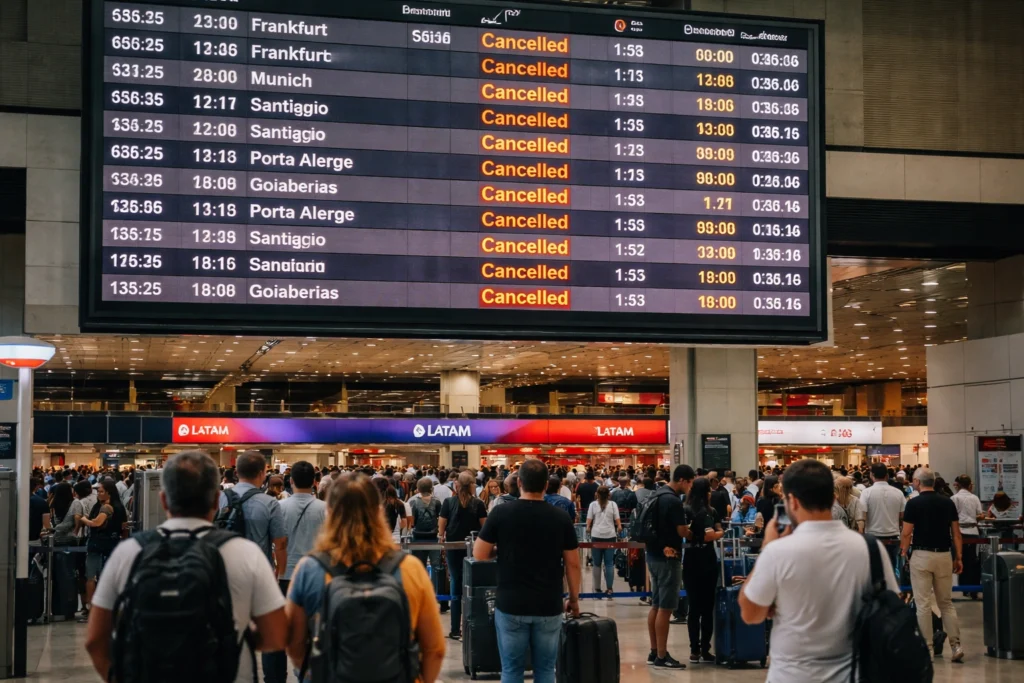
Brazil’s aviation network has been hit by a fresh wave of disruption after 23 flight cancellations were recorded across major domestic and international routes, affecting travelers heading to São Paulo, Brasília, Rio de Janeiro, Frankfurt, Munich, Santiago and several regional destinations. The latest schedule cuts involve leading carriers including LATAM, Lufthansa, Azul and GOL, adding pressure to one of Latin America’s busiest air travel markets.
The cancellations span some of Brazil’s most important gateways, including São Paulo–Guarulhos, São Paulo–Congonhas, Brasília, Rio de Janeiro–Galeão and Campinas–Viracopos. For passengers, the impact reaches far beyond airport terminals, affecting onward connections, business trips, leisure holidays, hotel bookings and tourism flows across the country.
São Paulo–Guarulhos Bears the Biggest Impact
São Paulo–Guarulhos International Airport, Brazil’s leading long-haul hub, saw the heaviest concentration of cancellations. Domestic LATAM services to Goiabeiras, Porto Alegre, Belém, João Pessoa and Curitiba were removed from the schedule, while Azul also suspended a service to Cuiabá.
International operations were also affected. Lufthansa cancelled flights to Munich and Frankfurt, including repeated Frankfurt disruptions across two days. LATAM’s Santiago route was also suspended, reducing regional connectivity between Brazil and Chile.
For tourism businesses, disruptions at Guarulhos can ripple quickly through the wider economy. The airport serves as a key arrival point for international visitors who connect onward to beaches, cultural cities, eco-tourism regions and cruise departures across Brazil.
Brasília Routes Disrupted for Business Travelers
In the capital, Brasília experienced cancellations on several high-demand domestic links. GOL flights to São Paulo–Congonhas and Rio de Janeiro–Galeão were cancelled, alongside a LATAM service to São Paulo–Guarulhos.
These are among Brazil’s most strategically important routes, heavily used by government officials, corporate travelers and domestic tourists. Even short-haul cancellations on these sectors can trigger wider delays, missed meetings and overnight accommodation changes for passengers.
Hotels near airports and city centers may also see shifting booking patterns as stranded travelers seek last-minute rooms or reschedule stays.
São Paulo–Rio Shuttle Faces Repeated Interruptions
At São Paulo–Congonhas Airport, multiple cancellations hit the famous São Paulo–Rio de Janeiro shuttle corridor, one of the busiest business travel routes in South America. Several GOL and LATAM flights to Santos Dumont were removed, while another LATAM service to Porto Alegre was also cancelled.
The shuttle route is vital not only for corporate movement but also for domestic tourism, weekend breaks and event travel between Brazil’s two largest visitor markets. Repeated disruptions here often have an outsized effect because of the high frequency and strong demand normally seen on the corridor.
Europe Connections Reduced from Rio and São Paulo
Long-haul travelers were also impacted after Lufthansa cancellations affected Frankfurt-bound services from both São Paulo–Guarulhos and Rio de Janeiro–Galeão. The Rio cancellation is particularly significant because Galeão remains an important international gateway for leisure visitors heading to Rio’s beaches, attractions and cruise terminals.
Flights to Frankfurt and Munich are key bridges between Brazil and Europe, carrying inbound tourists, business travelers and passengers connecting onward across the continent. Reduced capacity on these routes can tighten seat availability, raise fares and push travelers to rebook through alternative hubs.
Regional Brazil Routes Under Pressure
Campinas–Viracopos, a major base for Azul’s domestic network, also recorded several cancellations. Routes affected included Belo Horizonte, Curitiba, Ribeirão Preto and Araraquara.
Regional services are especially important for local tourism and economic activity because they connect secondary cities with larger metropolitan centers. When these routes are disrupted, smaller destinations can feel the impact quickly through delayed meetings, reduced visitor arrivals and interrupted family travel.
What the Disruptions Reveal
Several patterns are emerging from the latest cancellations. High-frequency domestic routes such as São Paulo–Rio de Janeiro were heavily affected. Long-haul European services faced repeated interruptions. Regional routes showed instability, particularly within Azul’s network. Most notably, multiple airlines adjusted schedules at the same time, suggesting broader operational strain rather than isolated incidents.
For travelers, that means flexibility is essential. Checking flight status regularly, arriving earlier at airports and maintaining direct contact with airlines can reduce stress during periods of volatility.
Outlook for Travelers and Tourism
Brazil remains one of the largest and most dynamic aviation markets in the region, supported by strong domestic demand, growing international interest and diverse tourism offerings. However, widespread cancellations at major hubs show how quickly operational challenges can affect the wider travel ecosystem.
As airlines continue adjusting schedules, passengers traveling in the coming days should expect possible changes, especially on busy domestic sectors and long-haul routes. For the tourism industry, restoring confidence through reliable schedules and smooth airport operations will be critical as Brazil moves through another demanding period for air travel.
For more travel news like this, keep reading Global Travel Wire