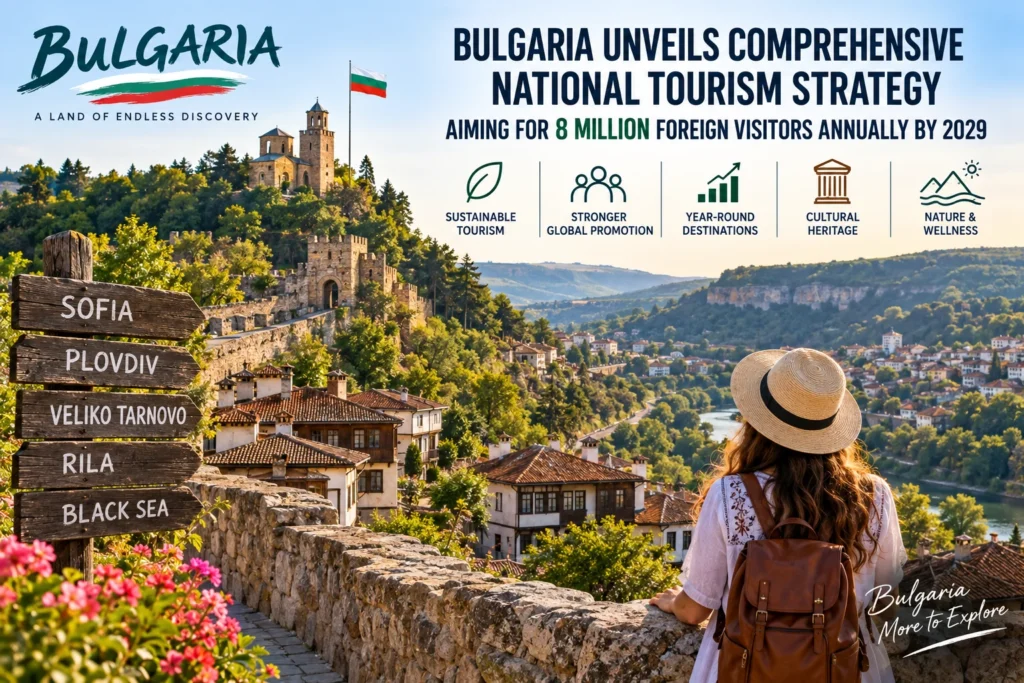
The Ministry of Tourism of the Republic of Bulgaria has formally introduced a strategic national growth roadmap designed to double foreign arrivals and reach eight million international visitors annually by 2029. Grounded in official statistical baselines that recorded 4,140,353 foreign tourist registrations—representing a 9.8 percent year-on-year increase—the strategic framework prioritizes targeted expansion across key European and long-haul source markets. The initiative seeks to balance regional visitor distribution by broadening the country’s appeal beyond seasonal Black Sea summer holidays into four-season ski, thermal mineral spa, and cultural heritage itineraries.
Strategic Evolution Beyond Black Sea Summer Coastal Tourism
Bulgaria’s multi-year tourism expansion framework transforms the Balkan nation from a predominantly seasonal beach getaway into a versatile, year-round European travel destination. Statistical updates published by the National Statistical Institute of Bulgaria show that total combined tourist volume reached 9,504,275 visitors. This total reflects sustained domestic engagement combined with growing international interest in historic urban centers, natural spa resorts, and mountain leisure regions.
Aligned with broader European Travel Commission framework objectives, the 2029 target of eight million foreign arrivals leverages Bulgaria’s complete integration into the Schengen Area for air and maritime travel. This regulatory milestone removes internal border checks at major international air gateways in Sofia, Varna, and Burgas, streamlining transit for European travelers.
Key Target Source Markets and Specialized Segment Priorities
The official national strategy targets five primary source markets through tailored promotional campaigns and infrastructure enhancements:
Germany and Poland
These established European origin markets represent a foundational core. Targeted campaigns prioritize high-value summer stays along the Black Sea coast while expanding winter sports bookings across major mountain resorts, including Bansko and Borovets.
Romania and Türkiye
High-density neighboring markets are engaged through expanded regional infrastructure. Strategy initiatives focus on direct highway corridors, cross-border coach transportation, and streamlined weekend cultural and wellness breaks.
Japan and Long-Haul Outbound Markets
Strategic promotional drives target premium long-haul travelers. Marketing efforts emphasize multi-city cultural itineraries connecting Sofia, Plovdiv, and Veliko Tarnovo, alongside wellness excursions to mineral spa destinations such as Velingrad and the Rose Valley region.
Growth Indicators and Target Source Market Parameters
The operational targets and strategic parameters guiding Bulgaria’s international tourism framework outline specific metrics across priority origin markets:
Foreign Tourist Arrivals
Official Recorded Metric: 4,140,353 registered visitors
Target Metric: 8,000,000 annual foreign arrivals
Strategic Operational Focus: Expanding year-round European visits and long-haul cultural arrivals
Total Combined Tourist Volume
Official Recorded Metric: 9,504,275 total visitors
Target Metric: Over 14,000,000 combined visitors
Strategic Operational Focus: Integrating domestic travel growth with sustained international expansion
Foreign Visitor Growth Rate
Official Recorded Metric: 9.8 percent increase
Target Metric: Steady 8 to 10 percent annual growth
Strategic Operational Focus: Capitalizing on full Schengen air integration and expanded route connectivity
Germany Source Market
Official Recorded Metric: Leading European feeder market
Target Metric: 15 percent annual growth rate
Strategic Operational Focus: Enhancing coastal resort packages at Sunny Beach and Golden Sands alongside winter ski offerings
Poland Source Market
Official Recorded Metric: Rapidly expanding Central European market
Target Metric: Expanded charter flight capacity and air links
Strategic Operational Focus: Promoting family coastal holidays, mountain trekking, and eco-wellness routes
Regional Neighbor Markets (Romania and Türkiye)
Official Recorded Metric: High-volume cross-border transit
Target Metric: Optimized land border transit facilities
Strategic Operational Focus: Driving short-break weekend trips, historic city stays, and thermal spa visits
Japan Source Market
Official Recorded Metric: Premium long-haul segment
Target Metric: Multi-city heritage travel expansion
Strategic Operational Focus: Highlighting Rose Valley tours, UNESCO World Heritage locations, and mineral spa retreats
Traveler Logistics: International Aviation Hubs and Rail Connectivity
Navigating Bulgaria’s regional destinations is supported by expanding international flight corridors and modernizing ground transport networks.
Airport Gateways and Air Connections
Sofia Airport serves as the central international entry point for the national capital, Western Bulgaria, and primary winter sports destinations including Bansko and Borovets. Low-cost air carriers maintain extensive point-to-point networks connecting the capital directly to major urban centers across Germany, Poland, and Western Europe. Along the coast, Varna Airport and Burgas Airport handle high-density seasonal flights alongside regional year-round services for northern and southern Black Sea resorts.
Schengen Border Rules and Digital Authorizations
Following Bulgaria’s entry into the Schengen Area for air and maritime transit, travelers arriving from other Schengen member states do not undergo internal passport checks at domestic airports. Visa-exempt non-EU citizens—including travelers from the United Kingdom, United States, Canada, Australia, and Japan—are required to complete the standard ETIAS digital travel authorization prior to departure.
Intercity Passenger Transport
The national rail network, operated by Bulgarian State Railways (BDZ), links Sofia Central Station to Plovdiv in approximately two hours and 30 minutes, and to Burgas in five hours and 30 minutes. Express coach services run frequent daily routes along primary highway corridors, providing ground transport across major provincial hubs.
Regional Economic Impact and Long-Term Sustainability
Reaching the milestone of eight million annual foreign visitors establishes the tourism sector as a key driver of Bulgaria’s national economic growth. Directing tourist flows toward winter sports hubs like Bansko, Borovets, and Pamporovo, as well as mineral spa centers like Velingrad, Hisarya, and Sapareva Banya, helps reduce summer overcrowding along coastal areas. This balanced approach supports year-round employment in rural and mountain municipalities while preserving natural reserves and cultural landmarks.
For more travel news like this, keep reading Global Travel Wire