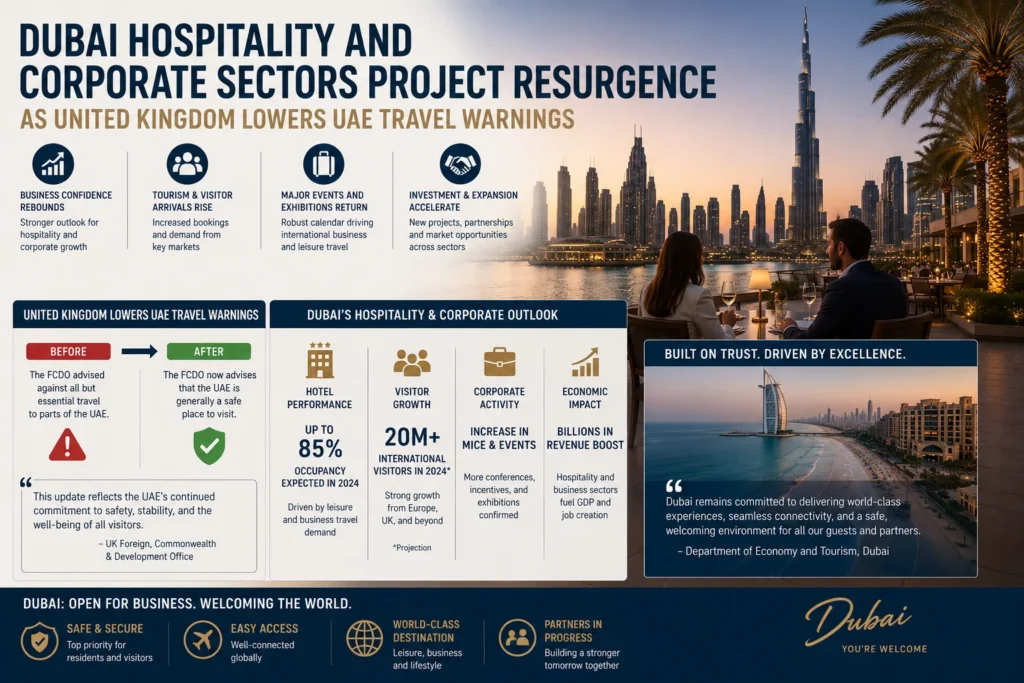
The hospitality, aviation, and corporate investment landscapes across the United Arab Emirates are preparing for a major influx of international arrivals following a pivotal policy revision by the United Kingdom government. Official data and ministerial releases confirm that the British Foreign, Commonwealth and Development Office has systematically dismantled its high-level warning advising citizens against all but essential travel to the Emirates. While the updated state directive still counsels travelers to maintain routine awareness due to broader regional maritime and transit dynamics, the lifting of the blanket restriction has immediately revived consumer interest and stabilized the financial framework governing international holiday bookings.
The timely policy adjustment serves as a critical structural turning point for regional commerce. For several months, rigid travel warnings enacted by Western European nations had severely hindered corporate travel networks, stalled corporate talent acquisition campaigns, and complicated international investment ventures. Because standard travel insurance packages are routinely invalidated when individuals journey to nations flagged under critical state advisories, the downgrade of the security alert has cleared away a primary financial hurdle for both leisure holidaymakers and enterprise entities looking to resume standard flight itineraries.
Broad Rebound and Economic Optimization Across Key Business Sectors
The strategic adjustment to the British travel matrix is generating intense optimism among local business bodies and trade organizations. According to official administrative assessments from regional commerce groups, including leadership from the British Chamber of Commerce Dubai, the removal of the restrictive advisory is highly significant for re-establishing baseline investor confidence. Local industrial tracking reveals that despite the recent window of regional transit volatility, underlying corporate interest has remained remarkably resilient, with official chamber membership inquiries trending twenty-five percent above targeted baselines.
The normalization of travel protocols is expected to yield immediate positive returns across multiple economic indicators:
Corporate Projects and Infrastructure Support: Major commercial operations that rely directly on technical experts and executive delegates traveling from the United Kingdom can now proceed with critical on-site project phases that were temporarily delayed by standard corporate insurance prohibitions.
MICE and Large-Scale Exhibitions: Dubai’s world-class convention bureau infrastructure is preparing for a revived schedule of international conferences, congresses, and trade exhibitions, as multi-national organizations can now comfortably clear their personnel for travel to the Gulf.
Hospitality and Premium Retail Dynamics: Local luxury hoteliers and premium retail districts are adjusting their capacity models to accommodate an immediate increase in room nights and visitor arrivals originating from Western Europe.
Landmark Institutional Safety Packages Rebuild Consumer Trust
The baseline for the region’s structural recovery is strongly reinforced by unprecedented public-private partnerships and state-backed corporate initiatives designed to insulate passengers from wider transit uncertainties. In an industry-first development aimed at maximizing consumer confidence, premier regional carriers have introduced revolutionary, conflict-inclusive travel insurance products.
The newly deployed “Comprehensive Travel Cover” framework, developed alongside international risk management leaders like Travel Guard, provides international arrivals with a level of financial protection completely unmatched by traditional insurance underwriters. The official provisions of the package guarantee up to $25,000 in conflict-related emergency medical coverage and offer a free thirty-day trip extension, completely independent of shifting foreign government travel advisories.
Furthermore, the state-backed aviation framework guarantees that if localized airspace closures or route adjustments cause flight cancellations, the operating airlines will fully manage and finance extended-stay hotel accommodations or seamlessly rebook passengers onto alternative carriers at no additional out-of-pocket cost. This safety architecture has effectively detached passenger vulnerability from geopolitical variables, positioning the region as a highly secure environment for families and solo travelers alike.
Historic Statistical Momentum Signals a Strong Second Half
The current resurgence builds directly upon an exceptionally strong operational foundation logged prior to the spring transport disruptions. Official statistical sheets published by the Dubai Department of Economy and Tourism reveal that the United Kingdom historically stands as the single largest source market for the emirate within Western Europe, accounting for more than thirty-six percent of all visitors from that continent. Official records indicate that Dubai successfully welcomed 1.04 million British overnight tourists during the first nine months of 2025 alone, reflecting a robust thirteen percent year-on-year growth trajectory.
As the summer travel season approaches, transport authorities project that aggressive pricing campaigns, combined with the comprehensive security guarantees provided by local airlines, will trigger a total normalization of passenger traffic by the second half of 2026. While the local aviation grid remains fully synchronized with global civil safety networks, travelers are advised by official ministerial bodies to continuously utilize state registration databases and maintain contact with their ticketing agents, ensuring a seamless and highly informed journey into one of the world’s premier tourism hubs.
For more travel news like this, keep reading Global Travel Wire