The landscape for international leisure travel and transit across the Gulf region is experiencing widespread administrative changes as multiple foreign ministries alter their formal security classifications. Following the declaration of a diplomatic memorandum of understanding between the United States and Iran aimed at stabilizing regional transit corridors, global transport ministries and departments of foreign affairs have begun reviewing active safety alerts. While certain European governments have started easing their high-level restrictions on major holiday destinations, state declarations emphasize that regional transport networks and local airspaces require continued operational vigilance from international arrivals.
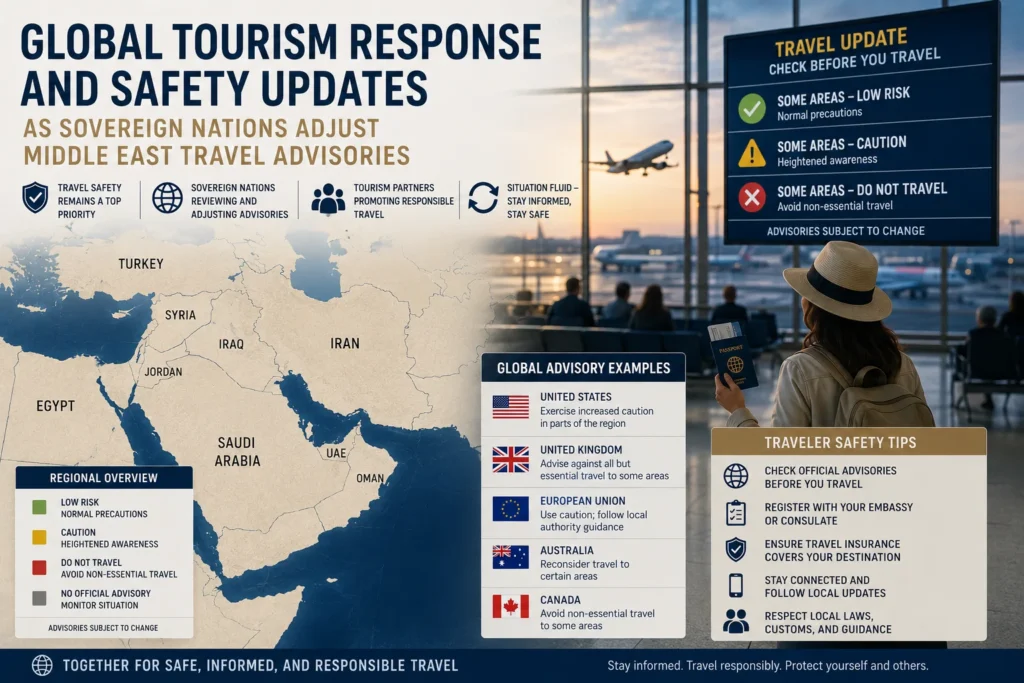
A major shift for commercial operators occurred when the United Kingdom Foreign, Commonwealth and Development Office officially revised its public security matrix. The ministry announced that it has removed its comprehensive warning advising against all but essential travel to the United Arab Emirates. This policy downgrade carries significant economic implications for global holidaymakers, as standard international travel insurance policies are routinely voided when citizens journey to destinations flagged under critical government alerts.
Easing Edicts Shape the Recovery of Dubai Tourism
The updated ministerial directive explicitly removes the blanket recommendation to avoid non-essential transit to major hubs like Dubai and Abu Dhabi. According to the formal statement released by British foreign authorities, travelers are no longer systematically urged to bypass the Emirates for holiday or business itineraries.
However, the state advisory notes that the regional security apparatus has not returned to a completely typical baseline. Government communications continue to notify the public that regional conditions remain fluid and that localized disruptions to civilian transit infrastructure could materialize with minimal advance notice. In the event of renewed friction, government directives advise citizens to continuously monitor local state-run media, register their presence with corporate embassy portals, and stay clear of designated military or security installations.
The regulatory adjustments follow a phased pattern as other global authorities implement varying frameworks based on their independent security reviews:
Australian Safe Travel Allocations: The Australian Department of Foreign Affairs and Trade similarly reduced its classification tier for the United Arab Emirates, Bahrain, Israel, Kuwait, and Qatar. The updated stance shifts these nations out of the strict prohibition zone into a cautionary classification advising citizens to thoroughly reconsider their immediate need for regional travel.
United States State Department Classifications: Conversely, the United States government maintains a more conservative administrative posture. The official state department index continues to log the region under a Level 3 designation, instructing American citizens to thoroughly reconsider travel plans while keeping current emergency communication lines open with nearby embassies.
Rigid Transport Restrictions Kept by Continental Authorities
While certain nations are opening doors for seasonal bookings, several major European and Asian transport ministries are sustaining robust travel prohibitions to manage potential international flight safety hazards. The Canadian Department of Global Affairs issued an official advisory instructing its citizens to avoid all travel to a broad network of regional destinations, specifically citing the direct vulnerabilities of commercial aviation networks and the possibility of abrupt airspace closures. The Canadian directive covers the United Arab Emirates, Iran, Iraq, Israel, Kuwait, Qatar, and Bahrain under its maximum safety alert level.
Similarly, the German Foreign Office and the Dutch Ministry of Foreign Affairs have retained highly restrictive frameworks for their traveling publics. German state alerts strongly counsel against entering the United Arab Emirates, Saudi Arabia, Qatar, Oman, Jordan, and Bahrain due to ongoing structural volatility within regional transit paths. The Dutch advisory maintains a strict orange alert level across most Gulf territories, which legally translates to a recommendation against standard vacation travel, while enforcing a maximum red alert level for specific outlying maritime territories including Abu Musa and the Tunb islands.
Northern European ministries have mirrored these strict parameters. The Swedish Ministry of Foreign Affairs and the Polish Ministry of Foreign Affairs continue to advise their nationals against all non-essential journeys to the United Arab Emirates, Bahrain, Kuwait, and Qatar. Swedish state officials took the additional step of publicly noting that state-sponsored emergency evacuation logistics and consular extraction support may be significantly constrained for individuals who choose to enter these boundaries against active state guidance.
Global Transit Hubs and Mandatory Registration Protocols
Across the Asia-Pacific region, foreign ministries are leaning toward a highly preventative approach. The Singapore Ministry of Foreign Affairs formally issued a recommendation for its nationals to fully defer upcoming itineraries to a wide array of Middle Eastern states, including Egypt, Jordan, Saudi Arabia, Oman, and the United Arab Emirates, emphasizing the unpredictability of the overarching international security climate.
Concurrently, the Ministry of Foreign Affairs Malaysia has mandated that any non-essential travel to these destinations should be deferred until regional transport data registers absolute stability. For Malaysian citizens currently residing within the Gulf zone for employment or extended stay, the state has issued an official order to immediately register contact data and physical addresses with the nearest active diplomatic mission to ensure seamless communication.
As the international aviation sector responds to these fragmented government declarations, global transport authorities recommend that travelers maintain direct contact with airline logistics providers to confirm flight paths. Utilizing comprehensive travel insurance policies that account for sudden itinerary modifications remains a critical baseline requirement as the global holiday market navigates these evolving government updates.
For more travel news like this, keep reading Global Travel Wire