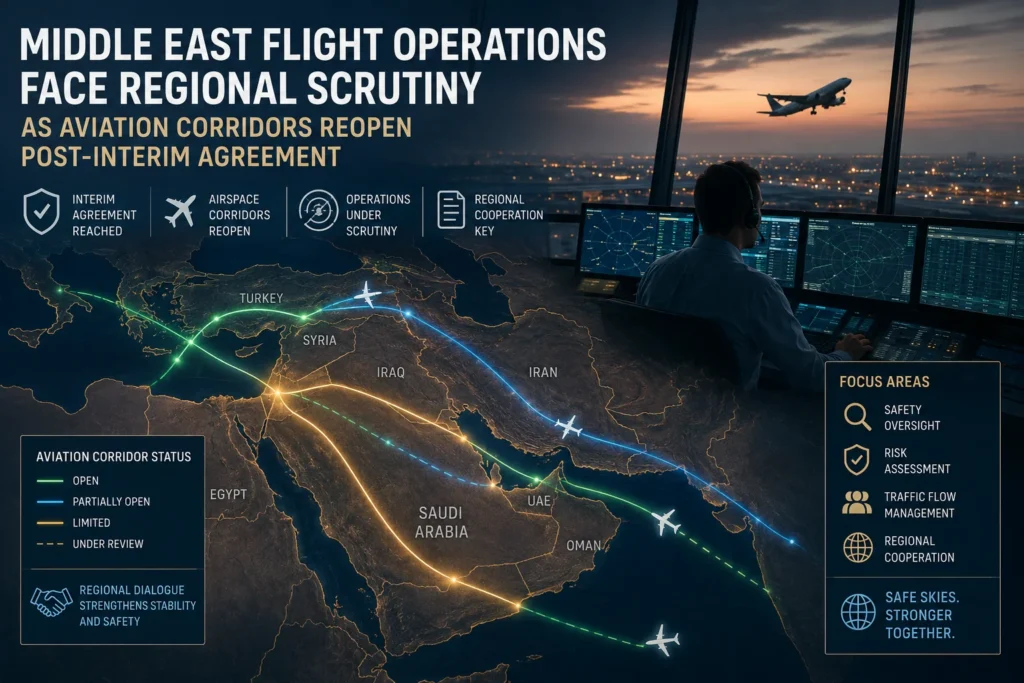
Global transit corridors across the Gulf region are undergoing a complex phased recovery following a landmark breakthrough in international diplomacy. With an interim agreement officially signed by United States President Donald Trump and Iranian authorities to systematically end the military conflict and reopen the strategic Strait of Hormuz, the international aviation community is intensely auditing the viability of standard commercial flight paths. For months, the persistent geopolitical volatility following targeted U.S. and Israeli operations on Iran had systematically altered long-haul flight routing, temporarily closing major aviation corridors and rerouting flights away from what is historically one of the world’s most critical tourism and air transit junctions.
While the formal declaration of a peace memorandum provides an foundational framework for normalization, the response from global commercial aviation networks remains highly fragmented. A collection of international carriers has initiated plans to restore partial flight schedules to specific destinations across the Middle East. However, a significant number of foreign passenger airlines have elected to extend their existing flight suspensions, continuing a pattern of long-term cancellations that has altered seasonal flight networks and left thousands of international itineraries in limbo.
Shift in Travel Guidance from International Authorities
The shifting security landscape prompted immediate policy adjustments from major international transport departments and foreign ministries tracking regional safety parameters. The United Kingdom’s Foreign, Commonwealth and Development Office officially announced an explicit downgrade of its security alerts for the region, stating that the government is no longer advising its citizens against non-essential travel to a collection of prominent Gulf states. This updated directive formally applies to travel corridors leading into the United Arab Emirates, Qatar, and Kuwait.
The easing of these travel advisories marks a significant policy pivot from the strict security posture maintained during the spring. In late February and early March, the British government had enacted emergency security alerts warning against all non-essential civilian travel to the broader Gulf zone. Those sweeping restrictions were triggered immediately after the launch of coordinated military strikes by the United States and Israel against infrastructure positions inside Iran, which subsequently led to retaliatory missile deployments from Iran across nearby Gulf territories.
While the new diplomatic framework has restored validity to standard international travel insurance policies for these nations, government tracking bodies continue to emphasize a posture of operational caution. Official ministerial alerts accompanying the updated guidance remind transit operators and commercial passengers that regional conditions remain structurally volatile and that tactical disruptions or local flight adjustments could theoretically re-emerge on minimal notice.
Global Airlines Navigate Divided Transit Strategy
The reopening of the Strait of Hormuz has introduced a critical economic variable for the global airline sector, which has suffered from elevated jet fuel expenses and costly long-range detours around closed regional airspaces over the past several months. Aviation safety regulators are now tasked with analyzing the safety profile of high-altitude corridors traversing the Persian Gulf. Despite the diplomatic progress, the resumption of regular operations is expected to follow a prolonged timeline rather than a uniform restart.
A review of active airline notices demonstrates a clear divide in how global carriers are approaching the security update:
Regional Hub Carrier Operations: Major local airlines based directly within the Gulf states have maintained localized operations throughout the core of the crisis and are currently working to ramp up frequencies to pre-conflict levels, leveraging the formal reduction in regional airspace risks.
International Fleet Extensions: Conversely, multiple flagship carriers based in North America and Western Europe have decided to maintain a conservative approach. Flight rosters show suspensions on key routes linking Western capitals directly to the Middle East extended deep into the upcoming winter season, with certain carriers indicating that regular services will not resume until late 2026.
This cautious timeline stems from the structural realities of international airline planning, where restoring long-haul capacity requires extensive logistical coordination, crew scheduling reallocations, and updated risk assessments from domestic civil aviation boards.
Long-Term Horizon for Regional Tourism Recovery
The signing of the interim agreement provides a vital sixty-day window during which international oversight bodies and state representatives intend to negotiate the definitive removal of military parameters and finalize agreements regarding the verified management of nuclear assets. As part of this transition, the newly enacted Persian Gulf Strait Authority has offered economic incentives to normalize maritime and aviation trade, including a temporary sixty-day waiver on all localized transit tariffs linked to security, environmental protection, and state insurance protocols.
For the prominent luxury tourism markets of Dubai, Doha, and Abu Dhabi, the combination of lowered government travel warnings and the physical reopening of trade channels represents the first concrete phase of structural recovery. Industry statistics from local tourism boards indicate that prior to the late-February disruptions, these destinations relied heavily on international stopover traffic, serving as a primary structural bridge for travelers moving between Europe, Africa, and the Asia-Pacific region.
While the physical infrastructure of these mega-airports remains fully intact and ready for normal passenger volumes, global aviation groups project that fully restoring consumer confidence and returning international flight frequencies to their baseline levels will be a gradual, multi-month process. Travelers planning journeys through the region are urged by national transport ministries to continuously monitor live airline scheduling databases, as individual carriers will continue to determine their specific route resumptions based on independent safety audits.
For more travel news like this, keep reading Global Travel Wire