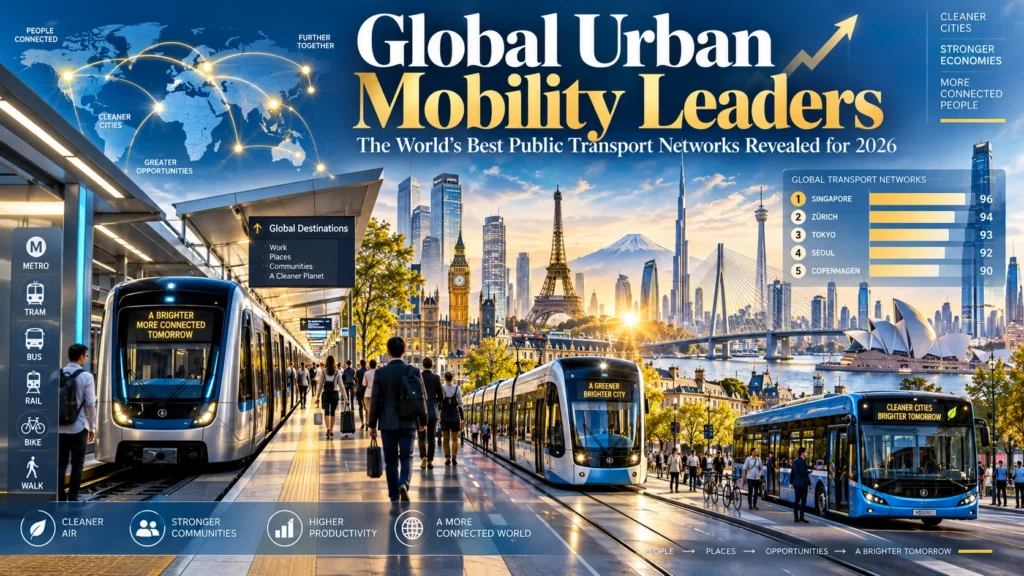
Efficient urban mobility forms the backbone of thriving metropolitan tourism. When public transit systems operate seamlessly, visitors and residents navigate cities effortlessly. Official local transit surveys involving over 24,000 residents across the globe highlight the top twenty international destinations setting global benchmarks for urban transit excellence, evaluating subways, buses, light rail networks, and integrated ticketing solutions.
To reflect global diversity, rankings limit inclusion to one top-performing city per country. Leading metropolitan hubs demonstrate that punctual transit, modern infrastructure, and accessible pricing significantly elevate urban quality of life.
Asia-Pacific Transit Systems Secure Top Global Spots
Metropolitan transit networks in Asia-Pacific continue to set world standards in efficiency, passenger satisfaction, and technological integration:
1. Taipei, Taiwan (95% Approval): Securing the top rank worldwide, Taipei’s Mass Rapid Transit system combines spotless facilities with extreme punctuality. Handling over 767 million passenger trips annually (averaging 2.1 million daily riders), the network utilizes the unified EasyCard system covering subways, municipal buses, and public bicycle rentals. Expanded light rail lines in New Taipei contributed to a record 30 million trips across surrounding corridors.
2. Singapore (93.5% Approval): Singapore’s Mass Rapid Transit network handles roughly 3.5 million daily trips across 146 stations, maintaining a 99.4% on-time operational reliability record according to Land Transport Authority metrics. Official infrastructure milestones in 2026 marked the completion of the Circle Line loop with new underground stations at Keppel, Cantonment, and Prince Edward Road.
3. Hong Kong (92.8% Approval): Hong Kong’s Mass Transit Railway recorded a 99.9% on-time performance rate across its heavy rail network, servicing nearly 2 billion passenger journeys over the year. The integrated Octopus card provides contactless access across high-speed rail links, historic double-decker trams, and traditional harbour ferries.
5. Seoul, South Korea (91.1% Approval): Renowned for digital connectivity and affordable fares starting at 1,550 won, Seoul’s subway system serves millions daily. The city’s Climate Pass initiatives provide seamless multi-modal transit access encompassing subways, buses, public bikes, and new river transit routes along the Han River.
European Metropolises Excel in Accessibility and Sustainability
European cities perform exceptionally well by combining heritage architecture with sustainable, integrated transit solutions:
4. Edinburgh, United Kingdom (92.4% Approval): Emerging as the highest-rated city in the UK, Edinburgh’s municipal transport success is driven by council-owned Lothian Buses (119 million annual customer journeys) and Edinburgh Trams (12.5 million journeys). Following tram line extensions through Leith to Newhaven, contactless daily fare capping ensures simple, affordable citywide travel.
6. Zurich, Switzerland (90.7% Approval): Swiss transit integration ensures passengers find a tram or bus stop roughly every 300 meters. A single ZVV ticket provides unified access across municipal trams, local buses, S-Bahn commuter rail, funiculars, and passenger ferry boats on Lake Zurich.
7. Vienna, Austria (90.3% Approval): Famed for affordable annual transit passes, Wiener Linien’s U-Bahn subways, trams, and buses processed over 903 million passenger journeys. Vienna continues to rank among top global capitals for combined public transit and urban cycling infrastructure.
8. Tallinn, Estonia (85.3% Approval): A pioneer in fare-free public transit for registered local residents since 2013, Tallinn offers efficient electric tram and bus operations, supported by city pass options that bundle transit access with museum entries for international tourists.
9. Helsinki, Finland (83.6% Approval): HSL integrated ticketing covers subways, commuter rail, buses, and year-round ferries servicing the UNESCO-listed Suomenlinna fortress. Infrastructure expansions include light rail Line 15 (Jokeri), connecting eastern urban districts with neighboring business hubs ahead of schedule.
Latin American Innovation in Urban Mobility
10. Medellín, Colombia (83% Approval): Medellín’s integrated transit network serves as a international model for urban inclusion. Anchored by the iconic Metrocable aerial cable car network—comprising six lines connecting steep hillside communities to the central valley floor—the combined system of trains, cable cars, trams, and bus rapid transit recorded over 310 million passenger trips.
Essential Takeaways for Global Travelers
Public transportation networks play a pivotal role in sustainable tourism development. From high-tech contactless payment cards to zero-emission cable cars and expanded light rail loops, cities that prioritize reliable public transit continue to deliver superior travel experiences for global visitors.
For more travel news like this, keep reading Global Travel Wire