Gulf tourism is facing a fresh test as updated international travel warnings, flight suspensions, and airline schedule changes place renewed pressure on the UAE, Qatar, and Saudi Arabia during a period of regional uncertainty.
The Gulf has spent years building one of the world’s most influential travel corridors, connecting Europe, Asia, Africa, and Oceania through major aviation hubs in Dubai, Abu Dhabi, Doha, Riyadh, and Jeddah. However, security concerns across the wider region have forced governments, airlines, tour operators, corporate travel managers, and insurers to reassess travel risk.
For travellers, the impact is being felt through altered flight schedules, fewer routing choices, added uncertainty around transit, and more cautious booking behaviour. For tourism economies, the challenge is to protect confidence while keeping hotels, airports, events, attractions, restaurants, and transport systems operating.
International Travel Warnings Reshape Gulf Demand
Government travel advisories have become one of the most powerful forces influencing Gulf tourism demand. When official guidance changes, the effects extend quickly across the travel chain.
Travellers may delay holidays, businesses may restrict employee trips, conference organisers may review attendance plans, and tour operators may adjust itineraries. Insurance coverage can also be affected when advisory levels rise, making some travellers more cautious even when airports and hotels remain open.
The United States, United Kingdom, Canada, Australia, and several European governments have all maintained or updated guidance for parts of the Gulf and wider Middle East during the recent period of regional instability. Advisory language varies by country and destination, but the wider message is clear: travellers are being urged to monitor conditions carefully, follow official instructions, and prepare for sudden changes.
For destinations such as the UAE, Qatar, and Saudi Arabia, perception now matters as much as operational reality. Even when tourism facilities continue functioning normally, advisory headlines can influence international confidence.
Airlines Respond With Suspensions And Schedule Changes
The aviation sector has seen the most immediate operational impact. Airlines must constantly review airspace safety, airport conditions, insurance requirements, crew welfare, aircraft routing, and passenger demand. During periods of heightened geopolitical risk, even limited uncertainty can lead to temporary reductions or route changes.
Some international carriers have adjusted Gulf schedules, paused selected services, or rerouted flights while monitoring developments. This affects not only travellers whose final destination is the Gulf, but also passengers using the region as a transit bridge between continents.
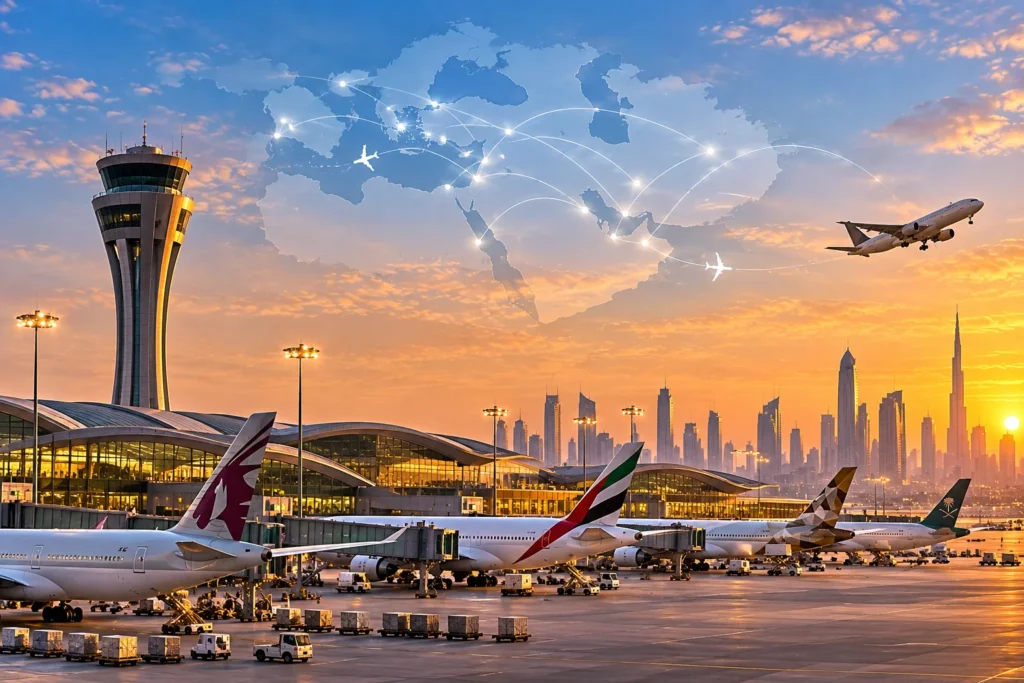
Dubai, Abu Dhabi, Doha, Riyadh, and Jeddah are not ordinary airports. They are major global transfer points, linking long-haul passengers across Asia-Pacific, Europe, Africa, and the Americas. Any disruption in these hubs can quickly affect wider international connectivity.
Regional airlines have continued to play a critical role by maintaining extensive networks and supporting passenger flows. However, full recovery depends on the return of broader airline confidence and stable international operating conditions.
UAE, Qatar And Saudi Tourism Continue Operating
Despite the uncertainty, tourism infrastructure across the UAE, Qatar, and Saudi Arabia has largely remained active. Hotels, resorts, airports, restaurants, shopping districts, cultural venues, convention centres, cruise facilities, and major attractions continue to serve visitors.
In the UAE, Dubai and Abu Dhabi remain central to luxury tourism, family holidays, business events, exhibitions, retail travel, beach resorts, and stopover itineraries. Qatar continues to develop its tourism identity around culture, hospitality, sports, museums, waterfront districts, and urban experiences. Saudi Arabia is pushing ahead with leisure tourism, religious travel, entertainment, heritage destinations, Red Sea development, and major events.
These destinations have invested heavily in long-term tourism growth. That investment gives them strong infrastructure, but it also raises the stakes when travel confidence weakens.
Business Travel And Events Feel The Pressure
The impact of travel warnings extends beyond leisure tourism. Business travel, meetings, exhibitions, sporting events, and conferences are highly sensitive to official government guidance.
Corporate travel departments often follow advisory levels when approving trips. If guidance becomes more cautious, companies may postpone meetings, shift events online, or reroute staff through alternative hubs. This can affect hotels, convention centres, premium airlines, ground transport operators, and hospitality suppliers.
The Gulf has become a major global events platform, hosting trade shows, luxury showcases, sports tournaments, cultural festivals, and investment forums. Protecting this segment is vital because business travellers often spend more on accommodation, dining, transport, and services than short-stay leisure visitors.
How Long Could Recovery Take?
The recovery timeline depends on three main factors: regional stability, government advisory updates, and airline confidence.
If security conditions stabilise and advisories are eased, airlines can restore capacity relatively quickly on high-demand routes. Gulf hubs have strong infrastructure, major home carriers, and deep international networks, which can support a faster rebound than smaller markets.
However, if uncertainty continues, recovery may become uneven. Leisure travellers may return first to destinations viewed as stable and well-connected, while corporate travel and group tourism may take longer because they depend on risk approvals, insurance conditions, and organisational policy.
In practical terms, short-term recovery could begin as soon as airlines restore confidence in operations. Full demand recovery may take longer, especially for markets where travellers remain cautious or where official guidance continues to discourage non-essential trips.
Gulf Tourism Remains Strategically Important
Despite current pressure, the Gulf remains essential to global tourism. The region’s airports, airlines, hotels, cruise terminals, resorts, entertainment districts, and cultural attractions form one of the most important travel ecosystems in the world.
The UAE, Qatar, and Saudi Arabia have all positioned tourism as a major economic growth engine. Their long-term strategies are supported by airport expansion, hotel development, destination marketing, entertainment investment, heritage tourism, religious travel, and major infrastructure projects.
This gives the region a strong foundation for recovery once confidence improves.
A Critical Moment For Gulf Travel Confidence
The latest travel warnings and airline adjustments have shown how quickly geopolitical uncertainty can affect tourism, aviation, and passenger behaviour across the Gulf.
For now, the UAE, Qatar, and Saudi Arabia remain open and operational, but the pace of recovery will depend on stable conditions, clearer government guidance, airline schedule restoration, and transparent communication with travellers.
The Gulf’s tourism future remains powerful, but the current test is clear. To recover quickly, the region must reassure visitors that its airports, hotels, events, and destinations remain prepared, resilient, and connected to the world.
For more travel news like this, keep reading Global Travel Wire