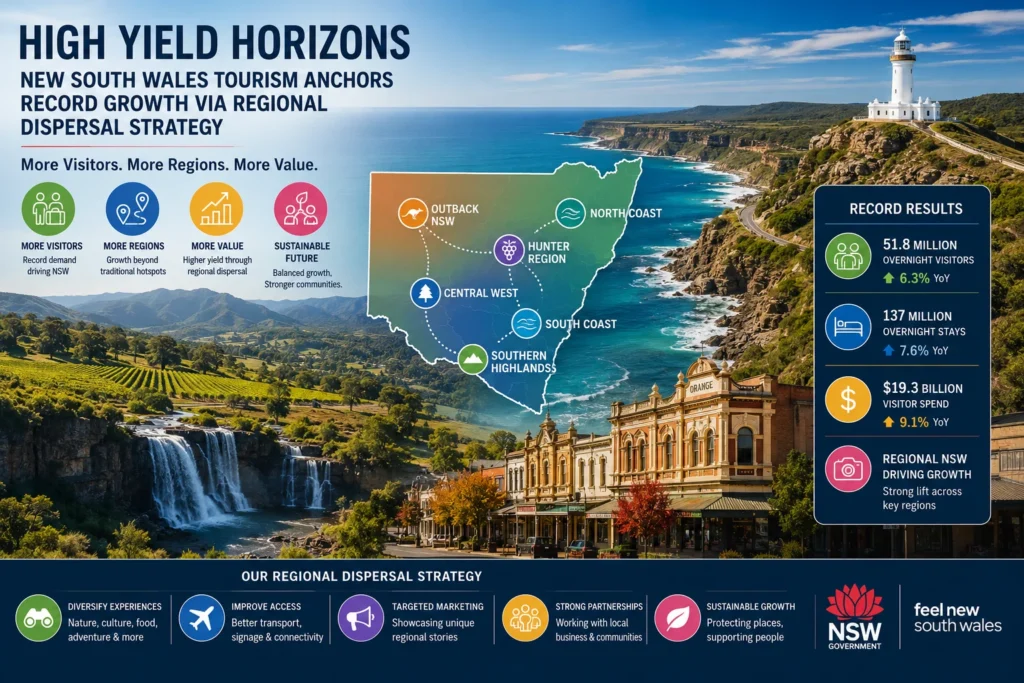
The Australian visitor economy has reached an unprecedented financial milestone, solidifying its position as a premier engine of regional development and high-yield travel. Official performance indicators released by Destination NSW and Tourism Research Australia confirm that the state of New South Wales generated a record-breaking AUD 61.9 billion in total visitor expenditure during the twelve-month period ending March 2026. This performance represents a major 16 percent increase in year-on-year spending, underscoring a structural shift in how domestic and international travelers interact with both urban hubs and natural landscapes.
The institutional datasets reveal a strategic transformation in consumer behavior. While the capital city of Sydney continues to operate as the state’s primary international aviation gateway, travelers are increasingly moving beyond urban borders. Progressive holiday frameworks are successfully encouraging visitors to combine metropolitan luxury stays with slow, localized excursions into regional outback and coastal ecological corridors.
The Financial Architecture of the Tourism Resurgence
According to statutory statistical briefs, New South Wales welcomed a collective 129.3 million domestic and international arrivals over the recorded year. The return of international aviation capacity and high-yield corporate segments significantly boosted the state’s financial baseline. Sydney alone attracted 4.2 million international arrivals, an increase of 7.9 percent year-on-year, contributing a substantial AUD 15.2 billion to the overarching expenditure matrix.
However, the defining characteristic of this growth period is the widespread distribution of capital into secondary markets. Regional tourism portfolios highlight that long-term traveler spending is rising rapidly across decentralized zones. This shift directly counters the traditional risk of metropolitan overtourism by channeling financial resources into small-scale rural businesses, boutique regional providers, and nature-focused tour entities situated outside the immediate urban footprint.
Funding Regional Infrastructure and Conservation Initiatives
Under the operational guidelines established by Destination NSW’s sustainable tourism charter, a targeted percentage of visitor-generated revenue is systematically reinvested into local heritage and conservation infrastructure. These strategic capital grants serve a dual purpose: they modernize regional transit assets while actively preserving vulnerable biomes and supporting indigenous community development.
Public environmental frameworks direct these state funds into several high-priority conservation projects:
Eco-Friendly Trail Development: The construction of low-impact boardwalks and walking tracks across pristine national parks to eliminate soil erosion.
Indigenous Tourism Backing: Providing foundational business resources for Aboriginal-owned and operated guiding companies in outback sectors.
Wildlife Protection Systems: Funding specialized habitat monitoring programs and conservation sanctuaries within the sub-alpine regions of the Snowy Mountains.
Aquaculture and Farm Trails: Supporting regional farm-to-table networks, such as the South Coast Oyster Trail, to expand decentralized economic yields.
By directly linking commercial travel success to localized environmental health, the state ensures that high-volume travel supports rather than depletes the natural landscape. Leisure travelers booking wellness retreats in Byron Bay or sampling premium vintages in the Hunter Valley contribute directly to the ecological maintenance of the ecosystems they journey to experience.
Performance Analysis Across Primary Regional Corridors
The performance metrics across the state’s diverse geographical zones show a balanced distribution of travel traffic:
Total State Footprint: Welcomed 129.3 Million domestic and international arrivals, establishing a record-breaking physical travel presence.
Overarching Expenditure: Achieved AUD 61.9 Billion in total visitor spending, marking a powerful 16 percent annual growth vector.
International Gateway: Tracked 4.2 Million overseas arrivals, driven by strong post-pandemic aviation route restorations.
Metropolitan Inbound Yield: Documented AUD 15.2 Billion in direct international spending within the primary metropolitan boundary.
Regional Dispersal Hubs: Led by the Blue Mountains, Hunter Valley, and the South Coast, facilitating the movement of traffic away from high-density urban zones.
Guidelines for Optimizing Regional Travel and Respectful Exploration
To ensure a high-quality holiday experience while maintaining a positive relationship with regional host communities, official advisory boards recommend distinct structural travel strategies. Planning excursions to popular natural landmarks or culinary zones during mid-week windows—specifically Tuesday through Thursday—enables individuals to avoid peak weekend accommodation rates while reducing weekend pressure on local infrastructure.
Environmental responsibility remains paramount when navigating the state’s extensive national park networks. Authorities mandate that visitors strictly adhere to marked walking tracks to protect the sensitive root zones of ancient eucalyptus forests and safeguard local wildlife habitats. When exploring the culinary trails of the South Coast, sourcing fresh oysters directly from authorized local leases provides vital financial stability to regional aquaculture families. Furthermore, when venturing into outback territories, booking excursions through registered Aboriginal guides guarantees access to authentic cultural history while supporting sustainable Indigenous employment structures.
The strategic combination of world-class urban luxury with well-managed regional wilderness journeys ensures that New South Wales retains its competitive edge within the crowded Asia-Pacific travel market. By prioritizing long-term destination management over short-term volume maximization, the state successfully implements a resilient, forward-looking blueprint that safeguards its distinct natural capital while fostering robust community development across all regional borders.
For more travel news like this, keep reading Global Travel Wire