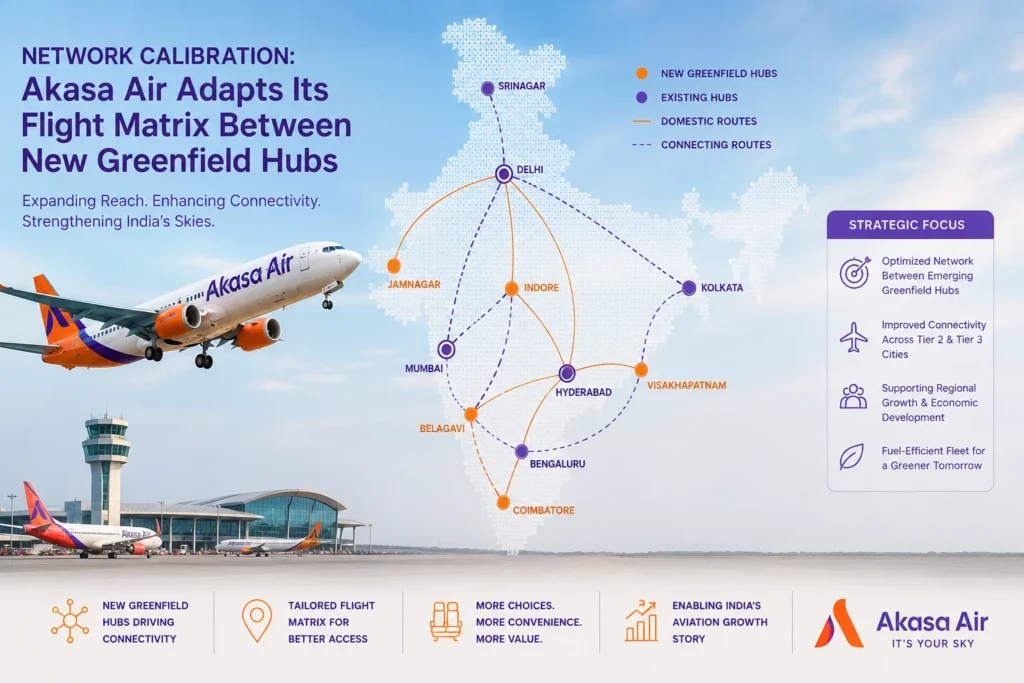
The rapidly expanding Indian civil aviation sector has witnessed a dynamic structural adjustment as domestic carriers align their fleet capacities with evolving passenger traffic trends. In a recent operational update, Mumbai-based carrier Akasa Air confirmed a strategic pause in its direct point-to-point passenger flight service connecting Noida International Airport and Navi Mumbai International Airport. This tactical decision, implemented shortly after the route’s initial summer rollout, highlights the complex logistical and demand-based parameters that govern route viability within the broader domestic air network.
The direct flight route was originally inaugurated to establish a seamless transit link between two of the country’s most anticipated greenfield aviation projects. However, after an introductory operational window lasting less than two weeks, the airline chose to temporarily suspend the specific daily rotation to perform a comprehensive network optimization review, redirecting its single-aisle aircraft resources toward higher-demand domestic sectors.
The Operational Mechanics of Greenfield Airport Development
The temporary route suspension underscores the broader commercial challenges associated with generating stable, consistent passenger loads at newly commissioned regional airfields. According to regulatory indicators from the Ministry of Civil Aviation, while the overarching travel corridor between the Delhi National Capital Region and the Mumbai metropolitan area remains one of the highest-density routes in the world, passenger demand remains highly concentrated at long-established mega-hubs.
Aviation planning data shows that point-to-point routes between secondary facilities face distinct traffic stabilization timelines. Fleet utilization strategies dictate that aircraft are most profitable when kept airborne on high-frequency trunk lines. When passenger traffic takes longer to mature due to developing surface infrastructure, commercial airlines routinely adjust their weekly timetables to protect general corporate yields.
Public assessments from regional transport offices point out that access logistics significantly impact initial terminal selection. The current absence of direct regional metro connections, paired with ongoing highway development projects surrounding both greenfield sites, makes access less immediate for certain business and leisure demographics compared to legacy city center options. These surface transit factors create a distinct break-even curve for pioneering direct air links during their opening structural phases.
Comprehensive Profile of the Suspended Regional Air Link
The logistical parameters of the recently altered regional itinerary illustrate the current operational framework:
Origin Node: Noida International Airport, serving as a newly developed alternative gateway for the extensive Delhi NCR market.
Destination Node: Navi Mumbai International Airport, designed as a secondary major airfield to handle expanding volumes in the Mumbai metropolitan zone.
Launch Timeline: The service commenced passenger operations in mid-June but was adjusted within a two-week window.
Current Operational Status: Temporarily suspended, with a targeted reactivation timeline earmarked for early autumn following structural network recalibrations.
Alternative Flight Options: High-frequency trunk routes linking Indira Gandhi International Airport to Chhatrapati Shivaji Maharaj International Airport.
Regulatory Safeguards and Alternate Passenger Routing Protocol
Under the structural consumer protection mandates enforced by the Directorate General of Civil Aviation, travelers holding confirmed bookings on the suspended flights are fully covered by the national passenger charter guidelines. When a scheduled domestic carrier alters its network configuration or suspends a specific route, it is legally required to offer affected ticket holders a choice between an alternative flight arrangement at no additional financial cost or a complete cash refund of the initial fare value.
Furthermore, regulatory directives dictate that if an operational cancellation occurs with minimal advance notice, carriers must ensure adequate passenger care protocols are executed. This includes providing complimentary refreshments, meals, and overnight hotel accommodations where sudden timetable adjustments create extended transit delays for stranded individuals.
To maintain travel connectivity between the northern and western commercial zones, transport authorities recommend that travelers adjust their travel plans by utilizing established high-frequency corridors. Major domestic carriers continue to scale up their daily flight rotations between the primary airports in Delhi and Mumbai, ensuring that the overall capacity connecting these two giant economic zones remains completely uninterrupted by localized greenfield adjustments.
Long Term Growth Projections for Next Generation Aviation Infrastructure
Despite the near-term capacity adjustments, the long-term infrastructure outlook for both new greenfield terminals remains exceptionally robust. Public updates from airport development consortia indicate that structural expansions are proceeding exactly as planned, with ultimate capacity designs capable of handling over 70 million passengers annually at full build-out.
As municipal authorities complete adjacent multi-modal ground transit links and airlines systematically optimize their fleet operations, point-to-point routes between these secondary gateways are expected to become highly viable commercial channels. The planned resumption of the service in October will serve as an essential industry benchmark, demonstrating how flexible scheduling helps domestic airlines successfully balance rapid infrastructure growth with sustainable network management.
For more travel news like this, keep reading Global Travel Wire