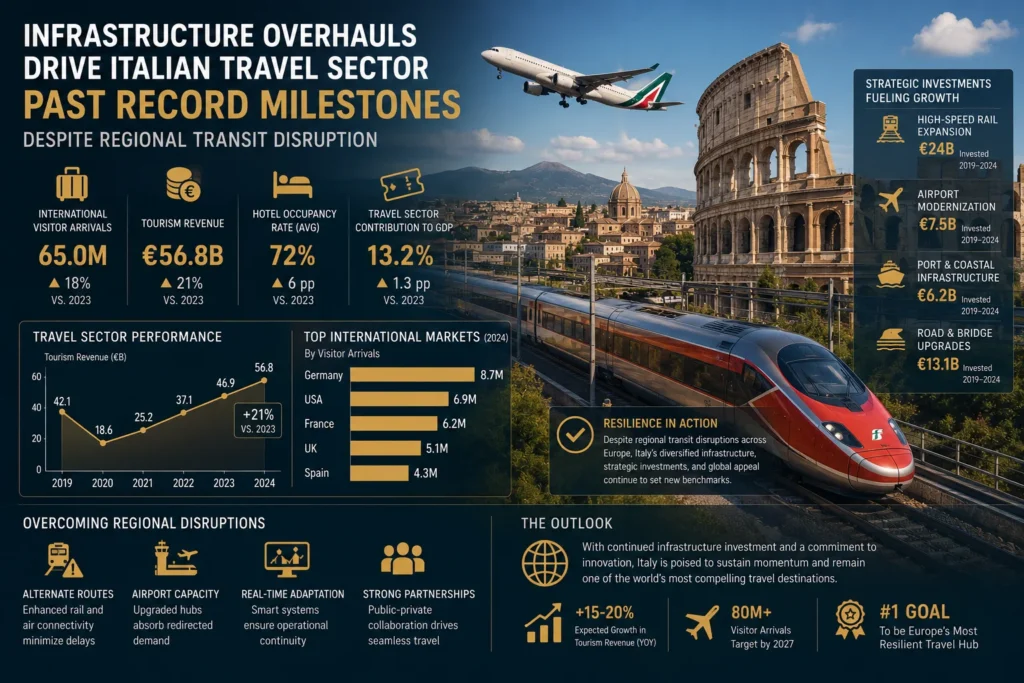
Widespread flight cancellations, major airport disruptions, and severe operational backlogs have heavily impacted transit networks across Northern and Western Europe over the past year. In response, strategic modernization efforts within the Mediterranean transport sector have allowed domestic tourism to experience sustained growth. By upgrading digital booking channels and expanding arrival networks to distribute high-volume traffic, the Italian travel economy has demonstrated resilience against broader continental travel friction.
Official figures from state economic updates and tourism monitor reports confirm that the marketplace has achieved a historic milestone, with Italy gross travel bookings climbing to an unprecedented €30 billion. This represents a clear 4.5% year-over-year increase, demonstrating that targeted investments in localized transport links and regional airport capacity can shield an economy from broader international aviation volatility.
The Scale of the Inbound Tourist Expansion
The foundation of this performance rests on an international demand shift combined with deep digital integration. While domestic vacation activity remained highly consistent, a substantial influx of overseas visitors chose alternative entry points to avoid the administrative bottlenecks impacting alternative European hubs. This shift has reinforced the country’s position within the global leisure market. By integrating regional flight options with a highly efficient national high-speed rail grid, public agencies and hospitality operators have established reliable travel corridors that allow visitors to navigate the peninsula seamlessly.
Data from the Italian National Institute of Statistics (ISTAT) and the Ministry of Tourism highlights the scale of this influx. The territory registered a historic high of 476 million overnight stays nationwide during the tracking period, reflecting an addition of roughly 10 million individual room nights compared to the previous calendar year.
This sustained visitor volume generated a record €57 billion in direct international tourist spending. This capital injection has directly stabilized employment and business growth across premium lodging networks, rural culinary venues, and localized transport operators. Crucially, due to decentralized entry routes, this economic benefit extended beyond primary urban centers like Rome, Florence, and Milan, flowing directly into secondary and tertiary regional economies.
Decoding the Aviation Realignment and Digital Upgrades
To understand how the domestic grid handled this volume, transport analysts point to structural changes across both aviation and digital reservation platforms.
Aviation Grid Realignment
The domestic aviation sector underwent a major structural shift to optimize passenger distribution. Low-cost carriers heavily expanded their seasonal routes, successfully accounting for 61% of total inbound airline capacity during peak operational months—a substantial rise from the 48% recorded during pre-pandemic baselines. This route expansion effectively diversified point-of-entry access. Rather than channeling millions of passengers through a small number of stressed major hubs, travelers flew directly into highly efficient regional airports, bypassing traditional transit congestion and distributing economic benefits evenly across the country.
Digital Booking Penetration
Recognizing that modern travelers demand immediate control over their itineraries during scheduling changes, the hospitality market accelerated its transition to digital infrastructure. Online reservation channels handled 58% of all domestic travel transactions, demonstrating the absolute dominance of digital-first consumer habits. Mobile interfaces accounted for over half of these digital bookings. Travel operators have responded by integrating automated, real-time data services, allowing passengers to alter arrangements instantly if broader continental rail or air delays disrupt their initial plans.
Hospitality and Structural Real Estate Inflows
The accommodation sector provided the financial core of this expansion, with traditional hotel room earnings reaching €19.1 billion. Attracted by this stable operational performance, international institutional investors directed over €2.5 billion into domestic hospitality real estate, marking a 19% year-over-year capital increase. These investments primarily targeted premium luxury properties and authentic, experiential boutique transformations, matching the evolving preferences of high-expenditure travelers who prioritize service quality alongside logistics.
High-Speed Rail Integration
When regional air networks experience scheduling constraints, the terrestrial transit network serves as a vital secondary option. Italy’s extensive high-speed rail system functioned as a crucial backup against flight adjustments, with gross rail bookings climbing to a record €4.3 billion. Digital sales channels dominated this segment as well, with 64% of all rail ticketing completed online. The high-speed rail network allowed passengers to commute reliably between major economic and cultural hubs without adding to airport passenger volumes.
Balanced Growth Management and Future Outlook
For the millions of international visitors navigating the territory, these integrated networks provided a highly consistent operational environment. While passengers in adjacent aviation sectors faced prolonged wait times and unexpected logistics costs due to sudden schedule adjustments, arrivals here benefited from redundant transport options. The ability to transition from a delayed flight to a high-speed train using a mobile interface minimized travel friction, protecting the vacation experience and supporting repeat visitation rates.
Industry reports emphasize that this economic performance is the result of strong international demand, advanced digital adoption, and sustained capital inflows. While global tourism analysts note that a high reliance on foreign visitors introduces exposure to broader macroeconomic shifts, the diversified nature of the domestic aviation market offers strong insulation. The presence of multiple competing regional carriers keeps transport costs stable, ensuring that no single operational bottleneck can disrupt national tourism infrastructure. As digital platforms continue to advance, the regional travel grid remains well-positioned to maintain its status as a major, reliable hub within the international visitor economy.
For more travel news like this, keep reading Global Travel Wire