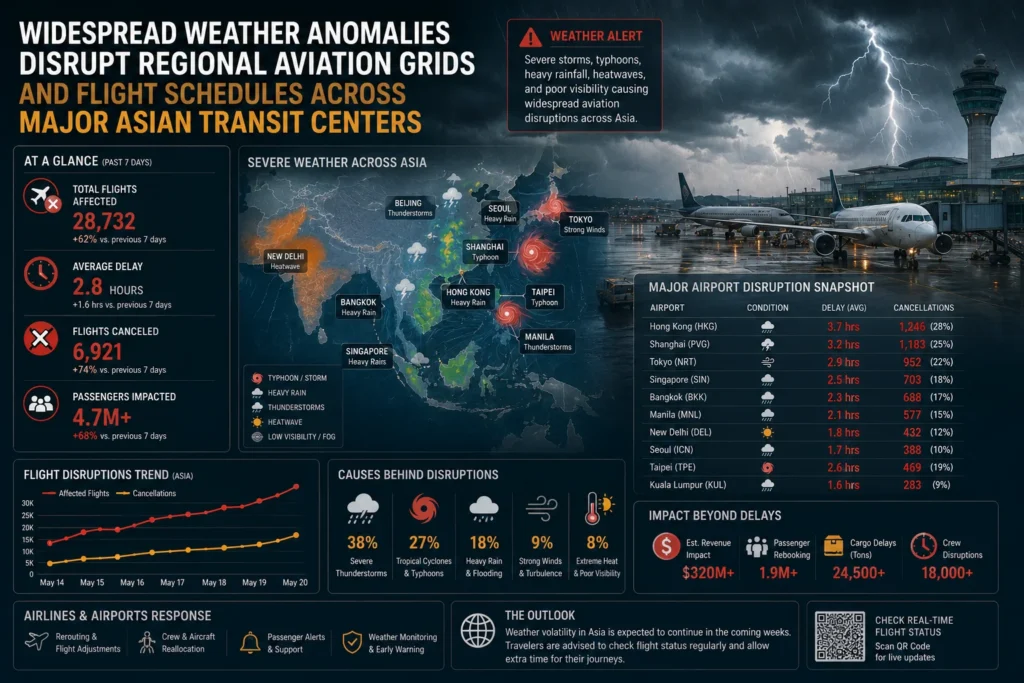
Extreme meteorological patterns and localized atmospheric instability are currently generating complex constraints across several major aviation markets in Asia. Public data records and meteorological updates show that flight schedules across the regional network have experienced notable adjustments.
A combined total of 477 flight cancellations and over 5,300 scheduled delays have impacted operations at major hubs. These logistical changes are affecting domestic and regional carriers including China Southern Airlines, China Eastern Airlines, IndiGo, and other network operators.
As significant thunderstorm activity, persistent downpours, and elevated regional weather risks alter airspace capacities, primary transport gateways are actively adjusting schedules to manage downstream backlogs. This situation has led to extensive Asian airport disruptions, impacting overall traveler itineraries.
Severe Weather Patterns and National Emergency Activation
The core of the recent scheduling adjustments is concentrated across major air corridors where dual weather fronts require strict air traffic flow management. The National Meteorological Center issued official public yellow rainstorm alerts alongside blue alerts for severe convective weather to manage ongoing atmospheric changes. Intensive rainbands are moving across crucial southern and eastern sub-regions, directly affecting flight corridors over Guangxi, Guangdong, Hunan, Jiangxi, Zhejiang, and Fujian.
Due to the persistent nature of these weather patterns, the Ministry of Water Resources officially activated a Level-IV flood emergency response covering six major provincial-level jurisdictions, including Hunan, Guangdong, Guangxi, Chongqing, Sichuan, and Guizhou. Official forecasts confirm that precipitation levels in parts of northeast, east, and south regions are projected to remain 10% to 20% higher than historical seasonal baselines.
Concurrently, northern sections are experiencing elevated wind variables, while western territories manage high summer temperatures. This widespread variation in weather behaviors requires continuous airspace coordination, leading to proactive route alterations and selective flight cancellations to preserve operational standards.
Evaluating Passenger Volume Pressures Across Major Gateways
The downstream operational impact is apparent across the continent’s high-density passenger and cargo hubs, where public flight tracking boards indicate altered wait times.
Southern and Eastern Flight Hubs
Guangzhou Baiyun International Airport has implemented comprehensive scheduling adjustments, recording approximately 741 individual departure delays and 62 full cancellations during peak weather alerts. Nearby Shenzhen Bao’an International Airport noted a similar trend, registering 535 delayed operations alongside 33 cancellations. In the eastern sector, Hangzhou Xiaoshan International Airport updated its boards to reflect 285 adjusted departures, while the dual-airport infrastructure serving Shanghai is managing high flow restrictions to clear regional airspace backlogs.
Capital Region Air Corridors
The primary commercial corridors route through the north have faced notable bottlenecks. Beijing Capital International Airport and Beijing Daxing International Airport together processed nearly 750 combined schedule modifications, extending standard wait times for connecting regional flights.
South Asian Regional Transit
The atmospheric variables are also affecting adjacent flight boundaries. In India, Indira Gandhi International Airport in Delhi reported over 200 schedule changes as regional aviation networks modified operations to account for broader seasonal wind variations and fuel-efficiency adjustments across domestic routes.
Southeast Asian and Eurasian Operations
Equatorial weather patterns are influencing transit points further south, with Jakarta Soekarno-Hatta International Airport recording more than 200 flight adjustments. Similarly, broader transit networks are adapting to regional delays at Moscow’s Sheremetyevo International Airport, which is working to realign its evening arrival slots.
Data Analysis of Airline Operations and Hub Pressures
The current operational situation requires substantial adjustments from major network operators. Regional state carriers are actively coordinating with civil aviation bureaus to manage delayed assets.
Official traffic statements indicate that China Eastern Airlines managed approximately 93 cancellations and 437 altered schedules, while China Southern Airlines adjusted operations for 17 cancellations and 648 delayed departures. South Asian short-haul carriers like IndiGo also updated roughly 395 scheduling timelines to safely navigate moving convective systems.
Additional network airlines—including Air China, Shenzhen Airlines, Hainan Airlines, SpiceJet, Saudia, and Garuda Indonesia—are similarly monitoring real-time weather reports and altering fleet assignments across international sectors to maintain safety protocols.
Mitigating Passenger Pressures in High-Density Airspaces
For travelers navigating these interconnected gateways, the presence of stationary storm systems means that wait times remain variable. When major hubs handle extensive route diversions, local terminal facilities face increased passenger volumes, which can complicate immediate rebooking and accommodation logistics.
Civil aviation authorities note that modern high-density airspaces are highly sensitive to significant weather fluctuations. Because safety guidelines require strict avoidance of active hail and severe convective storm cells, air traffic control towers must implement reduced departure frequencies. This measure controls the volume of active aircraft in specific flight sectors, causing sequential delays that affect subsequent long-haul schedules.
Prolonged Management of the Continental Flight Network
Aviation networks remain on alert as regional meteorological agencies maintain active rainstorm warnings across the southern river basins. With hundreds of combined cancellations and extensive scheduling adjustments officially registered across the network, carriers are deploying extra personnel to manage terminal logistics.
Until regional precipitation levels normalize and atmospheric conditions stabilize, flight paths traversing major transit hubs will continue to operate under adapted flow protocols. Passengers traveling through these sectors are encouraged to utilize digital checking systems and consult updated airline notifications before arriving at terminals.
For more travel news like this, keep reading Global Travel Wire