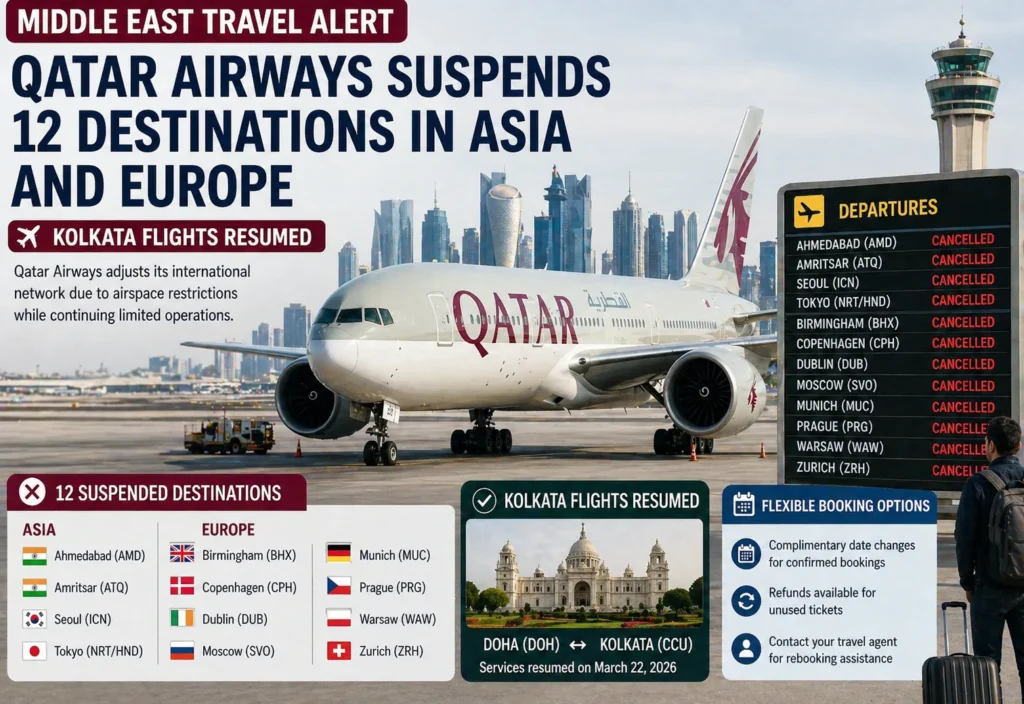
Travelers planning journeys through the Gulf are being urged to review itineraries after Qatar Airways adjusted its international network, suspending multiple routes across Asia and Europe while restoring services to Kolkata. The latest changes come as regional airspace challenges and operational restrictions continue to affect one of the world’s most important global transit regions.
For millions of passengers, Doha has long served as a strategic connection point linking Asia, Europe, Africa, and the Middle East. Any reduction in services from a major Gulf carrier can influence holiday plans, business trips, student travel, and long-haul connections worldwide.
At the same time, the resumption of Kolkata flights offers positive news for travelers in eastern India and surrounding markets who rely on direct access to Doha’s global network.
Why Gulf Aviation Matters to Global Tourism
The Middle East occupies a unique geographic position between East and West. Airlines based in the Gulf connect passengers from South Asia, Southeast Asia, Europe, Africa, and the Americas through efficient hub airports.
Doha, Dubai, Abu Dhabi, and other regional gateways are central to modern international travel. Many travelers choose one-stop connections through the Gulf because of convenient schedules, premium service, and broad route networks.
When operations in this region face restrictions, the effects are felt far beyond local borders. Tourists heading to Europe, families visiting relatives, and business travelers attending meetings across continents may all need to adjust plans.
This is why every route update from a leading Gulf carrier attracts global attention.
Qatar Airways Suspends 12 International Destinations
Qatar Airways has announced temporary suspension of services to 12 destinations across Asia and Europe as it manages current operational challenges.
The suspended routes include key cities in India, Japan, South Korea, the United Kingdom, Germany, Switzerland, Ireland, Denmark, Poland, the Czech Republic, and Russia.
These destinations have traditionally been important parts of the airline’s global network, serving both point-to-point demand and connecting passengers through Doha.
For travelers, route suspensions can mean fewer seat options, longer journey times, alternative connections, or revised travel dates.
Airlines often prioritize available capacity on routes with the strongest operational viability or highest immediate demand during periods of disruption.
Impact on Asian Travelers
Several suspended destinations are in Asia, including major Indian cities and important Northeast Asian markets.
This matters because travelers from India, Japan, and South Korea frequently use Gulf hubs for onward journeys to Europe, Africa, and North America.
For Indian passengers, connectivity through Doha has been especially valuable because it offers access to a wide international network from multiple regional cities.
If some routes remain paused, passengers may need to depart from alternative Indian gateways or consider revised travel schedules.
Travelers from Japan and South Korea may also face fewer one-stop choices for certain long-haul itineraries.
Europe Connections Also Affected
The suspended European routes include cities in Northern, Central, and Western Europe.
These markets are important for both inbound tourism and outbound travel. European holidaymakers traveling to Asia, the Maldives, Africa, and the Middle East often connect through Gulf carriers due to convenient routings and competitive service standards.
Business travelers also rely heavily on these connections for fast access between financial centers and emerging markets.
When routes are paused, passengers may need to route through larger hubs or travel via nearby airports still served by the airline.
While this can create inconvenience, global networks often adapt quickly through alternate scheduling.
Kolkata Flights Resume in Positive Boost for East India
In a welcome development, Qatar Airways has restored flights between Doha and Kolkata.
The return of Kolkata services is significant for eastern India, a region with strong demand from business travelers, students, migrant workers, leisure tourists, and visiting families.
Kolkata is one of India’s most important cultural and commercial cities, and improved international connectivity supports tourism, trade, and regional mobility.
For travelers from West Bengal and neighboring states, the resumed service reduces the need to connect via other Indian metros before reaching global destinations.
It also strengthens access to destinations across Europe, Africa, and the Middle East through Doha’s hub network.
What Passengers Should Do Now
Travelers with upcoming bookings should review their flight status immediately and remain flexible.
Recommended steps include:
Check airline notifications regularly
Confirm whether your route is operating
Review rebooking or refund eligibility
Consider alternate nearby departure cities
Allow extra connection time on revised itineraries
Book early if seats become limited on remaining routes
Passengers with urgent travel needs may benefit from acting quickly, especially during periods when network capacity is reduced.
Flexible Booking Options Available
Qatar Airways has indicated flexible options for affected passengers, including date changes and refunds for eligible unused tickets.
Such policies are increasingly important during uncertain operating conditions because they allow travelers to adapt without losing full booking value.
For tourism confidence, flexibility matters almost as much as price. Travelers are more willing to book when they know alternatives exist if schedules change.
This is particularly relevant for families planning holidays, students with academic deadlines, and professionals traveling for time-sensitive commitments.
Wider Tourism Impact in 2026
The latest route changes highlight how geopolitics and aviation remain closely linked. Tourism growth depends on stable air access, reliable schedules, and passenger confidence.
However, the global travel industry has become increasingly resilient. Airlines now adjust faster, deploy aircraft more strategically, and communicate changes more effectively than in the past.
Travel demand across many markets remains strong, especially for summer holidays, visiting friends and relatives travel, and international events.
That means temporary route suspensions do not necessarily reduce long-term tourism appetite.
Outlook for Travelers
Passengers should expect continued schedule adjustments while regional conditions evolve. Some routes may return quickly, while others could remain paused until operations normalize.
The most important strategy is preparation. Travelers who monitor updates, remain flexible, and consider alternative airports usually navigate disruptions more successfully.
For Kolkata travelers, the restored route is an encouraging sign that selective network recovery is underway.
For the wider market, the latest Middle East travel alert is a reminder of how important Gulf aviation remains to world tourism. Even amid disruption, airlines continue working to keep passengers moving and destinations connected.