As the summer travel season swings into full gear, thousands of vacationers across Texas and the wider United States are preparing their international itineraries. While exploring new cultural landscapes and coastal retreats remains a top priority for families and solo adventurers alike, federal oversight bodies urge a thorough review of global safety profiles before finalized bookings. Public security datasets managed by the Bureau of Consular Affairs outline that dozens of popular global destinations currently sit under rigorous safety alerts, requiring a strategic approach to trip preparation.
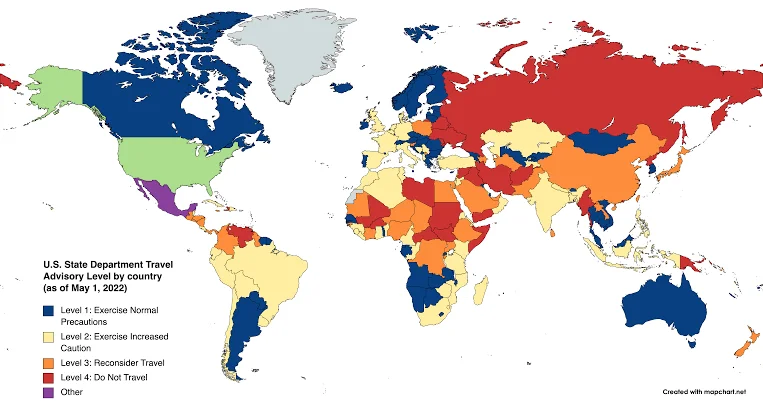
According to formal statements from the U.S. Department of State, more than 20 countries across multiple continents have been designated under Level 3 travel advisories. This classification formally instructs citizens to reconsider travel due to elevated and localized security concerns. Rather than acting as an outright ban, a Level 3 designation serves as an official alert that safety risks have escalated to a point where standard vacation activities could expose travelers to significant operational or physical disruptions.
The Structure of the Four-Tier Advisory Framework
To assist international travelers in evaluating global risks, the Bureau of Consular Affairs utilizes a standardized, four-tiered classification system. This framework is systematically reviewed and updated to mirror real-time conditions on the ground, with lower-risk destinations evaluated annually and higher-risk regions scrutinized at least every six months.
The lowest level of public notification is Level 1, which advises travelers to exercise normal precautions, acknowledging that all foreign transits carry a baseline level of unpredictability. Level 2 elevates the recommendation to exercising increased caution, highlighting specific, manageable safety or security threats that require heightened personal situational awareness.
When a destination transitions to a Level 3 advisory, it indicates a substantial shift in the local threat matrix, officially advising individuals to reconsider travel plans entirely. The most restrictive tier, Level 4, explicitly warns citizens not to travel, often because the host country faces extreme crises and the domestic government possesses a limited or entirely suspended capability to provide emergency consular assistance to stranded citizens.
Breaking Down the Nine Core Security Risk Indicators
The assignment of a Level 3 advisory is never arbitrary. Government analytical teams continuously evaluate destinations against nine specific, standardized risk indicators. Each indicator is represented by an explicit letter code within official consular publications, ensuring that travelers understand the exact nature of the environmental threats present.
Crime and Terrorism Focus
Widespread violent or organized crime is a primary driver behind many multi-month safety warnings. When the crime indicator is active, it signals that local law enforcement infrastructure may lack the resources, jurisdiction, or training to effectively counter serious criminal networks or protect foreign nationals from targeted offenses.
Similarly, the terrorism indicator highlights regions where active extremist groups maintain the operational capability to execute attacks. Official security briefs note that these incidents often target crowded public infrastructure, including regional transit hubs, open-air markets, international hotel chains, and prominent cultural landmarks where tourists naturally congregate.
Civil Unrest and Political Instability
Political, economic, or religious friction frequently leads to unexpected civil unrest. In areas experiencing heightened instability, public demonstrations and labor strikes can materialize rapidly with minimal warning. These events have the potential to disrupt municipal utility frameworks, shut down commercial air space, close land border checkpoints, and impede access to local medical facilities or emergency services.
Health Infrastructure and Natural Disaster Risks
The status of local health infrastructure plays an essential role in international travel safety assessments. A specialized health indicator is deployed when a nation experiences critical shortages of life-saving medical supplies, ongoing disease outbreaks, or a systemic collapse of its emergency medical transport networks. In these environments, finding adequate trauma care or standard clinical intervention during an emergency becomes a severe challenge.
Furthermore, environmental volatility, such as active volcanic chains, severe seasonal monsoons, predictable hurricane pathways, or frequent seismic activity, triggers natural disaster risk alerts. These phenomena can compromise regional housing structures and sever vital communication lines without notice.
Targeted Threats and Short-Term Triggers
The remaining risk indicators focus on severe, localized dangers. Kidnapping or hostage-taking alerts denote regions where criminal or political factions systematically target individuals for financial extortion or political leverage. Wrongful detention warnings are issued for territories where governing authorities utilize local legal codes to arbitrarily arrest or detain foreign nationals without standard due process.
Finally, short-term regional triggers, such as highly contested national elections, major geopolitical transitions, or localized security events, can cause a temporary escalation in a country’s baseline advisory level to safeguard incoming visitors.
Essential Safety Protocols for Summer Departures
For travelers who choose to move forward with international transits through regions under active advisories, immigration and safety bureaus emphasize the critical necessity of proactive planning. Officials strongly discourage entering high-risk zones without a verified, comprehensive contingency plan.
A foundational step for any international journey is registering with the Smart Traveler Enrollment Program. This free service connects individual itineraries directly with the nearest local embassy or consulate in the destination country. In the event of a sudden natural disaster, civil emergency, or unexpected airspace closure, verified registration enables consular teams to send real-time security updates and coordinate vital communication with emergency contacts back home.
Additionally, travelers are urged to secure robust, specialized travel insurance policies prior to departure. Standard medical coverage rarely extends across international borders, making independent policies that include explicit medical evacuation provisions essential. Maintaining a highly detailed backup communication plan, keeping low profiles in highly populated commercial zones, and verifying entry requirements via official ministerial portals ensure that summer travel remains both memorable and secure.
For more travel news like this, keep reading Global Travel Wire