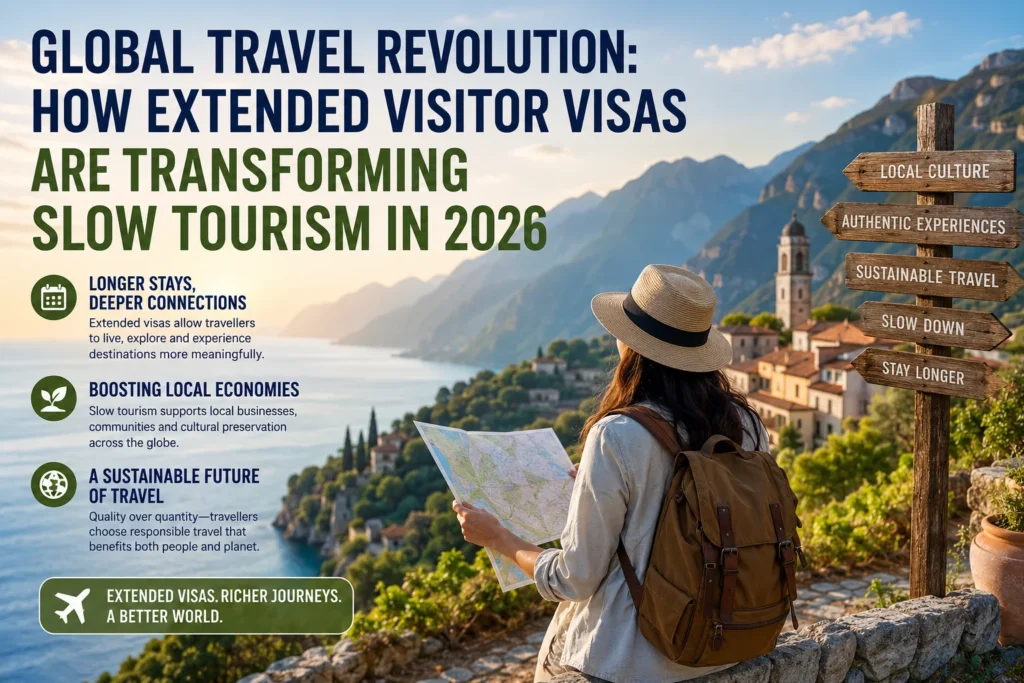
The global tourism economy is undergoing a structural transformation as sovereign governments increasingly replace traditional short-term tourist permits with flexible, extended visitor visas. According to official ministry releases and updated immigration data, international destinations are pivoting toward frameworks that allow eligible travelers to remain within their borders for half a year or even a full year. This coordinated policy evolution specifically targets a highly lucrative, modern demographic: remote professionals, freelance digital creators, and dedicated slow tourists who prioritize cultural immersion over brief sightseeing trips.
This widespread regulatory adjustment serves as an explicit economic strategy to reshape national hospitality sectors. Official tourism board reports indicate that high-value visitors who opt for extended stays distribute their capital more evenly throughout local economies. Unlike weekend holidaymakers or cruise passengers who crowd isolated cruise terminals and primary commercial centers, long-stay travelers typically invest heavily in regional transportation networks, residential neighborhood economies, suburban grocery providers, and authentic cultural experiences. Furthermore, official state tourism statistics highlight that extending the legal duration of visitor entry effectively mitigates the economic volatility brought on by traditional seasonal tourism peaks, establishing a more predictable year-round baseline of revenue for local small-and-medium enterprises.
The Economic Impact and Growth of Slow Tourism
The modern transition toward multi-month international stays directly aligns with the documented evolution of contemporary professional structures. Following the broad normalization of decentralized work environments across major global industry sectors, traditional brief vacations are steadily being supplanted by multi-month regional immersions.
Official statistical dashboards published by state tourism development ministries confirm that long-stay visitors generate substantially higher cumulative domestic revenue per arrival than standard vacationers. By dedicating significant capital to prolonged residential rentals, regional hospitality providers, and localized services, these individuals foster long-term economic stability. Crucially, public policy papers released by departments of environmental and cultural heritage note that this model minimizes the acute environmental degradation and social infrastructure friction frequently caused by hyper-concentrated, high-turnover mass tourism.
Georgia Leading the Global Market with Year-Long Access
Georgia continues to hold a highly prominent position within this evolving regulatory landscape. Under longstanding public statutes managed by the Ministry of Foreign Affairs, citizens from dozens of designated nations are legally permitted to enter and reside in the country for up to 365 consecutive days without being required to navigate the bureaucratic complexities of obtaining a formal temporary residence permit.
The public administration has successfully positioned cities like Tbilisi and Batumi as prime digital nomad hubs by pairing this open-border framework with accessible public services and specialized legal structures. According to recent announcements from the Ministry of Foreign Affairs of Georgia, entering international visitors must comply with updated regulatory amendments. All foreign nationals entering for tourism are required to maintain valid health and accident insurance coverage throughout their stay, ensuring that prolonged visits remain sustainably integrated with national medical infrastructure.
North American and European Stay Limits
Across North America, Canada maintains a robust and highly structured approach to managing extended visitor stays. Immigration, Refugees and Citizenship Canada permits eligible international arrivals to remain for up to six months under standard visitor entry permissions. While the foundational framework provides an expansive six-month window, final stay determinations are executed individually by border services officers at the port of entry based on financial sufficiency and demonstrated temporary intent.
In a similar fashion, the United Kingdom offers substantial flexibility for long-haul leisure and business travelers. The standard entry framework permits a maximum continuous stay of up to six months. To accommodate frequent international travelers, the UK government provides extended multi-entry visitor categories valid for structured periods of two, five, or ten years. However, immigration authorities enforce a strict operational cap mandating that no individual continuous visit exceeds the maximum six-month limitation.
Expanding Frontiers Across the Asia-Pacific and Latin America
Within the Asia-Pacific region, complex immigration frameworks are utilized to attract high-value long-stay travelers. The Australian Department of Home Affairs structures its Subclass 600 Visitor Visa into multiple distinct streams, allowing for approved stays spanning three, six, or twelve months depending on the specific profile, financial verification, and travel motivations of the applicant. Official immigration guidelines for Australia emphasize that while a twelve-month stay can be granted under specific family or exploratory categories, approvals are systematically verified on a case-by-case basis to confirm genuine temporary entry intentions. Nearby, New Zealand offers a dedicated framework allowing eligible international holidaymakers to apply for visits extending up to nine months within a comprehensive eighteen-month evaluation window.
In Latin America, Mexico stands as a premier regional destination for extended cultural tourism. The National Migration Institute routinely grants eligible international arrivals entry permissions lasting up to 180 days. This streamlined administrative process enables long-term travelers to extensively tour heritage zones and coastal communities without encountering the immediate necessity of applying for formal residency visas. Similar 180-day visitor access policies exist within regional business and transit hubs such as Panama, while Peru offers entry windows reaching up to 183 days for specialized adventure and archaeological tourism.
Compliance and Legal Boundaries for International Visitors
While these modern immigration updates unlock unprecedented flexibility for global itineraries, public safety and border protection departments emphasize the critical importance of maintaining strict compliance with visa conditions. Extended visitor permits are strictly distinct from formal domestic employment authorization.
Official statements from international immigration ministries reiterate that while remote work conducted exclusively for an employer based outside the host country is broadly accommodated under modern digital nomad provisions, engaging in local labor markets, executing domestic business transactions, or seeking local corporate employment on a standard visitor visa remains strictly prohibited. Travelers are officially advised to monitor their exact permissible dates of stay, verify medical insurance mandates, and confirm specific bilateral entry requirements through official consular portals prior to planning extended international departures.
For more travel news like this, keep reading Global Travel Wire