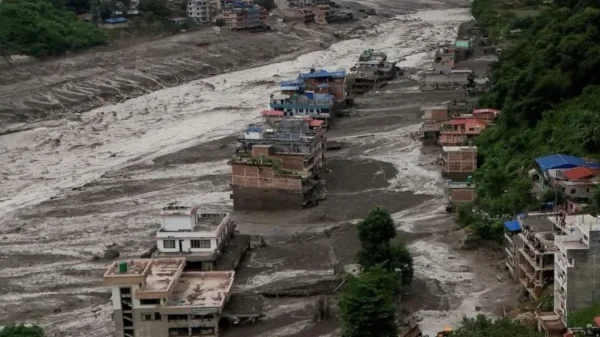
A catastrophic flood and landslide in Nepal’s northern Rasuwa district has left 403 tourists and travellers reported missing or unaccounted for. The emergency has disrupted a vital tourism corridor near the Nepal-China border and triggered an international search effort.
According to preliminary information from the Nepal Tourism Board, the missing include 341 foreign nationals and 62 Nepalis. India represents the largest affected foreign group, with 133 nationals reported missing.
Travellers from the United States, Australia, the United Kingdom, Canada, Malaysia and several other countries are also on the preliminary list. However, authorities continue to verify identities and reconcile records supplied by travel companies, government agencies and diplomatic missions.
Therefore, the figures may change as communications return and rescue teams reach isolated communities. Being reported missing or unaccounted for does not mean a traveller has been confirmed dead.
Indian pilgrims form largest foreign group
Many of the missing Indian nationals were reportedly travelling towards Kailash Mansarovar through the Rasuwa border corridor. The route is important for religious tourism because it connects Nepal with Tibet and provides access to one of Hinduism’s most sacred pilgrimage destinations.
The scale of the Indian involvement highlights Nepal’s role as both a destination and transit gateway for South Asian pilgrimage travel. India has offered support for rescue and relief operations as Nepal responds to the unfolding disaster.
The United States has 47 citizens on the preliminary missing-person list. Australia follows with 34, while the United Kingdom has 33 and Canada has 24.
Malaysia accounts for 19 people in Nepal’s tourism-related records. However, separate consular information has produced different totals in some cases. Such differences are common during emergencies when tour operators, embassies and rescue agencies are working with incomplete passenger information.
Other affected nationalities reportedly include travellers from Ukraine, Singapore, South Africa, New Zealand, Japan, Germany, France, Spain, Ireland, the Netherlands and Russia. Several additional countries appear in the wider preliminary register without consistently confirmed individual totals.
Flood destroys strategic border infrastructure
The disaster struck the Bhotekoshi River corridor near the border with Tibet. Powerful water, mud and debris swept through settlements while damaging roads, bridges, communications systems, energy facilities and other infrastructure.
Access to the Rasuwagadhi border crossing has been severely disrupted. This crossing supports tourism, pilgrimage journeys, local transport and cross-border commerce between Nepal and China.
The destruction has complicated rescue operations because emergency teams must navigate unstable slopes, broken roads and damaged bridges. Communications and electricity interruptions have also made it difficult to contact travellers or determine whether groups moved to safer locations.
Preliminary assessments have examined whether an ice-and-rock collapse or another high-altitude geological event generated the sudden flood surge. Authorities must complete further investigations before confirming the precise cause.
Nepal tourism faces widespread disruption
The missing-person records reportedly include 203 men and 200 women who travelled towards Gosaikunda or Kailash Mansarovar through different companies. Gosaikunda is an important pilgrimage and trekking destination, attracting domestic visitors alongside international travellers.
The emergency is therefore affecting far more than conventional holiday tourism. Those caught in the disaster zone may include pilgrims, trekkers, guides, tourism workers and people employed at infrastructure projects.
Nepal’s mountain communities also face severe economic consequences. Hotels, lodges, restaurants, guides, drivers and small retailers depend heavily on visitors moving through Himalayan corridors. Road closures and safety restrictions can quickly remove their primary source of income.
Tour companies may now need to suspend departures, redesign itineraries and help travellers reach alternative destinations. Visitors planning journeys through Rasuwa should avoid affected areas until Nepalese authorities confirm that access is safe.
Traveller records become vital during emergencies
The crisis demonstrates why tourism businesses operating in remote regions require accurate passenger manifests and dependable emergency communication systems. Satellite connectivity, local contact networks and clearly documented evacuation procedures can become critical when conventional infrastructure fails.
Travel companies must also share verified passenger information quickly with authorities and embassies. Conflicting lists can increase distress for families and divert limited rescue resources.
Tourists should register their journeys where official systems are available. They should also provide relatives with their itinerary, operator details, accommodation plans and emergency contacts before entering remote mountain regions.
Comprehensive travel insurance remains essential for trekking and pilgrimage journeys. Policies should address emergency evacuation, medical treatment, trip interruption and natural disasters at high altitude.
Rescue and verification remain priorities
Search and rescue operations, identification of missing travellers and restoration of emergency access remain Nepal’s immediate priorities. Governments and diplomatic missions are coordinating with Nepalese authorities to establish the welfare of their citizens.
The Rasuwa disaster will also increase pressure for stronger early-warning systems, resilient bridges and better crisis coordination across Himalayan tourism routes. Changing mountain conditions can expose visitors and local communities to sudden floods, landslides and infrastructure failures.
Nepal remains one of the world’s leading destinations for trekking, pilgrimage and Himalayan adventure. However, restoring confidence will require transparent updates, careful reconstruction and firm safety controls.
For now, the reported total of 403 missing travellers remains preliminary. Families and visitors should rely on official government, tourism-board, embassy and tour-operator information while rescue teams continue searching the devastated corridor.
For more travel news like this, keep reading Global Travel Wire