Japan has introduced clearer five-level disaster warnings to help residents and international visitors respond faster to floods, heavy rain, landslides and storm surges.
Established on May 29, 2026, the revised framework places a numerical level directly within relevant warning names. This creates a more consistent connection between an escalating weather threat and the protective action people should take.
The system could influence transport, hotel operations, attractions and outdoor activities during severe weather. However, it does not change Japan’s visa policies, passport requirements, immigration procedures, border controls or visa-free entry arrangements.
Airports, railways, roads, hotels and tourism facilities also do not close automatically when a warning appears. Operators and local authorities will continue making decisions based on conditions in each affected location.
Five levels make danger easier to understand
Japan already used a five-level evacuation framework before the reform. However, weather advisory and warning names did not always correspond clearly with those levels.
The updated Japan disaster warnings cover heavy rain, river flooding, landslides and storm surges. The consistent numerical format should help visitors understand when to monitor conditions, prepare for evacuation or move away from danger.
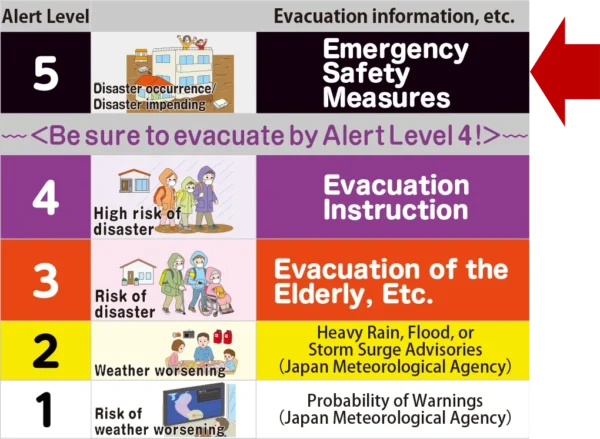
Level 1 signals that weather conditions could deteriorate. Travellers should follow forecasts and reconsider plans involving mountains, rivers, beaches or other exposed locations.
Level 2 indicates an advisory. Visitors should check hazard maps, identify nearby safe locations and confirm evacuation routes from their accommodation.
At Level 3, dangerous conditions are developing. Older people, visitors with disabilities and anyone requiring additional assistance should begin evacuating from hazardous areas. Other travellers should prepare to move.
Level 4 represents a high disaster risk. Everyone in a dangerous area should evacuate and follow instructions issued by municipal authorities.
Level 5 means a disaster may already be occurring or presenting an immediate threat to life. Anyone remaining in danger must take the safest action available. Travellers should never wait for Level 5 before leaving an unsafe location.
Local evacuation orders remain essential
National weather warnings and municipal evacuation information perform connected but separate functions. Local authorities assess forecasts, observed conditions, infrastructure risks and community requirements before issuing evacuation directions.
Consequently, international visitors must monitor both warning levels and local announcements. Hotel employees, station personnel, emergency services and municipal authorities may provide instructions based on conditions surrounding a particular property or transport route.
Evacuation does not always mean travelling to a public shelter. A structurally secure hotel outside a flood or landslide risk zone may be safer than walking through intense rain. Visitors should seek local guidance before attempting to move during dangerous conditions.
Record visitor demand increases safety needs
Japan welcomed an estimated 3,442,100 international visitors in July 2026, representing a 0.1% increase over July 2025. This was the highest visitor total recorded for July.
Seventeen source markets achieved record July arrivals, while Taiwan exceeded 700,000 visitors during one month for the first time. Demand also increased across several East Asian, European, North American and Middle Eastern markets.
Strong inbound growth makes accessible emergency communication increasingly important. Foreign visitors may not understand Japanese announcements, traditional warning terminology, local place names or municipal evacuation systems.
A clearly displayed number gives travellers a faster indication of the danger. It can also assist tourism employees when explaining emergency measures to guests from different language backgrounds.
Japan’s tourism strategy encourages travellers to explore destinations beyond major gateways. As more visitors enter rural, mountainous and coastal regions, tourism operators will need robust safety plans for flooding, landslides and storm surges.
Severe weather may interrupt entire journeys
A numbered warning does not automatically cancel a flight, train or hotel reservation. Nevertheless, severe weather can disrupt different parts of a journey at different times.
Rail services may slow or stop, while ferries and flights could face delays or cancellations. Roads can close because of flooding, debris or unstable slopes. An airport might remain operational even when passengers cannot reach it safely.
Hotels may relocate guests from vulnerable floors or arrange early evacuation. Mountain resorts could close trails, while beaches, campsites, waterfalls, gorges and riverside attractions may restrict access.
Visitors should therefore check their complete route. A confirmed flight or attraction booking does not guarantee that connecting roads, buses or rail services remain safe.
Multilingual support helps foreign visitors
Japan provides multilingual safety information covering serious weather, earthquakes, tsunamis and other emergencies. Visitors can also contact the Japan Visitor Hotline within Japan at 050-3816-2787. The service operates around the clock in English, Chinese, Korean and Japanese.
Travellers should download official safety tools, enable emergency notifications and save accommodation details before beginning their journey. They should identify evacuation routes, carry medication and keep a charged portable power bank available.
During warnings, visitors must avoid rivers, beaches, underpasses and unstable mountain paths. They should never walk or drive through floodwater.
The revised system makes Japan’s complex disaster information easier to interpret. Its success will depend on multilingual communication, visible guidance and consistent implementation across hotels, airports, stations, ports and attractions.
Most importantly, travellers should prepare at Level 3, evacuate dangerous areas by Level 4 and never delay action until Level 5.
For more travel news like this, keep reading Global Travel Wire