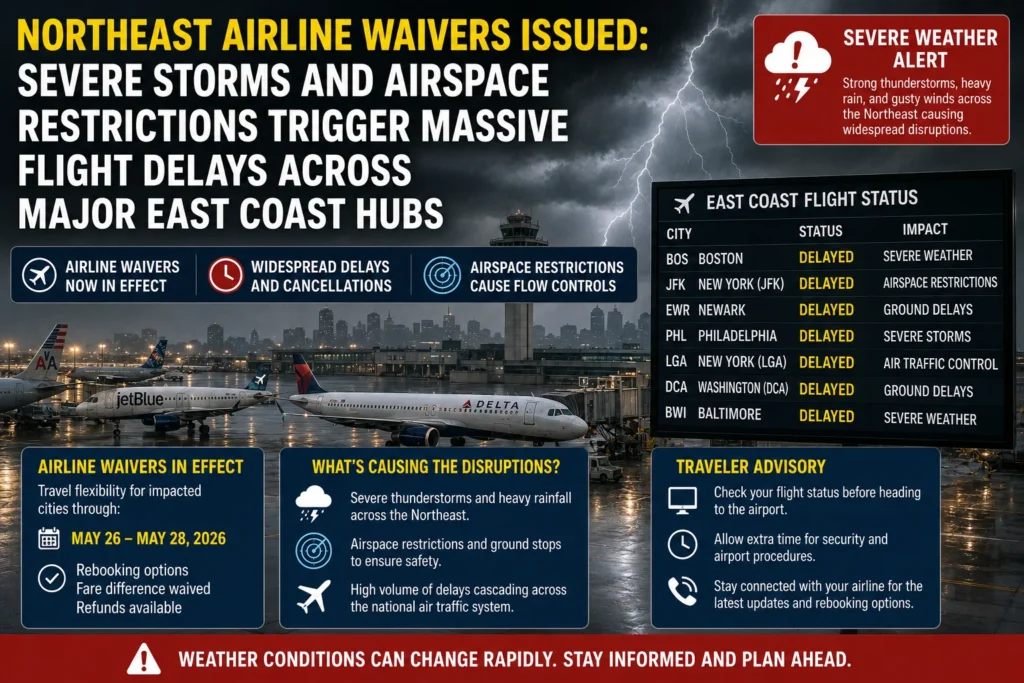
Commercial aviation networks throughout the Northeast corridor are enduring a severe operational backlog, forcing primary domestic carriers to implement emergency scheduling updates. A volatile combination of severe weekend weather patterns, peak post-holiday tourism volumes, and consecutive airspace restrictions has generated a widespread gridlock across multiple prominent East Coast transportation hubs.
Federal aviation tracking metrics indicate a sharp increase in departure and arrival delays, leaving airline personnel and independent travel coordinators struggling to balance thin aircraft capacities. Airport terminals across New York, New Jersey, and Massachusetts are managing high passenger volumes as operations teams try to reposition planes and cabin crews that were displaced by the initial wave of storms.
Extensive Gridlock Impacts Prime Flight Corridors
The primary catalyst for the scheduling disruption dates back to a series of violent localized thunderstorms that swept through the Northeast immediately following an intense summer heatwave. The National Weather Service verified that these storm cells produced destructive wind gusts exceeding 75 miles per hour across several flight paths, making standard takeoffs and landings impossible.
The immediate result was a major breakdown of scheduling timetables. A staggering percentage of scheduled departures were stalled or outright cancelled at New York’s LaGuardia Airport, with similar percentage drops hitting John F. Kennedy International Airport, Newark Liberty International Airport, and Ronald Reagan Washington National Airport.
Because regional infrastructure is interconnected, the backlog has rolled heavily into Monday flight sheets. Morning statistics reveal that LaGuardia is experiencing sustained disruption, with seven percent of its scheduled morning departures and an additional ten percent of its inbound arrivals actively delayed. Boston Logan International Airport is facing similar cascading delays, complicating the transit of connecting international tourists.
Major Carriers Active Emergency Policy Adaptations
To systematically handle terminal overcrowding and alleviate gridlock at check-in desks, major airlines have published comprehensive travel alerts alongside flexible rebooking options. These official policies allow travelers to adjust their upcoming flights without facing severe financial penalties.
Delta Air Lines Policy Extensions
Delta Air Lines has officially expanded its flexible rebooking structure for passengers holding confirmed tickets into, out of, or passing through seven primary regional hubs. This includes comprehensive coverage for flights routed via LaGuardia, John F. Kennedy International, Newark Liberty, and Ronald Reagan Washington National. Under this provision, administrative change fees and localized fare differences are entirely waived, provided that the passenger’s replacement ticket is reissued and the rescheduled journey begins on or before the established deadline of July 7, 2026.
American Airlines Operational Waivers
The executive management team at American Airlines has deployed a comparable waiver map to assist passengers routed through major Northeast hubs. The carrier’s protective policy covers all travelers originally scheduled to fly through July 7, 2026. To qualify for the complete waiver of change fees and fare differences, the updated travel dates must be formally booked by July 7, 2026, and the actual physical transit must be completed by July 10, 2026. Additionally, the revised booking must align with the passenger’s originally selected cabin tier.
JetBlue Airspace Allowances
Directly impacted by severe weekend airspace restrictions and lingering ground constraints, JetBlue has introduced proactive cancellation and alteration allowances. The carrier is systematically waiving baseline change fees, cancellation costs, and ticket fare differences for clients whose initial flight schedules were locked through July 5, 2026. According to ministerial filings, the rebooked travel itinerary must be finalized and completely traveled by Wednesday, July 8, 2026, to prevent the reapplication of standard administrative penalties.
Further Weather Pressures Threaten Transit Grids
Aviation officials caution that the operational atmosphere surrounding the New York metropolitan region is unlikely to show substantial improvement over the coming days. Regional meteorological forecasts indicate that a secondary storm front is projected to deposit an additional two to four inches of continuous rainfall across already saturated coastal plains.
This sustained precipitation introduces a renewed threat of terminal delays and strategic tactical cancellations as airfield drainage systems and runway lighting networks are managed under emergency safety thresholds. The New York City Office of Emergency Management has actively sustained its localized flash flood and severe weather warnings.
The agency specifically emphasized that intense rainfall patterns could spill over into the subterranean transit networks, potentially triggering localized subway line shutdowns and disrupting municipal rail corridors linking Manhattan to outlying suburban airport connections. Visitors and leisure tourists currently navigating the Northeast corridor are strongly encouraged to actively cross-reference their boarding data with real-time digital carrier feeds prior to initiating transit toward regional airport terminals.
For more travel news like this, keep reading Global Travel Wire