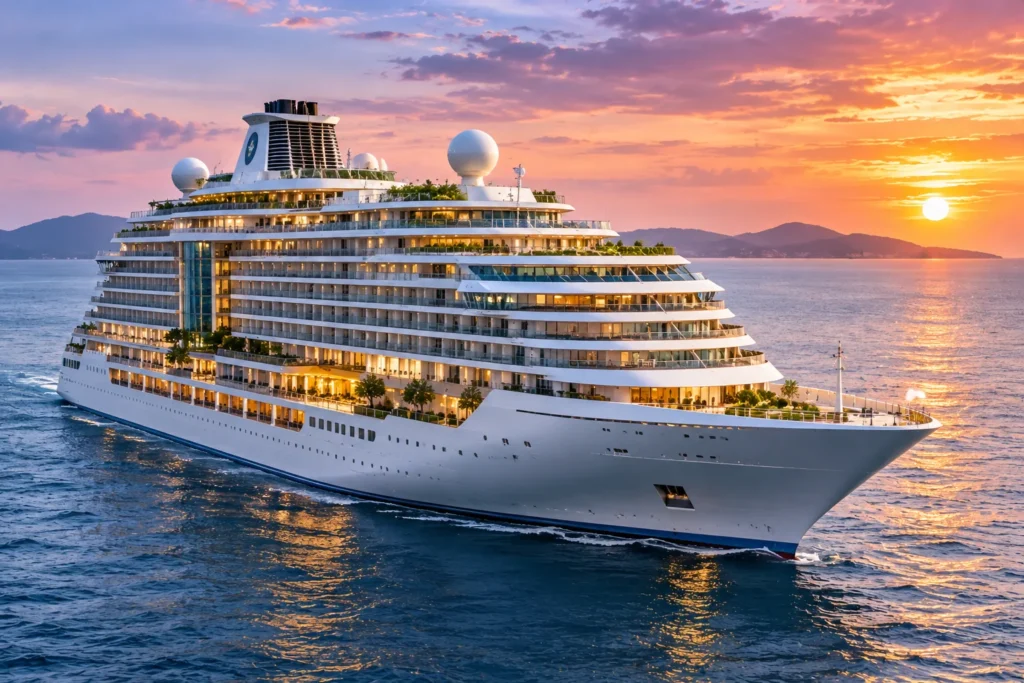
Official maritime governance frameworks, consumer protection guidelines, and sovereign port administration releases highlight significant operational vulnerabilities across extended residential cruise tourism ventures as prolonged geopolitical volatility impacts global shipping economics. Regulatory statements issued by international maritime bodies and national port authorities confirm that long-term residential cruise vessels, designed to offer continuous multi-year circumnavigations to global travelers, are experiencing severe economic pressure driven by escalating marine fuel expenses, commercial waterway diversions, and tightened port compliance requirements.
Recent port logs and municipal maritime announcements from Southeast Asian maritime hubs, including Cambodian port authorities, indicate that approximately two hundred international cruise residents were required to disembark following the unexpected suspension of operations by residential vessel management. International transport departments and diplomatic consular agencies are monitoring passenger repatriation efforts to ensure that foreign travelers receive essential consular assistance, emergency visa extensions, and access to commercial aviation channels for safe homeward transit.
Severe Operational Inflation Impacts Global Maritime Itineraries
Statements released by residential cruise line executives indicate that the rapid escalation of marine fuel expenditures created insurmountable financial headwinds for continuous worldwide cruising. Energy market data published by sovereign ministries of energy and international transport tracking agencies document substantial increases in marine gas oil and bunker fuel prices following extensive supply disruptions across key maritime corridors in the Middle East.
According to operational data released by voyage operators, per-cabin monthly fuel allocation costs surged from historical operational baselines of 1,800 dollars to unexpected estimates between 6,000 and 8,000 dollars in Asian navigation waters. Operators cited these steep cost escalations as a direct catalyst for operational insolvencies, noting that fuel volatility severely outpaced the fixed capital reserves gathered from initial cabin purchases and recurring maintenance subscriptions.
Public transport watchdogs observe that continuous residential voyages operate under delicate financial models. Unlike conventional commercial week-long cruise itineraries that maintain agile route flexibility and diversified revenue sources from constant passenger turnover, long-term residential passenger ships carry a static voyager base. When international fuel pricing experiences steep unexpected spikes, vessel operators face acute liquidity constraints, often resulting in abrupt cancellations, emergency port stays, or total voyage terminations.
Sovereign Port Regulations and International Passenger Welfare
The unexpected conclusion of long-term global voyages places immediate operational and legal responsibilities on local maritime administrations and destination immigration authorities. Under established conventions coordinated by the International Maritime Organization, port state control authorities enforce strict regulations regarding vessel seaworthiness, environmental compliance, crew provisioning, and the orderly handling of passengers in transit.
When passenger vessels declare financial suspension or insolvency while berthed in foreign territorial waters, national immigration directorates must facilitate orderly shoreside transit without compromising sovereign border security protocols. In regional coastal centers such as Sihanoukville and neighboring regional entry points, port management agencies coordinate with international embassies to verify travelers’ identity credentials, oversee luggage handovers, and coordinate commercial ground transport to regional international airports.
Consumer advocacy divisions within national tourism ministries note that long-term cruising concepts present novel legal challenges regarding passenger asset protection. Because many residential cruise voyagers commit substantial private savings—often ranging into hundreds of thousands of dollars to secure lifetime occupancy rights—the abrupt cessation of maritime operations leaves travelers vulnerable to property displacement, sudden financial loss, and logistical strandedness abroad.
Reassessing Consumer Protections in Long-Term Tourism Models
The suspension of extended maritime expeditions has prompted regulatory bodies and travel insurance federations to review existing financial bond mechanisms. Statutory requirements governing standard packaged tours generally require operators to deposit insolvency insurance to fund passenger repatriation and guarantee refund disbursements. However, non-standard residential ship memberships often sit outside conventional retail travel protection schemes, operating under private contractual arrangements that leave consumers with limited administrative recourse during financial collapses.
Consumer rights bureaus within major outbound source markets, including North America and Western Europe, advise international tourists to evaluate the financial protections, vessel registration jurisdictions, and operator solvency guarantees before committing substantial capital to extended lifestyle cruising products. Public advisories encourage travelers to examine whether an operator maintains independently managed escrow accounts, third-party completion bonds, and verified contingency plans for unexpected itinerary cessations.
Simultaneously, destination management organizations emphasize that sovereign ports must remain vigilant when welcoming private residential ships. While residential voyages provide valuable spending across local retail, dining, and cultural excursions during extended port calls, abrupt voyage terminations place sudden administrative pressures on local municipal resources, emergency accommodation facilities, and immigration processing counters.
Future Outlook for Global Extended Cruise Travel
The broader cruise industry continues to demonstrate strong recovery across established regional routes in the Caribbean, the Mediterranean, and Northern Europe. However, specialized residential cruise tourism remains a highly precarious niche vulnerable to global fuel supply shocks, fluctuating international shipping tariffs, and complex transnational maritime regulations.
Transport policy analysts and maritime trade boards emphasize that future growth in continuous maritime living ventures will require far more rigorous capital adequacy frameworks, transparent operating disclosures, and mandatory consumer financial insurance. Until comprehensive regulatory standards are instituted to govern long-term cruise residence contracts, international travelers seeking multi-year global voyages will face significant operational risks during periods of geopolitical and macroeconomic uncertainty.
For more travel news like this, keep reading Global Travel Wire